After exiting parameterization mode, the display
shows a small, rotating “o” and a “P”.
7.4 Performing the Learning Cycle
The learning cycle must be performed while the motor
is cold. During the learning cycle, the door leaf must
not be moved manually or held open; otherwise, the
control unit cannot determine the parameters correctly.
Safety sensors and activators are switched off during
the learning cycle so that the learning cycle sequence
is not interrupted.
Smoke detectors and the deactivation of the drive
function are active.
1. Secure the motion range of the door leaves.
2. Close the door and switch the program switch to the
OFF position.
A rotating “o” and an “O” indicate that a learning
cycle is required.
3. Press the
button for 3 seconds.
► The door performs various movements and the display
shows a sequence of characters.
The door leaf’s movements must not be stopped.
The door is in the 70° position and is waiting for
the opening width to be set.
4. Slide the door into the desired opening position and
press the
button.
If the spring tension is too low, the display shows
the small, rotating “o” and an “F”.
5. In this case, increase the spring tension and restart the
learning cycle.
The door is ready for operation.
Due to system tolerances, the actual forces on the
door leaf must be measured and changed if necessary
following the automatic learning cycle to ensure
compliance with local standards and regulations.
7.5 Commissioning a Double-Leaf System
1. Commission the active leaf.
2. Following the learning cycle, switch the
program switch to PERMANENT OPEN.
3. Commission the passive leaf.
Additional Parameterization
• At active leaf:
Set >dL< parameter (door type) to “1”.
Set >Ad< parameter (castor angle) to the desired value.
• At passive leaf:
Set >dL< parameter to “2”.
7. Commissioning
(also after reset with factory setting (Fact Setup))
7.1 Conditions
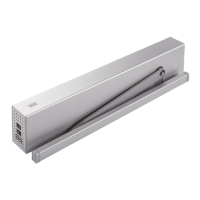
• The drive is fully installed and correctly connected to
the door leaf.
• The parts supplied separately, such as the program
switch and activators (radar detectors, Night/Bank key
switches), are installed and connected.
• The motor is cold.
7.2 Commissioning the Drive
1. Switch the drive on at the mains switch.
► The display shows a sequence of characters which
reflect the current editing state.
The system is being checked.
Two segments jumping back and forth in the
center indicate that the control unit is waiting on
internal signals (max. 1 second).
Two underscores elevating up and down indicate
that the installation position can now be entered.
The characters appear upside-down on the display
if the entry was incorrect.
2. Press the button at the bottom
(only required during initial commissioning).
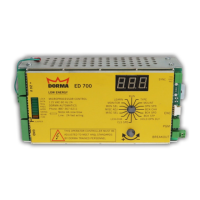
The device ID “runs” through the display. ED 100
or ED 250 and the firmware version (represented
by XX XX).
A small, rotating “o” and a “P” indicate that
further parameterization is required. (Only when
commissioning for the first time or following reset
with factory setting).
3. Set the parameters: installation type (AS), lintel depth
(rd) and door width (Tb).
Please refer to the table on page 24 for the meaning
and value ranges of the parameters.
7.3 Changing Parameters
1. Press the button for 3 seconds to call up
the parameter menu.
2. Press the buttons to select the desired
parameters.
or
3. Press the button to display the parameter
value.
4. Press the button to select the value to be
changed
=> the value flashes
5. Press the buttons to adjust the desired
value.
or
6. Press the button to save the changed
value.
7. Press the button to return to the
Parameter menu.
8. Press the button to select the next
parameter.
or
ED 100, ED 250
—
27DORMA




 To Next Page