8
EN
monly, of pump cavitation due to:
– excessive difference in height or excessive pressure loss along suction
line,
– delivery line backpressure too low;
– problems associated with liquid temperature.
For more information on the factors that reduce and/or compromise suc-
tion lift and hence the pump’s performance, see the troubleshooting sec-
tion in chap. 14.
Note that for temperatures and altitudes higher than those specied, the
motor’s output is reduced and you will need to have a motor with greater
output or is necessary to reduced the request motor’s performance. See
chap. 15.2 on the subject.
Make sure there is no water hammer or pressure peaks in the system
caused by fast-closing valves exceeding 1.5 times the pump’s nominal pres-
sure. In the long run, they can cause damage to the actual pump.
Avoid operating the pump with the isolating valve on the delivery line closed
for any more than a few seconds.
You should also avoid using the pump for continuous duty with a ow rate
below the minimum rate indicated on the rating plate as this may result in
the liquid being pumped overheating and in the unnecessary overloading of
pump or motor bearings.
11.4 STOPPING
a) Gradually interrupt water circulation in the delivery section to avoid
overpressure in the piping and pump caused by water hammering;
b) Cut off the power supply.
12. MAINTENANCE AND REPAIRS
Before commencing any maintenance work on the motor-
driven pump, turn off the power
The electric pump has no need of scheduled maintenance; however, you
should periodically check that it is running properly depending on the uid
being pumped and the operating conditions; check in particular for abnor-
mal running noise and vibration.
Said checks may give you a rough idea of what preventive repairs are re-
quired, if any, instead of having to perform repairs following sudden prob-
lems.
The main and most common special maintenance operations are generally
as follows:
− replacement of mechanical seals
− replacement of grommets
− replacement of bearings
− replacement of capacitors. (where present)
Nonetheless, even these parts typically subject to wear may last a very long
time if the pump is used correctly.
When the pump remains inactive for a long period, it should be emptied
completely, removing the discharge and lling caps, washed carefully with
clean water then emptied. Do not leave water deposits inside. This opera-
tion must always be carried out whenever there is a chance of frost in order
to avoid the breakdown of the pump components.
When performing repair work, order original spare parts
from our sales and customer support network.
Non-original spare parts can damage the product and are
a hazard for persons and property.
12.1 REPLACEMENT OF SHAFT SEAL
[-D-]
13. DISPOSAL
When scrapping the product, observe local waste disposal regulations, and
do not leave any treated uid inside it.
Most of our pumps do not contain hazardous polluting material.
The user is responsible for disposing of the equipment by taking it to a col-
lection and recycling facility authorized to dispose of electrical waste.
For further information on equipment collection points, contact your local
waste disposal authority or the store that you purchased the product from.
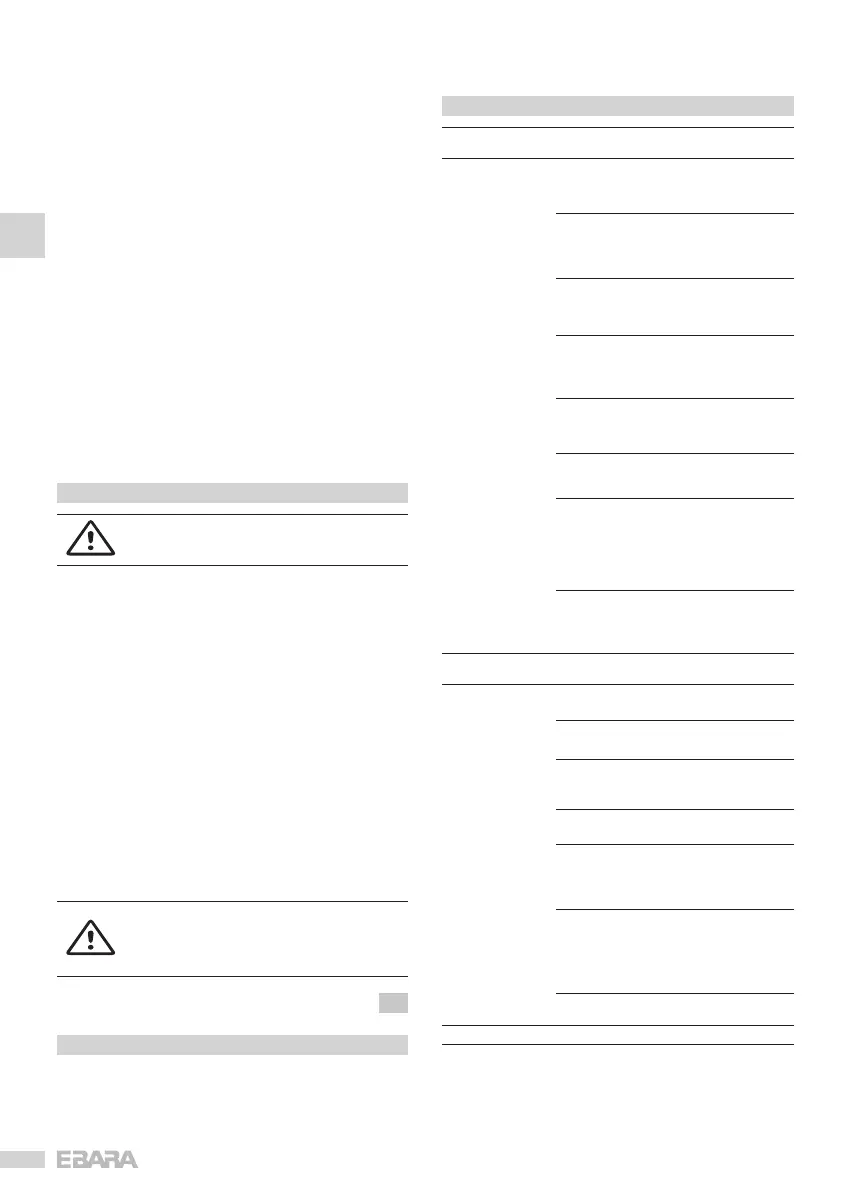
14. TROUBLESHOOTING
DISPLAYED FAULT
CAUSE SOLUTION
THE PUMP DOES
NOT WORK
The motor does not
turns
Float sticking
Check that the oat
reaches the level ON
Thermal protection ac-
tivated (single phase)
It reactivates
automatically
(single phase only)
Incorrect electrical
connection
Check the terminal
board and the
electrical panel
Automatic switch
triggered or fuses
blown (*)
Reset the switch or
replace the fuses and
verify the cause
No electricity
Check the electrical
supply meter
Plug not inserted
Check the connection
to the power supply
Built-in thermal over-
load protection device
(if tted) or thermal
cutout in control panel
tripped (*)
Wait for built-in thermal
overload protection
device to reset or reset
thermal cutout in con-
trol panel
Device protecting
against dry running
tripped (*)
Check water level and/
or correct connection
of system devices
(*)Ifyouencounterthesametroubleagain,callourServicingDe-
partment
THE PUMP DOES
NOT WORK
The motor turns
Decrease in the line
voltage
Wait for voltage to
return to normal
Suction lter / hole
blocked
Pulire il ltro/foro
Foot valve
blocked (**)
Release or clean the
valve and check that it
works properly
Pump has not been
lled (**)
Fill (sect. 10)
Water level low (if no
protection system is
tted) (**)
Restore water level
Pump not primed
Prime the pump
Check any delivery
non-return valves
Check the liquid level
Pressure too low
Restrict the
delivery gate
(**)Caution:mechanicalsealcouldbedamaged


 To Next Page
 Loading...