Need help?
Do you have a question about the EBARA EVM Series and is the answer not in the manual?
Manufacturer's official name, address, and contact information for EBARA Pumps Europe S.p.A.
Conditions that void warranty and how to contact authorized service centers for product issues.
Essential safety precautions and adherence to product specifications for safe operation by the user.
Details on product guards, electrical insulation, and earth conductor for enhanced safety.
Potential hazards like fan contact or unexpected restarts due to motor overheating.
Guidelines for lifting and moving the pump to prevent crushing hazards and damage.
Proper conditions for storing the pump to protect it from environmental factors and damage.
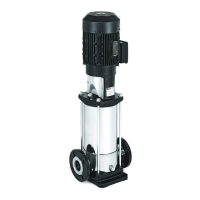
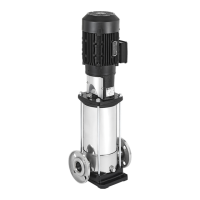
Overview of vertical multi-stage non-self-priming pumps and model identification.
Applications for which the pumps are designed, including water distribution and treatment.
Specific procedure for initial use with drinking water to ensure proper function.
List of applications that are hazardous and will void the product warranty.
Technical details including max temperature, solids handling, and pressure ratings.
Details on motor type, IP rating, insulation class, and duty cycle.
Explanation of the information found on the pump's technical specifications label.
Sound emission values for motor-driven pumps at different frequencies.
Instructions for coupling the motor to the pump, ensuring correct alignment and fit.
General guidelines for installing the pump safely and correctly.
Requirements for pump placement, ventilation, and protection from elements.
Procedures for securely mounting the pump to a rigid base using appropriate fasteners.
Specifics on suction pipe diameter, foot valve, and immersion depth for efficient operation.
Specified torque values for tightening flange bolts on various pump models.
Table of maximum admissible torque values for different flange connections.
Information on permissible strain limits for pump flanges.
Guidelines for safe electrical connection, including qualified personnel and protective devices.
Step-by-step guide for filling the pump and suction line in a suction lift configuration.
Procedure for filling the pump when installed in a flooded system with an open suction valve.
Critical warnings regarding pump operation, including avoiding dry running and excessive starts.
Steps for correctly starting the pump, including checking rotation direction and initial run parameters.
Instructions for smooth and quiet operation, including pressure checks and gradual opening of the delivery valve.
Procedure for safely stopping the pump to prevent overpressure and water hammering.
Regular checks for abnormal noise and vibration to anticipate potential repairs.
List of typical maintenance tasks like seal, bearing, and capacitor replacement.
Procedure for emptying and cleaning the pump for periods of inactivity or to prevent frost damage.
Guidance on complying with local regulations for scrapping the product and electrical waste.
Diagnosing and resolving issues when the pump motor fails to start.
Troubleshooting common problems when the motor runs but the pump does not operate correctly.
Identifying causes for reduced pump flow and potential solutions.
Addressing issues where the pump stops due to thermal overload protection tripping.
Troubleshooting thermal protection intervention that causes the pump to stop intermittently.
Resolving problems where the pump fails to stop in pressure-controlled applications.
Diagnosing and fixing causes of excessive vibration or noise during pump operation.
Addressing problems related to switch operation, circuit breaker tripping, and leakage current.
Table detailing standard voltages and their tolerances for different pump models and frequencies.
Factors affecting motor output based on ambient temperature and altitude, and how to compensate.
Chart showing maximum working pressures for various pump models across different frequencies.
Explains cavitation, its causes, and how to prevent it through proper installation and operation.
Dimensions for the positioning of holes used for securely fastening the pump down.
Critical warnings and recommendations for ensuring correct operation of EVM motor-driven pumps.
Explanation of the code used to identify motor-driven pump models.
 General
| Model | EVM Series |
|---|---|
| Protection Degree | IP55 |
| Insulation Class | F |
| Application | Water supply, irrigation |
| Pump Body | Cast Iron |
| Impeller | Stainless Steel |
| Material | Cast Iron, Stainless Steel |
| Motor Voltage | 220-240V, 380-415V |
| Frequency | 50 Hz / 60 Hz |
| Connection | Flanged |
| Seal Type | Mechanical Seal |
| Motor Power | 0.37 kW to 15 kW |

 To Next Page