EasyManua.ls Logo

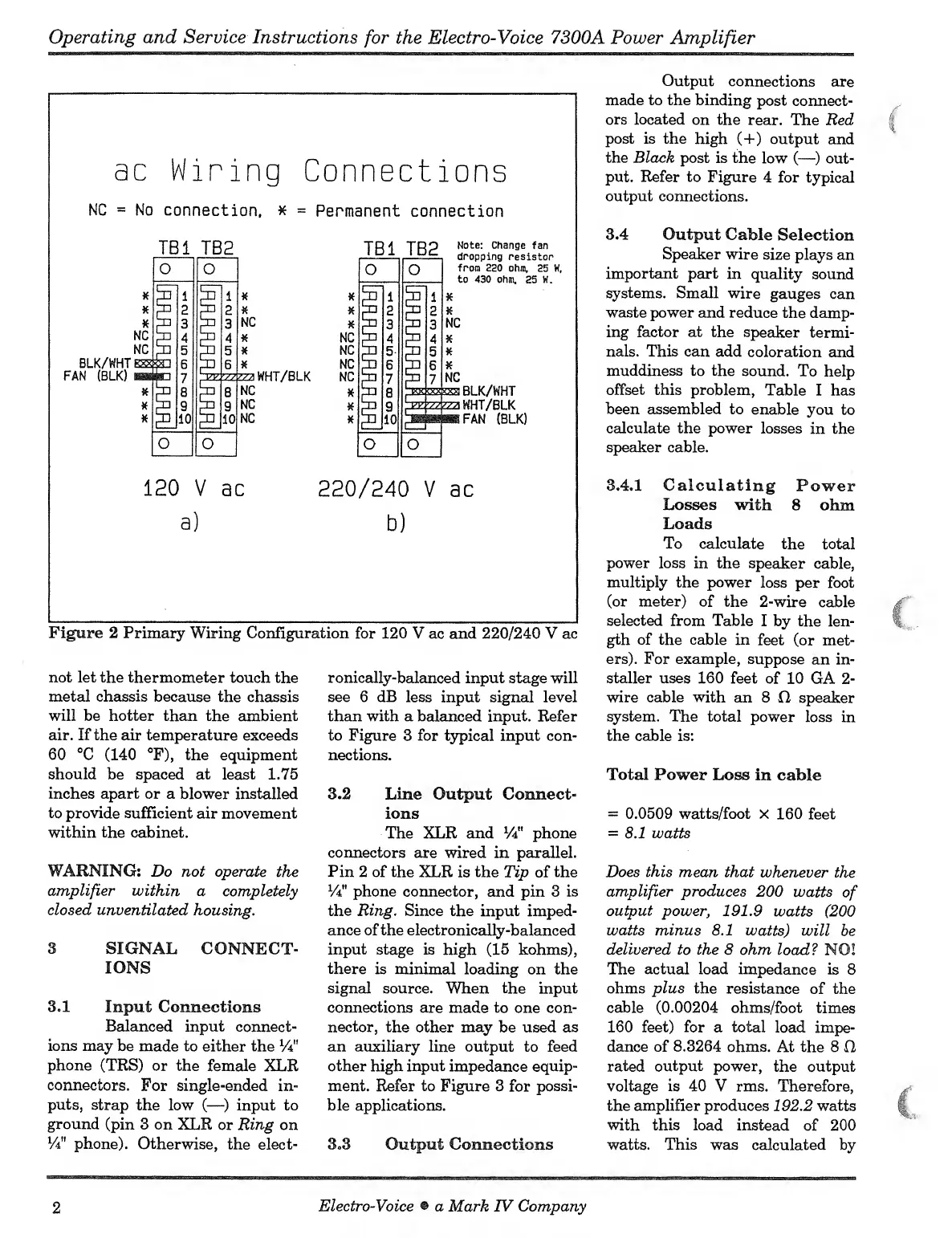
Electro-Voice 7300A - Signal Connections; O O; Q Q; Q a

Electro-Voice 7300A
24 pages
Print Icon
To Next Page IconTo Next Page
To Previous Page IconTo Previous Page
Loading...
Operating
and
Service
Instructions
for
the
Electro-Voice
7300A
Power
Amplifier
not
let
the
thermometer
touch
the
metal
chassis
because
the
chassis
will
be
hotter
than
the
ambient
air.
If
the
air
temperature
exceeds
60
°C
(140
°F),
the
equipment
should
be
spaced
at
least
1.75
inches
apart
or
a
blower
installed
to
provide
sufficient
air
movement
within
the
cabinet.
WARNING:
Do
not
operate
the
amplifier
within
a
completely
closed
unventilated
housing.
3
SIGNAL
CONNECT¬
IONS
3.1
Input
Connections
Balanced
input
connect¬
ions
may
be
made
to
either
the
Vi"
phone
(TRS)
or
the
female
XLR
connectors.
For
single-ended
in¬
puts,
strap
the
low
(—)
input
to
ground
(pin
3
on
XLR
or
Ring
on
Va"
phone).
Otherwise,
the
elect¬
ronically-balanced
input
stage
will
see
6
dB
less
input
signal
level
than
with
a
balanced
input.
Refer
to
Figure
3
for
typical
input
con¬
nections.
3.2
Line
Output
Connect¬
ions
The
XLR
and
Vi"
phone
connectors
are
wired
in
parallel.
Pin
2
of
the
XLR
is
the
Tip
of
the
Vi"
phone
connector,
and
pin
3
is
the
Ring.
Since
the
input
imped¬
ance
of
the
electronically-balanced
input
stage
is
high
(15
kohms),
there
is
minimal
loading
on
the
signal
source.
When
the
input
connections
are
made
to
one
con¬
nector,
the
other
may
be
used
as
an
auxiliary
line
output
to
feed
other
high
input
impedance
equip¬
ment.
Refer
to
Figure
3
for
possi¬
ble
applications.
3.3
Output
Connections
Output
connections
eire
made
to
the
binding
post
connect¬
ors
located
on
the
rear.
The
Red
post
is
the
high
(-I-)
output
and
the
Black
post
is
the
low
(—)
out¬
put.
Refer
to
Figure
4
for
typical
output
connections.
3.4
Output
Cable
Selection
Speaker
wire
size
plays
an
important
part
in
quality
sound
systems.
Small
wire
gauges
can
waste
power
and
reduce
the
damp¬
ing
factor
at
the
speaker
termi¬
nals.
This
can
add
coloration
and
muddiness
to
the
sound.
To
help
offset
this
problem.
Table
I
has
been
assembled
to
enable
you
to
calculate
the
power
losses
in
the
speaker
cable.
3.4.1
Calculating
Power
Losses
with
8
ohm
Loads
To
calculate
the
total
power
loss
in
the
speaker
cable,
multiply
the
power
loss
per
foot
(or
meter)
of
the
2-wire
cable
selected
from
Table
I
by
the
len¬
gth
of
the
cable
in
feet
(or
met¬
ers).
For
example,
suppose
an
in¬
staller
uses
160
feet
of
10
GA
2-
wire
cable
with
an
8
O
speaker
system.
The
total
power
loss
in
the
cable
is:
Total
Power
Loss
in
cable
=
0.0509
watts/foot
X
160
feet
=
8.1
watts
Does
this
mean
that
whenever
the
amplifier
produces
200
watts
of
output
power,
191.9
watts
(200
watts
minus
8.1
watts)
will
he
delivered
to
the
8
ohm
load"?
NO!
The
actual
load
impedance
is
8
ohms
plus
the
resistance
of
the
cable
(0.00204
ohms/foot
times
160
feet)
for
a
total
load
impe¬
dance
of
8.3264
ohms.
At
the
8
G
rated
output
power,
the
output
voltage
is
40
V
rms.
Therefore,
the
amplifier
produces
192.2
watts
with
this
load
instead
of
200
watts.
This
was
calculated
by
2
Electro-Voice
®
a
Mark
IV
Company

Other manuals for Electro-Voice 7300A

Related product manuals