EasyManua.ls Logo

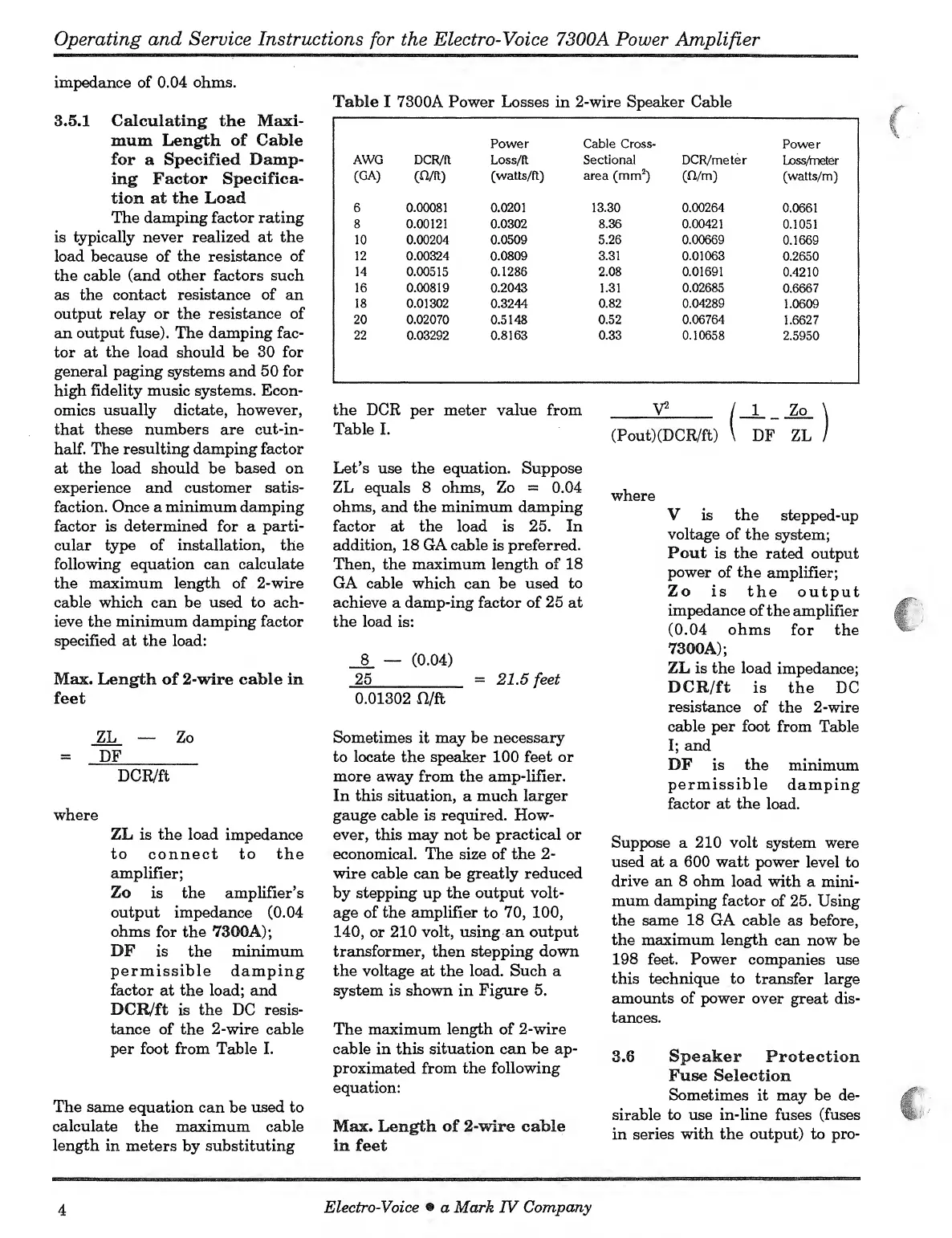
Electro-Voice 7300A - Calculating the Maximum Length of Cable for a Specified Damping Factor

Electro-Voice 7300A
24 pages
Print Icon
To Next Page IconTo Next Page
To Previous Page IconTo Previous Page
Loading...
Operating
and
Service
Instructions
for
the
Electro-Voice
7300A
Power
Amplifier
impedance
of
0.04
ohms.
3.5.1
Calculating
the
Maxi¬
mum
Length
of
Cable
for
a
Specified
Damp¬
ing
Factor
Specifica¬
tion
at
the
Load
The
damping
factor
rating
is
typically
never
realized
at
the
load
because
of
the
resistance
of
the
cable
(and
other
factors
such
as
the
contact
resistance
of
an
output
relay
or
the
resistance
of
an
output
fuse).
The
damping
fac¬
tor
at
the
load
should
be
30
for
general
paging
systems
and
50
for
high
fidelity
music
systems.
Econ¬
omics
usually
dictate,
however,
that
these
numbers
are
cut-in¬
half.
The
resulting
damping
factor
at
the
load
should
be
based
on
experience
and
customer
satis¬
faction.
Once
a
minimum
damping
factor
is
determined
for
a
parti¬
cular
type
of
installation,
the
following
equation
can
calculate
the
maximum
length
of
2-wire
cable
which
can
be
used
to
ach¬
ieve
the
minimum
damping
factor
specified
at
the
load:
Max.
Length
of
2-wire
cable
in
feet
ZL
Zo
=
_M
_
DCR/ft
where
ZL
is
the
load
impedance
to
connect
to
the
amplifier;
Zo
is
the
amplifier’s
output
impedance
(0.04
ohms
for
the
7300A);
DF
is
the
minimum
permissible
damping
factor
at
the
load;
and
DCR/ft
is
the
DC
resis¬
tance
of
the
2-wire
cable
per
foot
from
Table
I.
The
same
equation
can
be
used
to
calculate
the
maximum
cable
length
in
meters
by
substituting
Table
I
7300A
Power
Losses
in
2-wire
Speaker
Cable
Power
Cable
Cross-
Power
AWG
DCR/ft
Loss/ft
Sectional
DCR/meter
LossAneter
(GA)
(a/ft)
(watts/ft)
area
(mm^)
(a/m)
(watts/m)
6
0.00081
0.0201
13.30
0.00264
0.0661
8
0.00121
0.0302
8.36
0.00421
0.1051
10
0.00204
0.0509
5.26
0.00669
0.1669
12
0.00324
0.0809
3.31
0.01063
0.2650
14
0.00515
0.1286
2.08
0.01691
0.4210
16
0.00819
0.2043
1.31
0.02685
0.6667
18
0.01302
0.3244
0.82
0.04289
1.0609
20
0.02070
0.5148
0.52
0.06764
1.6627
22
0.03292
0.8163
0.33
0.10658
2.5950
the
DCR
per
meter
value
from
/
1
Zo
\
Table
1.
(Pout)(DCR/ft)
\
DF
ZL
1
Let’s
use
the
equation.
Suppose
ZL
equals
8
ohms,
Zo
=
0.04
ohms,
and
the
minimum
damping
factor
at
the
load
is
25.
In
addition,
18
GA
cable
is
preferred.
Then,
the
maximum
length
of
18
GA
cable
which
can
be
used
to
achieve
a
damp-ing
factor
of
25
at
the
load
is:
8
(0.04)
_25_
=
21.5
feet
0.01302
O/ft
Sometimes
it
may
be
necessary
to
locate
the
speaker
100
feet
or
more
away
from
the
amp-lifier.
In
this
situation,
a
much
larger
gauge
cable
is
required.
How¬
ever,
this
may
not
be
practical
or
economical.
The
size
of
the
2-
wire
cable
can
be
greatly
reduced
by
stepping
up
the
output
volt¬
age
of
the
amplifier
to
70,
100,
140,
or
210
volt,
using
an
output
transformer,
then
stepping
down
the
voltage
at
the
load.
Such
a
system
is
shown
in
Figure
5.
The
maximum
length
of
2-wire
cable
in
this
situation
can
be
ap¬
proximated
from
the
following
equation:
Max.
Length
of
2-wire
cable
in
feet
where
V
is
the
stepped-up
voltage
of
the
system;
Pout
is
the
rated
output
power
of
the
amplifier;
Zo
is
the
output
impedance
of
the
amplifier
(0.04
ohms
for
the
7300A);
ZL
is
the
load
impedance;
DCR/ft
is
the
DC
resistance
of
the
2-wire
cable
per
foot
from
Table
I;
and
DF
is
the
minimum
permissible
damping
factor
at
the
load.
Suppose
a
210
volt
system
were
used
at
a
600
watt
power
level
to
drive
an
8
ohm
load
with
a
mini¬
mum
damping
factor
of
25.
Using
the
same
18
GA
cable
as
before,
the
maximum
length
can
now
be
198
feet.
Power
companies
use
this
technique
to
trsinsfer
large
amounts
of
power
over
great
dis¬
tances.
3.6
Speaker
Protection
Fuse
Selection
Sometimes
it
may
be
de¬
sirable
to
use
in-line
fuses
(fuses
in
series
with
the
output)
to
pro-
4
Electro-Voice
®
a
Mark
TV
Company

Other manuals for Electro-Voice 7300A

Related product manuals