EasyManua.ls Logo

Electro-Voice 7600 - Signal Connections; Input Connections; Line Output Connections; Output Connections

Electro-Voice 7600
23 pages
Print Icon
To Next Page IconTo Next Page
To Previous Page IconTo Previous Page
Loading...
Operating
and
Servicing
Instructions
for
the
Electro-Voice
7600
Power
Amplifier
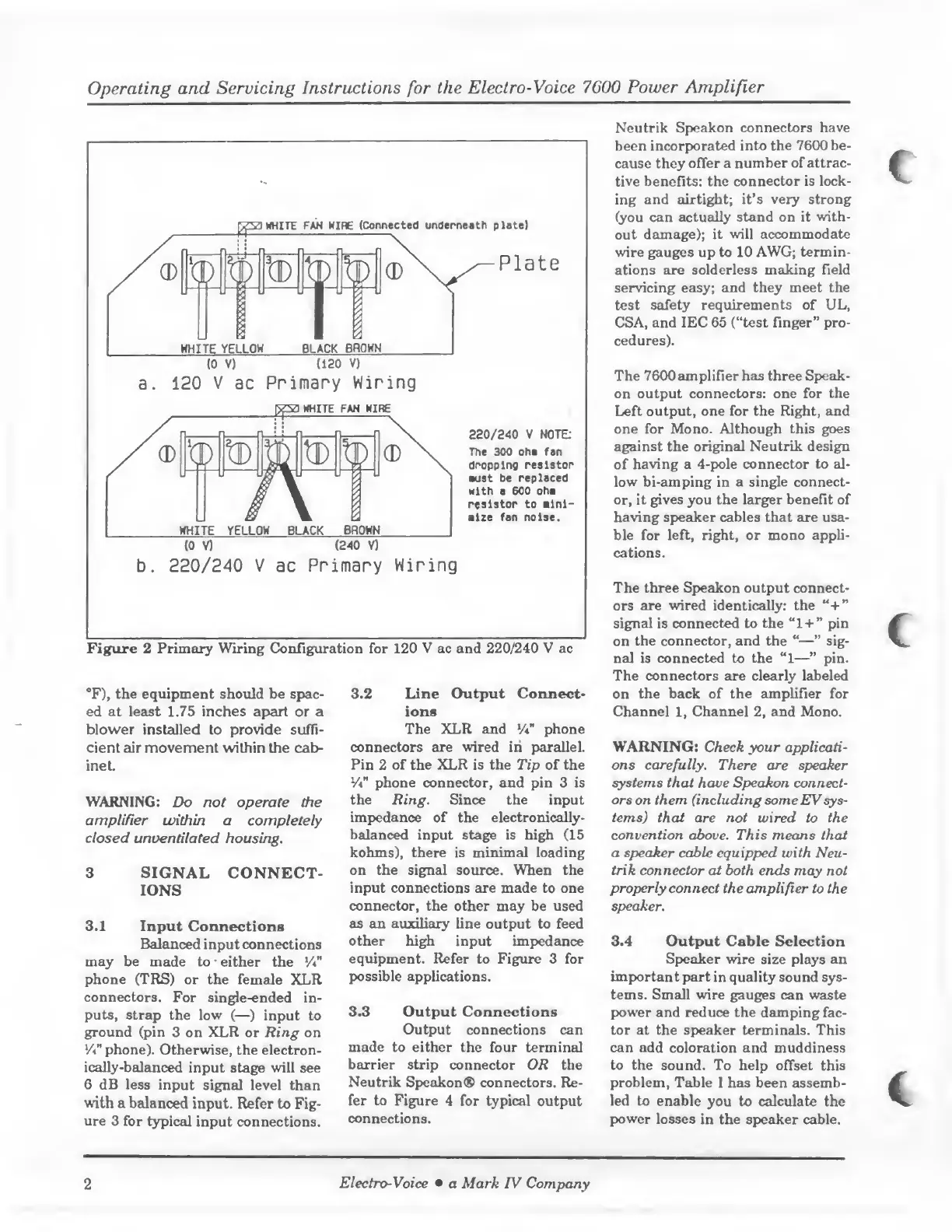
a.
120
V
ac
Primary
Wiring
220/240
V
NOTE;
The
300
ohi
fan
dropping
resistor
aust
be
replaced
with
a
600
oha
resistor
to
alnl-
alze
fan
noise.
b.
220/240
V
ac
Primary
Wiring
Figure
2
Primary
Wiring
Configuration
for
120
V
ac
and
220/240
V
ac
°F),
the
equipment
should
be
spac¬
ed
at
least
1.75
inches
apart
or
a
blower
installed
to
provide
suffi¬
cient
air
movement
within
the
cab¬
inet.
WARNING:
Do
not
operate
the
amplifier
within
a
completely
closed
unventilated
housing.
3
SIGNAL
CONNECT¬
IONS
3.1
I
nput
Connections
Balanced
input
connections
may
be
made
to
either
the
'/«"
phone
(TRS)
or
the
female
XLR
connectors.
For
single-ended
in¬
puts,
strap
the
low
(—)
input
to
ground
(pin
3
on
XLR
or
Ring
on
Vi"
phone).
Otherwise,
the
electron¬
ically-balanced
input
stage
will
see
6
dB
less
input
signal
level
than
with
a
balanced
input.
Refer
to
Fig¬
ure
3
for
typical
input
connections.
3.2
Line
Output
Connect¬
ions
The
XLR
and
Vi"
phone
connectors
are
wired
in
parallel.
Pin
2
of
the
XLR
is
the
Tip
of
the
Vi"
phone
connector,
and
pin
3
is
the
Ring.
Since
the
input
impedance
of
the
electronically-
balanced
input
stage
is
high
(15
kohms),
there
is
minim
al
loading
on
the
signal
source.
When
the
input
connections
are
made
to
one
connector,
the
other
may
be
used
as
an
auxiliary
line
output
to
feed
other
high
input
impedance
equipment.
Refer
to
Figure
3
for
possible
applications.
3.3
Output
Connections
Output
connections
can
made
to
either
the
four
terminal
barrier
strip
connector
OR
the
Neutrik
Speakon®
connectors.
Re¬
fer
to
Figure
4
for
typical
output
connections.
Neutrik
Speakon
connectors
have
been
incorporated
into
the
7600
be¬
cause
they
offer
a
number
of
attrac¬
tive
benefits:
the
connector
is
lock¬
ing
and
airtight;
it’s
very
strong
(you
can
actually
stand
on
it
with¬
out
damage);
it
will
accommodate
wire
gauges
up
to
10
AWG;
termin¬
ations
are
solderles3
making
field
servicing
easy;
and
they
meet
the
test
safety
requirements
of
UL,
CSA,
and
IEC
65
(“test
finger”
pro¬
cedures).
The
7600
amplifier
has
three
Speak¬
on
output
connectors:
one
for
the
Left
output,
one
for
the
Right,
and
one
for
Mono.
Although
this
goes
against
the
original
Neutrik
design
of
having
a
4-pole
connector
to
al¬
low
bi-amping
in
a
single
connect¬
or,
it
gives
you
the
larger
benefit
of
having
speaker
cables
that
are
usa¬
ble
for
left,
right,
or
mono
appli¬
cations.
The
three
Speakon
output
connect¬
ors
are
'wired
identically:
the
“+"
signal
is
connected
to
the
“1
+
pin
on
the
connector,
and
the
“—”
sig¬
nal
is
connected
to
the
“1—”
pin.
The
connectors
are
clearly
labeled
on
the
back
of
the
amplifier
for
Channel
1,
Channel
2,
and
Mono.
WARNING:
Check
your
applicati¬
ons
carefully.
There
are
speaker
systems
that
have
Speakon
connect¬
ors
on
them
(including
some
EVsys¬
tems)
that
are
not
wired
to
the
convention
above.
This
means
that
a
speaker
cable
equipped
with
Neu¬
trik
connector
at
both
ends
may
not
properly
connect
the
amplifier
to
the
speaker.
3.4
O
utput
Cable
Selection
Speaker
wire
size
plays
an
important
part
in
quality
sound
sys¬
tems.
Small
wire
gauges
can
waste
power
and
reduce
the
damping
fac¬
tor
at
the
speaker
terminals.
This
can
add
coloration
and
muddiness
to
the
sound.
To
help
offset
this
problem,
Table
I
has
been
assemb¬
led
to
enable
you
to
calculate
the
power
losses
in
the
speaker
cable.
2
Electro-Voice
a
Mark
IV
Company

Related product manuals