EasyManua.ls Logo

Electro-Voice 7600 - Calculating the Maximum Length of Cable for a Specified Damping Factor

Electro-Voice 7600
23 pages
Print Icon
To Next Page IconTo Next Page
To Previous Page IconTo Previous Page
Loading...
Operating
and
Servicing
Instructions
for
the
Electro-Voice
7600
Power
Amplifier
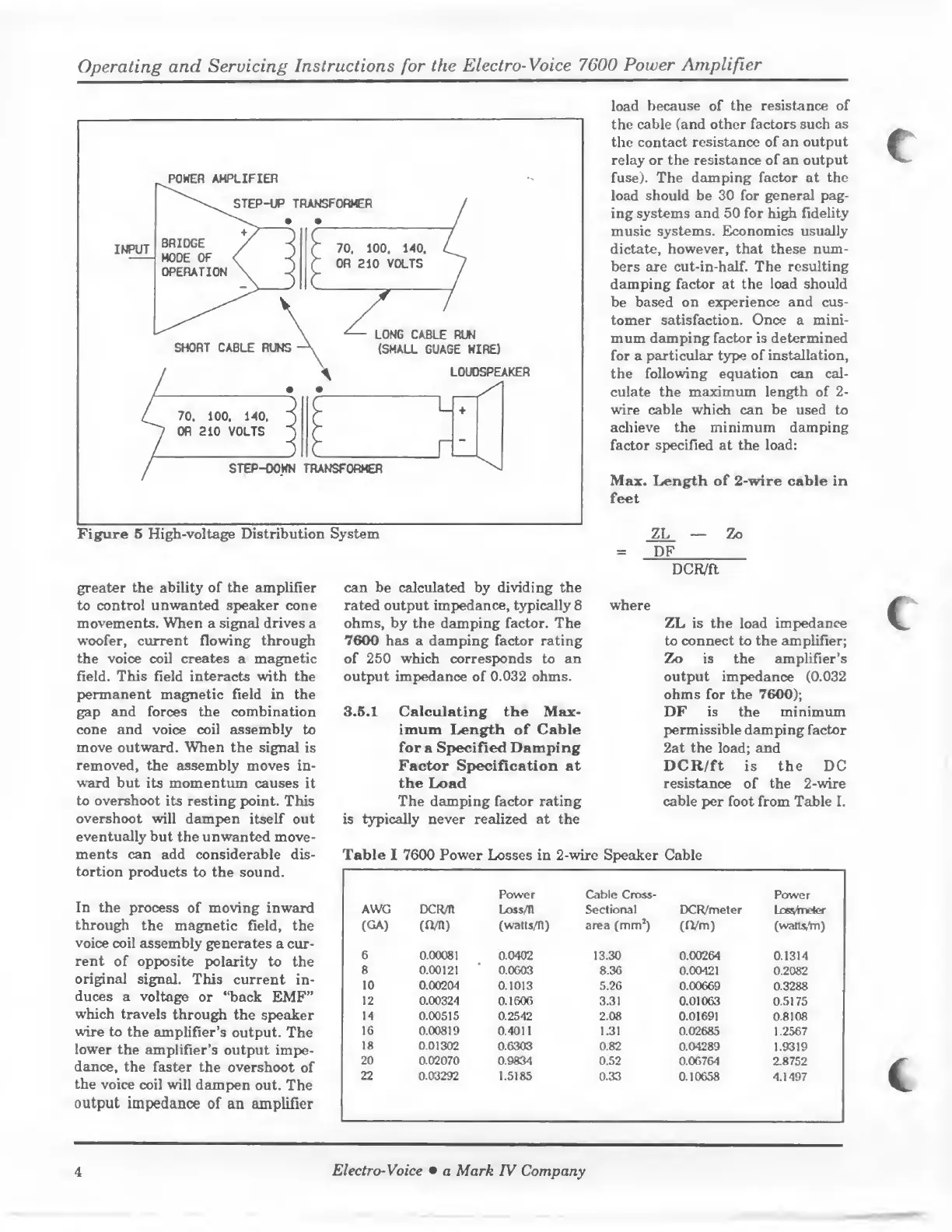
Figure
5
High-voltage
Distribution
System
greater
the
ability
of
the
amplifier
to
control
unwanted
speaker
cone
movements.
When
a
signal
drives
a
woofer,
current
flowing
through
the
voice
coil
creates
a
magnetic
field.
This
field
interacts
with
the
permanent
magnetic
field
in
the
gap
and
forces
the
combination
cone
and
voice
coil
assembly
to
move
outward.
When
the
signal
is
removed,
the
assembly
moves
in¬
ward
but
its
momentum
causes
it
to
overshoot
its
resting
point.
This
overshoot
will
dampen
itself
out
eventually
but
the
unwanted
move¬
ments
can
add
considerable
dis¬
tortion
products
to
the
sound.
In
the
process
of
moving
inward
through
the
magnetic
field,
the
voice
coil
assembly
generates
a
cur¬
rent
of
opposite
polarity
to
the
original
signal.
This
current
in¬
duces
a
voltage
or
“back
EMF”
which
travels
through
the
speaker
wire
to
the
amplifier’s
output.
The
lower
the
amplifier’s
output
impe¬
dance,
the
faster
the
overshoot
of
the
voice
coil
will
dampen
out.
The
output
impedance
of
an
amplifier
can
be
calculated
by
dividing
the
rated
output
impedance,
typically
8
ohms,
by
the
damping
factor.
The
7600
has
a
damping
factor
rating
of
250
which
corresponds
to
an
output
impedance
of
0.032
ohms.
3.5.1
Calculating
the
Max¬
imum
Length
of
Cable
for
a
Specified
Damping
Factor
Specification
at
the
Load
The
damping
factor
rating
is
typically
never
realized
at
the
load
because
of
the
resistance
of
the
cable
(and
other
factors
such
as
the
contact
resistance
of
an
output
relay
or
the
resistance
of
an
output
fuse).
The
damping
factor
at
the
load
should
be
30
for
general
pag¬
ing
systems
and
50
for
high
fidelity
music
systems.
Economics
usually
dictate,
however,
that
these
num¬
bers
are
cut-in-half.
The
resulting
damping
factor
at
the
load
should
be
based
on
experience
and
cus¬
tomer
satisfaction.
Once
a
mini¬
mum
damping
factor
is
determined
for
a
particular
type
of
installation,
the
following
equation
can
cal¬
culate
the
maximum
length
of
2-
wire
cable
which
can
be
used
to
achieve
the
minimum
damping
factor
specified
at
the
load:
Max.
Length
of
2-wire
cable
in
feet
ZL
Zo
=
_DF_
DCR/ft
where
ZL
is
the
load
impedance
to
connect
to
the
amplifier;
Zo
is
the
amplifier’s
output
impedance
(0.032
ohms
for
the
7600);
DF
is
the
minimum
permissible
damping
factor
2at
the
load;
and
DCR/ft
is
the
DC
resistance
of
the
2-wire
cable
per
foot
from
Table
I.
Table
I
7600
Power
Losses
in
2-wire
Speaker
Cable
Power
Cable
Cross-
Power
AWG
DCR/fl
Loss/n
Sectional
DCR/meter
Loss+neier
(GA)
(n/«)
(watts/ft)
area
(mm
2
)
(fi/m)
(watts/m)
6
0.00081
0.0402
13.30
0.00264
0.1314
8
0.00121
0.0603
8.36
0.00421
0.2082
10
0.00204
0.1013
5.26
0.00669
0.3288
12
0.00324
0.1606
3.31
0.01063
0.5175
14
0.00515
0.2542
2.08
0.01691
0.8108
16
0.00819
0.4011
1.31
0.02685
1.2567
18
0.01302
0.6303
0.82
0.04289
1.9319
20
0.02070
0.9834
0.52
0.06764
2.8752
22
0.03292
1.5185
0.33
0.10658
4.1497
4
Electro-Voice
a
Mark
IV
Company

Related product manuals