EasyManua.ls Logo

Electro-Voice 7600 - Speaker Protection Fuse Selection; Compression Driver Protection Capacitors

Electro-Voice 7600
23 pages
Print Icon
To Next Page IconTo Next Page
To Previous Page IconTo Previous Page
Loading...
Operating
and
Servicing
Instructions
for
the
Electro-Voice
7600
Power
Amplifier
The
same
equation
can
be
used
to
calculate
the
maximum
cable
len¬
gth
in
meters
by
substituting
the
DCR
per
meter
value
from
Table
I.
Let’s
use
the
equation.
Suppose
ZL
equals
8
ohms,
Zo
=
0.032
ohms,
and
the
minimum
damping
factor
at
the
load
is
25.
In
addition,
18
GA
cable
is
preferred.
Then,
the
maximum
length
of
18
GA
cable
which
can
be
used
to
achieve
a
damping
factor
of
25
at
the
load
is:
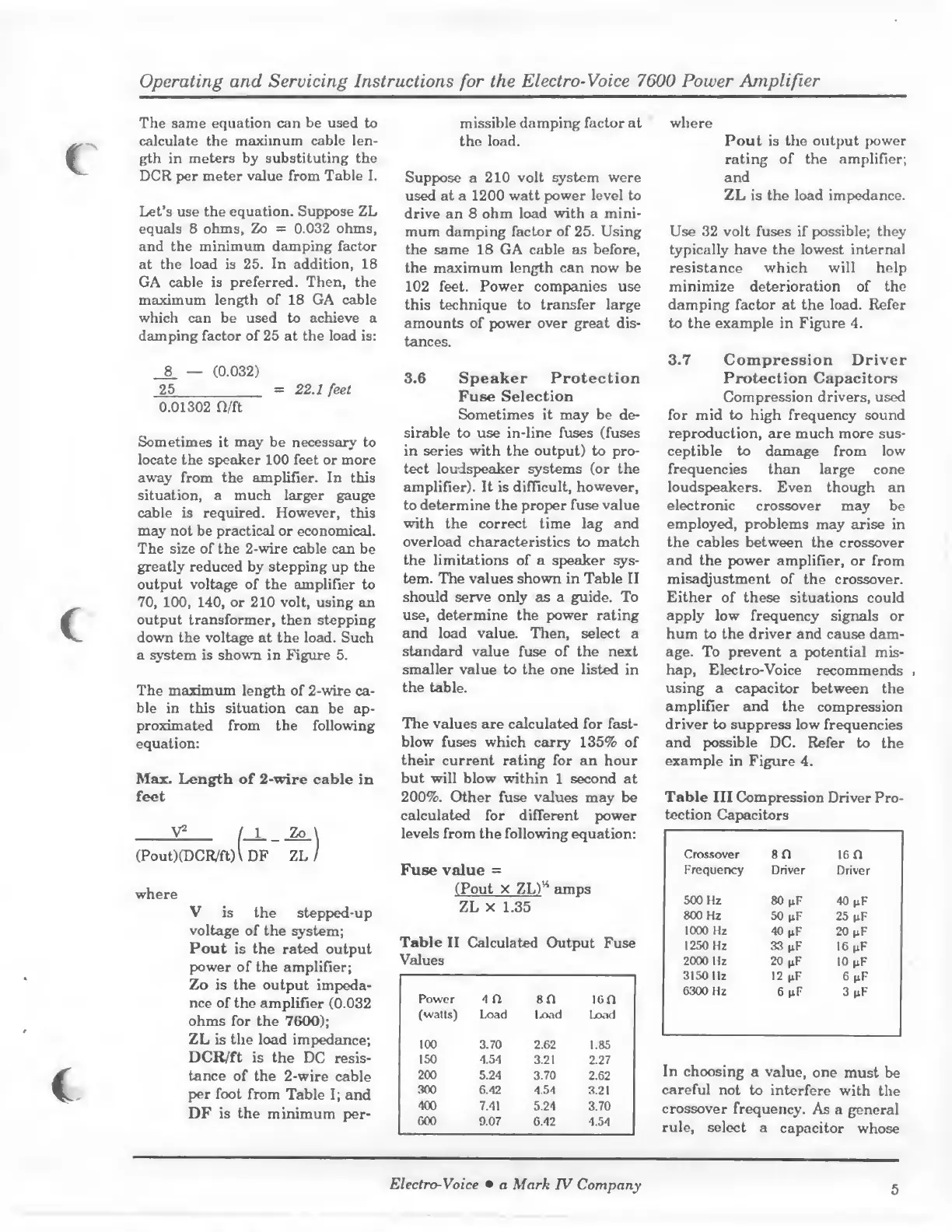
8
(0.032)
25
_
=
22.1
feet
0.01302
n/ft
Sometimes
it
may
be
necessary
to
locate
the
speaker
100
feet
or
more
away
from
the
amplifier.
In
this
situation,
a
much
larger
gauge
cable
is
required.
However,
this
may
not
be
practical
or
economical.
The
size
of
the
2-wire
cable
can
be
greatly
reduced
by
stepping
up
the
output
voltage
of
the
amplifier
to
70,
100,
140,
or
210
volt,
using
an
output
transformer,
then
stepping
down
the
voltage
at
the
load.
Such
a
system
is
shown
in
Figure
5.
The
maximum
length
of
2-wire
ca¬
ble
in
this
situation
can
be
ap¬
proximated
from
the
following
equation:
Max.
Length
of
2-wire
cable
in
feet
V
2
/_1_Zo_\
(Pout)(DCR/ft)\
DF
ZL/
where
V
is
the
stepped-up
voltage
of
the
system;
Pout
is
the
rated
output
power
of
the
amplifier;
Zo
is
the
output
impeda¬
nce
of
the
amplifier
(0.032
ohms
for
the
7600);
ZL
is
the
load
impedance;
DCR/ft
is
the
DC
resis¬
tance
of
the
2-wire
cable
per
foot
from
Table
I;
and
DF
is
the
minimum
per¬
missible
damping
factor
at
the
load.
Suppose
a
210
volt
system
were
used
at
a
1200
watt
power
level
to
drive
an
8
ohm
load
with
a
mini¬
mum
damping
factor
of
25.
Using
the
same
18
GA
cable
as
before,
the
maximum
length
can
now
be
102
feet.
Power
companies
use
this
technique
to
transfer
large
amounts
of
power
over
great
dis¬
tances.
3.6
Speaker
Protection
Fuse
Selection
Sometimes
it
may
be
de¬
sirable
to
use
in-line
fuses
(fuses
in
series
with
the
output)
to
pro¬
tect
loudspeaker
systems
(or
the
amplifier).
It
is
difficult,
however,
to
determine
the
proper
fuse
value
with
the
correct
time
lag
and
overload
characteristics
to
match
the
limitations
of
a
speaker
sys¬
tem.
The
values
shown
in
Table
II
should
serve
only
as
a
guide.
To
use,
determine
the
power
rating
and
load
value.
Then,
select
a
standard
value
fuse
of
the
next
smaller
value
to
the
one
listed
in
the
table.
The
values
are
calculated
for
fast-
blow
fuses
which
carry
135%
of
their
current
rating
for
an
hour
but
will
blow
within
1
second
at
200%.
Other
fuse
values
may
be
calculated
for
different
power
levels
from
the
following
equation:
Fuse
value
=
(Pout
x
ZL)
H
amps
ZL
x
1.35
Table
II
Calculated
Output
Fuse
Values
Power
4
n
8
fl
160
(watts)
Load
lead
Load
100
3.70
2.62
1.85
150
4.54
3.21
2.27
200
5.24
3.70
2.62
300
6.42
4.54
3.21
400
7.41
5.24
3.70
600
9.07
6.42
4.54
where
Pout
is
the
output
power
rating
of
the
amplifier;
and
ZL
is
the
load
impedance.
Use
32
volt
fuses
if
possible;
they
typically
have
the
lowest
internal
resistance
which
will
help
minimize
deterioration
of
the
damping
factor
at
the
load.
Refer
to
the
example
in
Figure
4.
3.7
Compression
Driver
Protection
Capacitors
Compression
drivers,
used
for
mid
to
high
frequency
sound
reproduction,
are
much
more
sus¬
ceptible
to
damage
from
low
frequencies
than
large
cone
loudspeakers.
Even
though
an
electronic
crossover
may
be
employed,
problems
may
arise
in
the
cables
between
the
crossover
and
the
power
amplifier,
or
from
misadjustment
of
the
crossover.
Either
of
these
situations
could
apply
low
frequency
signals
or
hum
to
the
driver
and
cause
dam¬
age.
To
prevent
a
potential
mis¬
hap,
Electro-Voice
recommends
.
using
a
capacitor
between
the
amplifier
and
the
compression
driver
to
suppress
low
frequencies
and
possible
DC.
Refer
to
the
example
in
Figure
4.
Table
III
Compression
Driver
Pro¬
tection
Capacitors
Crossover
80
160
Frequency
Driver
Driver
500
Hz
80
(iF
40
(iF
800
Hz
50
(iF
25
nF
1000
Hz
40
|iF
20
|iF
1250
Hz
33
jiF
16
|iF
2000
Hz
20
|iF
10
|*F
3150
Hz
12
|iF
6
|iF
6300
Hz
6
(iF
3
!iF
In
choosing
a
value,
one
must
be
careful
not
to
interfere
with
the
crossover
frequency.
As
a
general
rule,
select
a
capacitor
whose
Electro-Voice
a
Mark
IV
Company
5

Related product manuals