33
Rosemount 8600 Vortex Flow Meter
Reference Manual
May 2019
Installation
00809-0100-4860, Rev BF
3.6.5 Grounding the transmitter case
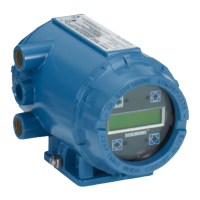
The transmitter case should always be grounded in accordance with national and local
electrical codes. The most effective transmitter case grounding method is direct
connection to earth ground with minimal impedance. Methods for grounding the
transmitter case include:
Internal Ground Connection: The Internal Ground Connection screw is inside the
FIELD TERMINALS side of the electronics housing. This screw is identified by a
ground symbol ( ), and is standard on all Rosemount 8600D transmitters.
External Ground Assembly: This assembly is included with the optional transient
protection terminal block (Option Code T1). The External Ground Assembly can
also be ordered with the transmitter (Option Code V5) and is automatically
included with certain hazardous area approvals.
Note
Grounding the transmitter case using the threaded conduit connection may not provide a
sufficient ground. The transient protection terminal block (Option Code T1) does not
provide transient protection unless the transmitter case is properly grounded. See
“Transient Terminal Block” on page 44 for transient terminal block grounding. Use the
above guidelines to ground the transmitter case. Do not run the transient protection
ground wire with signal wiring as the ground wire may carry excessive current if a lightning
strike occurs.
3.6.6 Wiring procedure
The signal terminals are located in a compartment of the electronics housing separate from
the flowmeter electronics. Connections for a HART-based communicator and a current test
connection are above the signal terminals. Figure 3-11 illustrates the power supply load
limitations for the flowmeter.
Note
A power disconnect is required to remove power from the transmitter for maintenance,
removal, and replacement.
Power supply
Power Supply Specifications:
Typical installations use a 22 Vdc – 28 Vdc power supply. The dc power supply should
provide clean power with less than 2% ripple. Refer to Figure 3-11 as a quick reference.
Loop resistance specification:
If HART communication is required, a minimum resistance of 250Ω dc is required between
the power supply and the transmitter.
Note
See the Loop Load Calculation section to determine the maximum allowable loop
resistance as a function of power supply voltage.



 To Next Page
 Loading...