EMW90HDNC1U Air-cooled Chiller
Prerequisites
The power has been cut off for at least 10
minutes.
The Phillips screwdriver and flat-blade
screwdriver have been prepared by referring
to Table 3-1.
Background
The electrical components (such as control board,
etc.) of the EMW90HDNC1U chiller are centrally
arranged in the electrical control box, and users
can maintain and replace the relevant
components according to the actual plan.
Procedure
Step 1 Remove the entire chiller and place it in an
area with sufficient maintenance space.
Step 2 Remove the maintenance panel and the
electric control box cover plate above the
chiller in sequence.
Step 3 Remove the fixing screws and wiring
terminals of the corresponding electrical
components according to the plan.
Step 4 Take out the electrical components for
replacement.
Step 5 Install in the reverse order of Step 3 to
Step 1 to complete the parts
replacement.
7.5 Alarm Handling
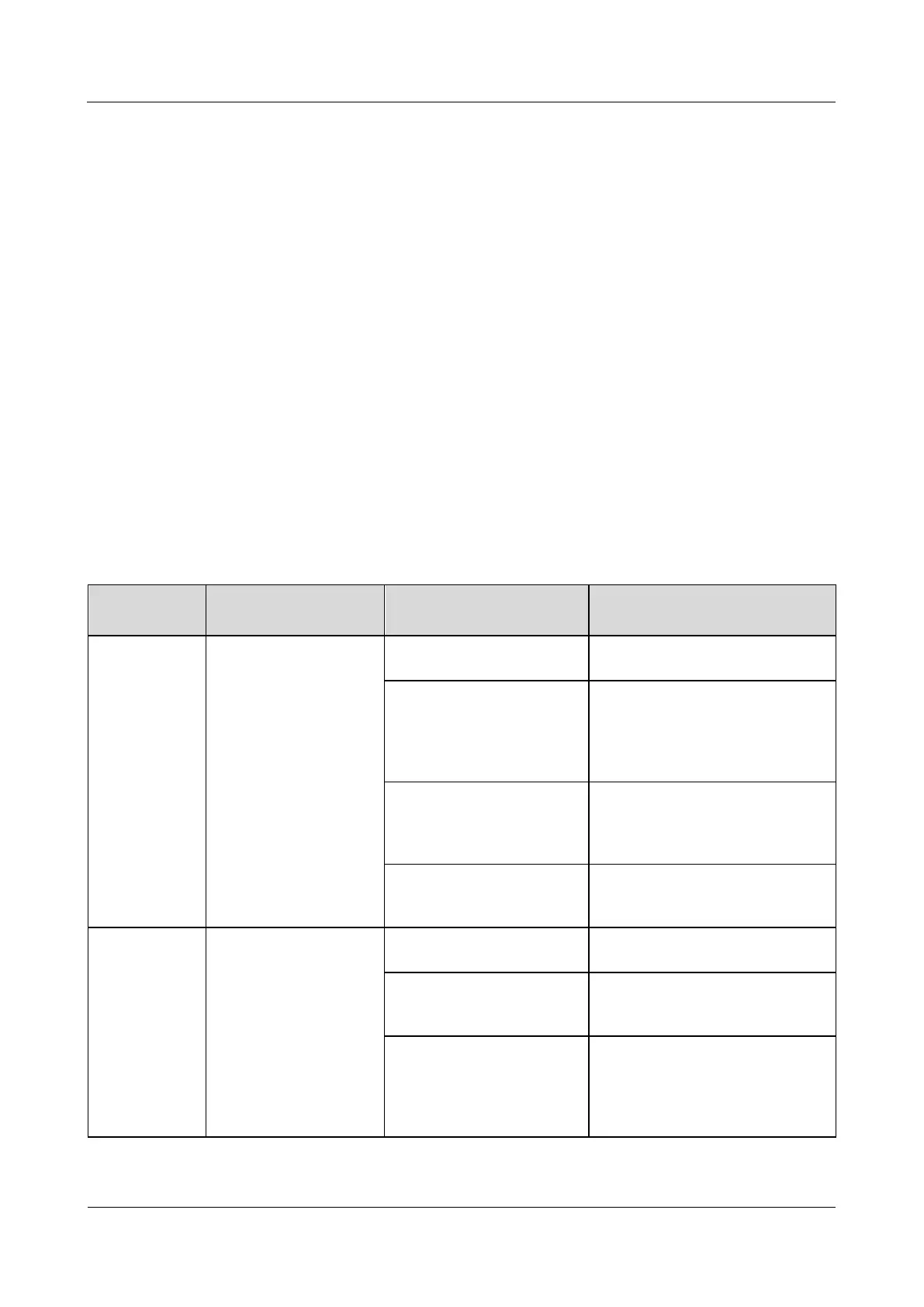
The alarm information of EMW90HDNC1U chiller is shown in Table 7-4.
The locking alarm (such as "System High Pressure Alarm Locking") needs to be manually released
by first powering off the chiller and then powering on the chiller, and other alarms will be automatically
released when the current scene does not meet the alarm conditions.
Table 7-4 Alarm list
Alarm Name
Generation
Condition
Possible Causes Processing Method
High Temp Of
Outlet Water
Outlet coolant
temperature is higher
than high temperature
set threshold.
temperature probe failure.
Replace the outlet coolant
temperature probe.
Abnormal operation of
compressor, electronic
expansion valve, internal
circulating coolant pump
or external fan.
Check the compressor,
electronic expansion valve,
internal circulating coolant
pump and external fan.
The load of the equipment
to be cooled exceeds the
design cooling capacity of
the chiller.
Check the load of the
equipment to be cooled.
in the cooling medium
circulation system.
Check the leakage point and
replenish the cooling medium
after repair.
Low Temp Of
Outlet Water
The outlet coolant
temperature is lower
than low temperature
set threshold.
temperature probe failure.
Replace the outlet coolant
temperature probe.
Malfunction of electric
heating tube or internal
circulation pump.
Check the electric heating tube
and internal circulating coolant
pump.
equipment to be cooled
exceeds the designed
heating capacity of the
chiller.
Check the heat leakage of the
equipment to be cooled.



 To Next Page