RX
-
8025
SA
/
NB
Page - 19 ETM10E-04
8.6. Alarm D function
The Alarm D function generates interrupt signals (output via the /INTA pin) that correspond to specified hours and
minutes.
For description of the Alarm W function, which supports only day, hour, and minute data, see "8.5. Alarm W Function".
A polling function is also provided to enable checking of each alarm mode by the host.
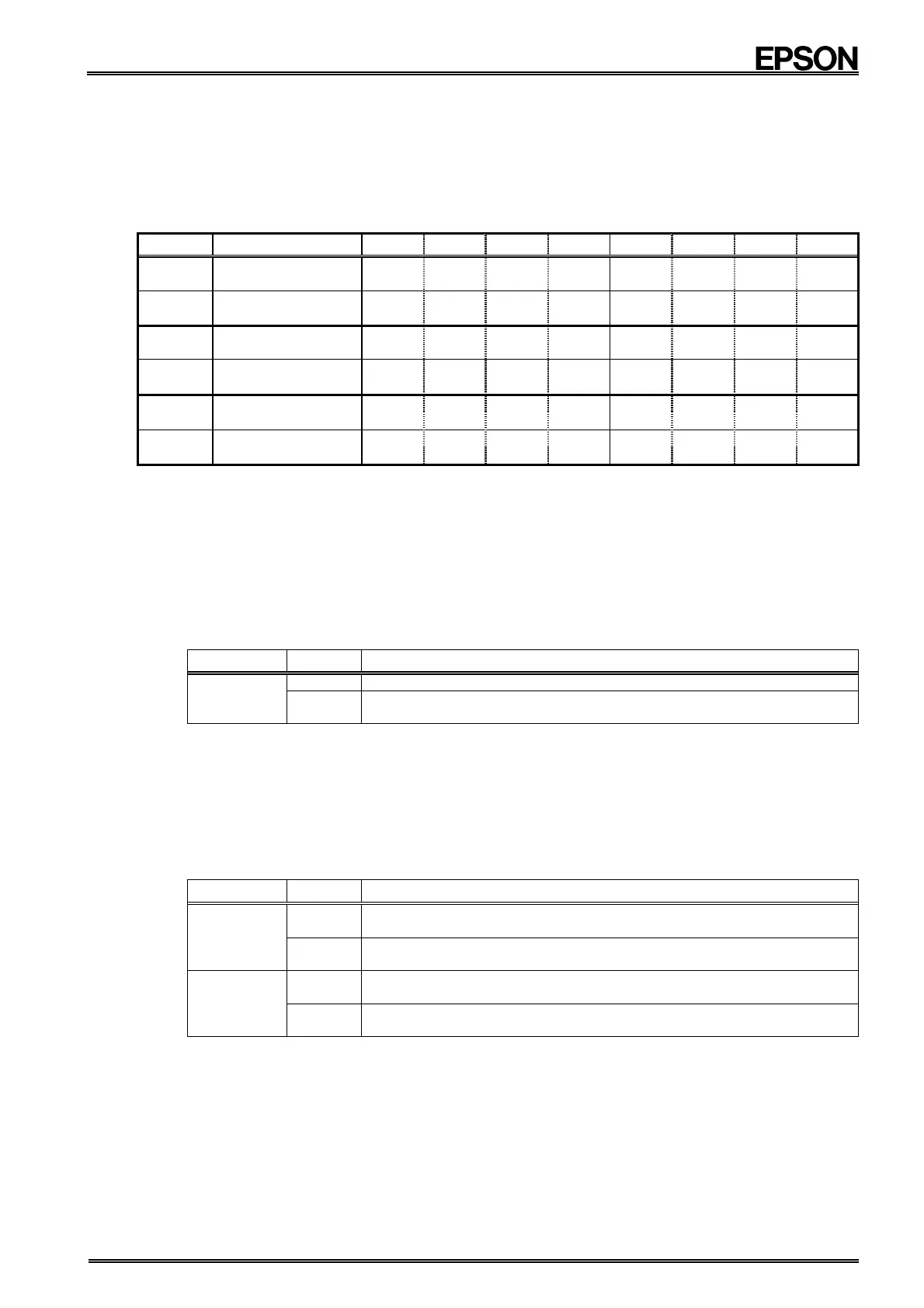
8.6.1. Related registers
Address
Function bit 7 bit 6 bit 5 bit 4 bit 3 bit 2 bit 1 bit 0
1
Minutes
M40 M20 M10 M8 M4 M2 M1
2
Hours
H20
P , /A
H10 H8 H4 H2 H1
B
Alarm_D ; Minute
DM40
DM20
DM10
DM8 DM4 DM2 DM1
C
Alarm_D ; Hour
DH20
DP , /A
DH10
DH8 DH4 DH2 DH1
E
Control 1
WALE
DALE
/12 , 24
/CLEN2
TEST CT2 CT1 CT0
(Default)
(0)
(0) (0)
( 0 ) ( 0 ) (0) (0) (0)
F
Control 2
VDSL VDET / XST PON /CLEN1
CTFG
WAFG
DAFG
(Default) (0) (0)
(−)
( 1 ) ( 0 ) (0)
(0)
(0)
∗1) The default value is the value that is read (or is set internally) after the PON bit has been set to "1," such as after powering up from 0 V or
recovering from a supply voltage drop.
∗2) "○" indicates write-protected bits. A zero is always read from these bits.
∗3) "−" indicates undefined status.
• When the Alarm_D setting matches the current time, /INTA pin is set to "L" and the DALE bit is set to "1".
Note: If the current date/time is used as the Alarm_D setting, the alarm will not occur until the counter counts up to
the current date/time (i.e., an alarm will occur next time, not immediately).
• During 24-hour clock operation, the "Alarm_D ; Hours" register's bit 5 (DH20, DP, /A) functions as DH20 (two-digit
hour display), and during 12-hour clock operation it functions as an AM/PM indicator.
1) DALE bit
This bit is used to set up the Alarm D function (to generate alarms matching hour or minute settings).
DALE Data Description
Write / Read
0 Alarm_D, match comparison operation invalid
∗ Default
1
Alarm_D, match comparison operation valid (/INTA = "L" when
match occurs)
∗ When using the Alarm D function, first set this DALE bit value as "0," then stop the function. Next, set the
hour, minute, and the DAFG bit. Finally, set "1" to the DALE bit to set the Alarm D function as valid.
The reason for first setting the DALE bit value as "0" is to prevent /INTA = "L" output in the event that a
match between the current time and alarm setting occurs while the alarm setting is still being made.
2) DAFG bit
This bit is valid only when the DALE bit value is "1". When a match occurs between the Alarm_D setting and the
current time, the DAFG bit value becomes "1" approximately 61 µs afterward. (There is no effect when the DALE
bit becomes "0".)
The /INTA = "L" status that is set at this time can be set to OFF by writing a "0" to this bit.
DAFG Data Description
Write
0
/INTA pin = OFF (Hi-z) (only when periodic interrupt output is
OFF)
∗ Default
1
The writes "1" are invalid.
Read
0
Alarm_D time setting does not match current time
(This bit's value is always "0" when the DALE bit's setting is "0")
∗ Default
1
Alarm_D time setting matches current time
(result is that bit value is held until cleared to zero)
∗ When a "0" is written to the DAFG bit, provisionally the DAFG bit value is "0" and the /INTA pin status is
OFF (Hi-z). However, as long as the DALE bit value is "1" the Alarm D function continues to operate, and
Alarm D occurs again the next time the same specified time arrives.
You can stop Alarm D from occurring by writing "0" to the DALE bit to set this function as invalid.
3) /12,24 bit
∗ See "/12, 24 bit" in section 8.5.1. 3.
8.6.2. WAFG, DAFG and /INTA, /INTB output
∗ See "WAFG, DAFG and /INTA, /INTB output" in section 8.5.3.


 To Next Page