30
Step buffer
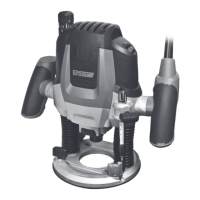
The step buffer (10) is particularly useful when cutting a very deep cut is required and
it is necessary to remove material in several steps. With this product you can divide
one deep cut into up to 8 steps.
NOTE: Proceeding in several steps is useful when making very deep
cuts. Otherwise the workpiece and the router bit could get damaged.
The steps on the step buffer are of different heights..
1. Set the required cutting depth with the lowest step of the step buffer (10) as
described above: “coarse adjustment” and “ne adjustment”.
2. Release the xing lever (19) by turning clockwise and raise the motor housing by
the spring force of the two pillars until highest position. (Fig. J, step 1)
WARNING! Be aware of the spring force in the pillars and put one
hand on the top of the router when release the xing lever (19) to avoid
unintended jumping-up of the router.
3. Turn the step buffer (10) to a higher step which the router bit starts to be able to
touch the work piece surface. Perform the rst cut with this setting.
4. Turn the step buffer (10) clockwise to the next lower step and perform a second
cut. Repeat such cut step by step until the nal cut with the lowest position is
nished. (Fig. K).
Operation
01
General routing (Fig. M)
WARNING! During operation ne dust will be generated! The dust is
highly inammable and explosive! Do not smoke during operation, keep
heat sources and open ames out of the working area!
Always wear a dust mask to protect yourself against hazards resulting
from ne dust!
NOTE: Before rst use on a workpiece make yourself familiar with the
different routing functions using waste material.
Even if you are familiar with this product, always make a trial cut on waste
material to test the adjusted speed, routing depth and chosen router bit.
1. Ensure the workpiece is free of obstacles like nails or screws before operation.
Remove them if required.
2. Always attach the desired router bit and a dust extraction device.
3. Hold the product rmly with both hands on its handles and put the router on the
work piece in desired positon before switch it on.
4. Always wait until the power tool has reached its full speed before cutting. Never
switch the power tool on when a bit is in contact with the workpiece as this can
lead to damage, kick-back or injury.
5. Press the router downward slowly and gently in desired position and running router
bit to start a plunge routing if applicable. Re-tighten the xing lever (19) and guide
the router gently and evenly over the workpiece.
6. Move the product with a slow and even speed. Pay attention to the direction of
feeding as instructed below.
7. Always keep the balance of the router to avoid falling to the non-supported side.
8. Bring the product to a stop at the end of the cut, release the on/off switch and wait
until the router bit has come to a complete stop before removing the product from
the workpiece.
2100W router MNL_ER2100_TPS_GB_V02_20180608.indd 30 6/8/18 19:22


 To Next Page