EasyManua.ls Logo

ESAB EPP-362 - Page 38

ESAB EPP-362
48 pages
Print Icon
To Next Page IconTo Next Page
To Previous Page IconTo Previous Page
Loading...
38
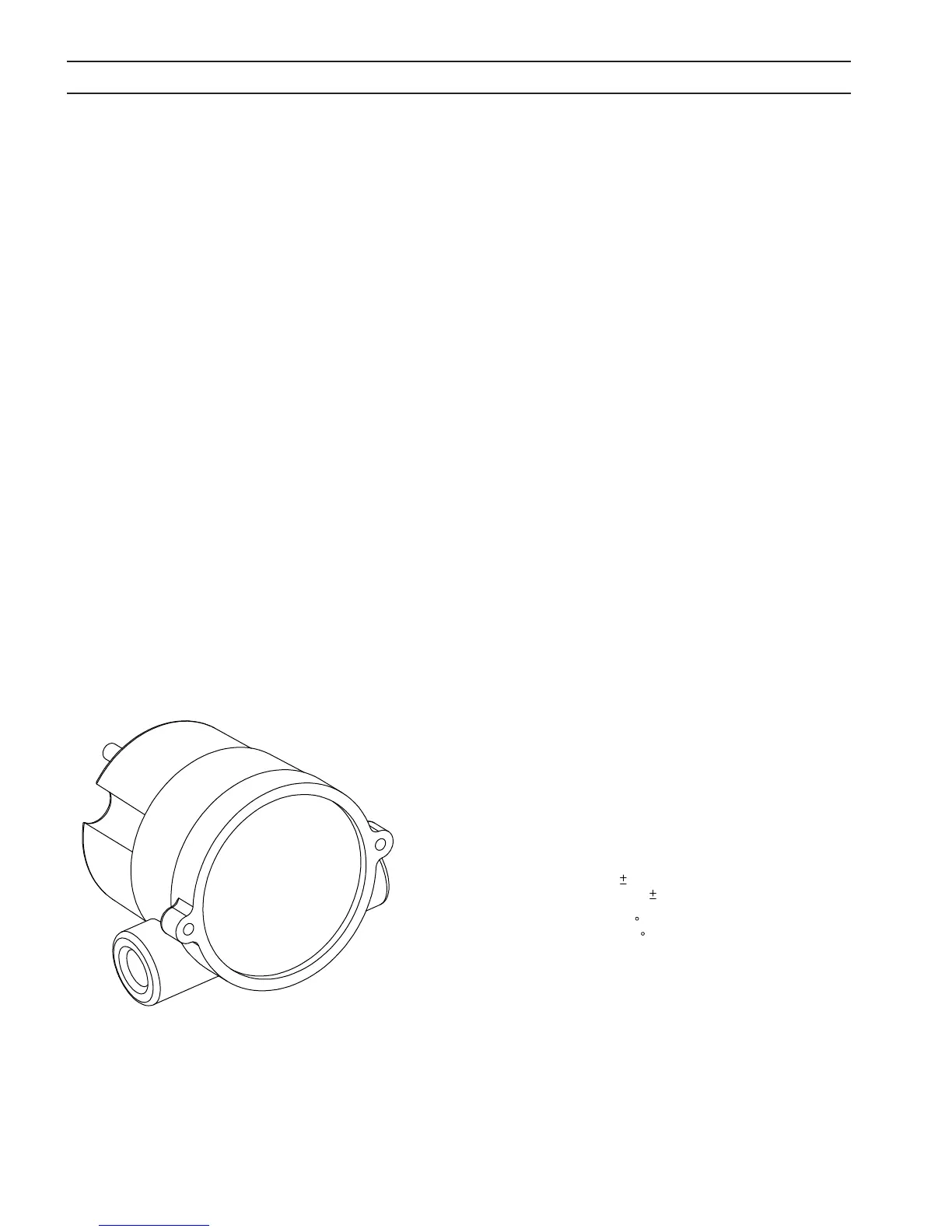
Operation: The rotor reacts to turbulence, pulsation, entrained air, and other ow anomalies induced in the ow
stream by other process hardware. For optimum performance, install RotorFlow units where nominal ow condi-
tions exist, with ports located at the top. Incoming ow may be placed to either port. A minimum of 8° of straight
pipe on the inlet side is recommended. Frequency output (RFO) is determined by the velocity of the monitored
uid acting on the sensor rotor. Input piping with an orice smaller than that of the sensor input will eect the
sensor output.
Installation: RotorFlow sensors connect to piping via NPT mating thread forms. The following guidelines are
provided to assist with installation for a leak-free seal, without damage to the unit:
1. Apply pipe thread sealant to male pipe threads.
2. Thread RotorFlow unit onto male pipe thread until hand-tight.
3. Tighten pipe 1 to 1-1/2 additional turns.
4. If improper seal results, continue turning pipe into unit in ¼ turn increments.
Recommended Pipe Sealants: (a) Permatex “No More Leaks” (b) Teon Thread Tape.
Filteration and Cleaning: 150 micron lteration is recommended. However, should foreign particles enter the Ro-
torFlow sensor, accumulation is easily cleared by removing the lens from the body. The lens is removed by turn-
ing its center rib 45° counter-clockwise and then pulling it out. To reinstall the lens, simply reverse the process.
Pressure must be relieved from the system prior to sensor clean-out.
5.3 Flow sensor




 





















































 
 

 
 






 
































































RotorFlow Sensor is used to monitor the ow rate of the coolant.
SECTION 5 MAINTENANCE

Related product manuals