ES441.1 - User’s Guide 63
ETAS Functional Description
5.10 Timeout (Monitoring the Input Signal)
The Timeout function enables the signals at the input channels to be monitored.
This time can be configured separately for each measurement channel in the
calibration software.
A check is carried out to see whether at least one signal change has taken place
within this time. If there is no signal change, no new measure values can be
determined. Depending on the measuring capability activated, the ES441.1
assigns fixed values to all sample values which follow in terms of time with the
Timeout function. They are transferred to the calibration software the next time
sampling takes place. These values are determined according to the measuring
capability.
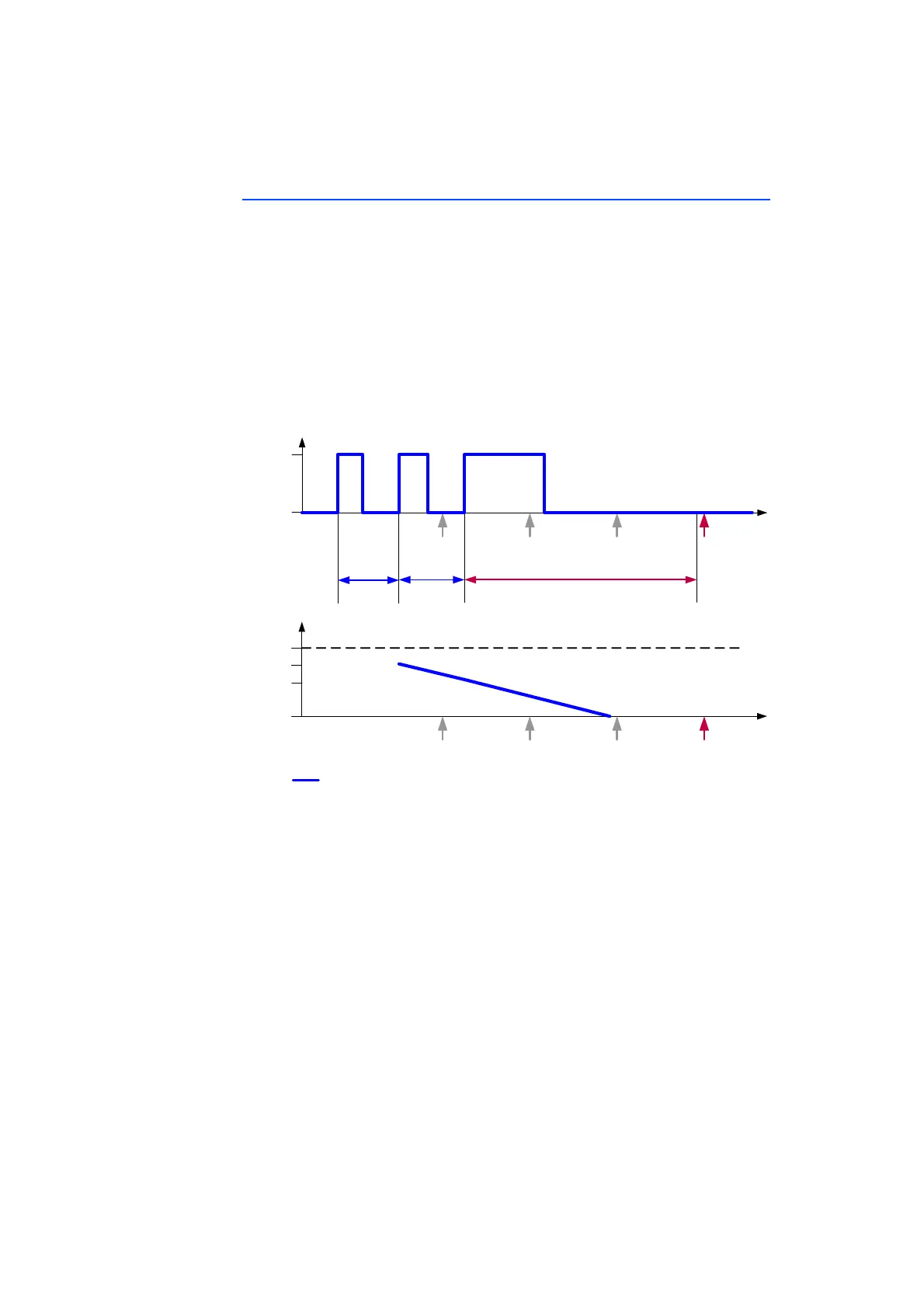
Fig. 5-31 Timeout
If the timeout of the ES441.1 has expired,
• the measured frequency (revolutions/min, velocity, flow, …) is set to zero,
• the duty cycle is set to 0% or 100% depending on the state,
• the active and inactive time of measurements of the state, period duration
or cycles are set to zero and
• the period duration is set to zero.
Frequencies whose period durations exceed the selected timeout cannot be mea-
sured.
The Timeout function is also used when the input signal is outside the measuring
range of the ES441.1.
Time
Input
Signal
Active
Inact ive
T
b
T
a
Tim eo u t Per io d
t
n+1
t
n+3
t
n
t
n+2
Input Frequency
Measured Frequency at Sample Point
f
0
Time
x
x
x
x
t
n
t
n+1
t
n+2
t
n+3
f
a
f
b
f
max
x



 To Next Page