8
3 Operating Principle
The Cable Locator consists of a transmitter
and a receiver. The signal generated by the
transmitter consists of a modulated current.
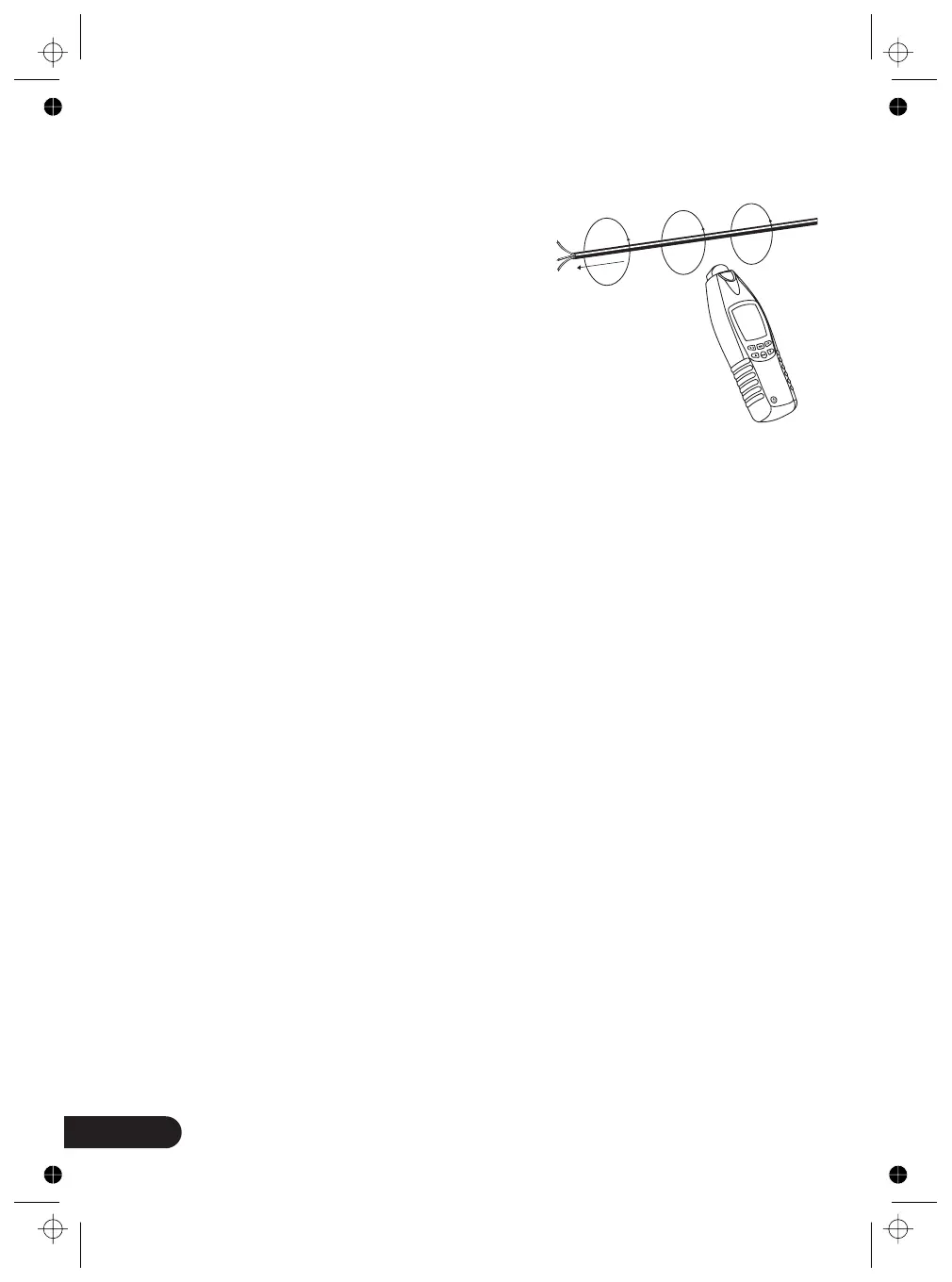
Generating a magnetic field around a conductor.
See figure 1. This electro-magnetic field
surrounding the conductor induces a voltage
within the receiver coils. For both automatic
and manual mode, the receiver works with
three coils and does, not depend on a position.
A selective and position-dependant search is
performed in selective mode with only one
active coil.
One-pole application: Connect the transmitter to only one conductor (one pole
application). In this operational mode, the transmitter is supplied by the built-in
battery. Due to the high-frequency signal generated by the transmitter, only one
single conductor can be located and traced. The second conductor is the ground.
This arrangement causes a high frequency current to flow through the conductor
and to be transmitted to ground, similar to a radio and receiver.
Double pole application: Connect the transmitter to the mains(double-pole
application). The transmitter is supplied by the mains. In this example, the
modulated current flows through the phase into the transformer and back through
neutral. There is a further possibility for voltage free systems by connecting the
transmitter to two line terminals while short-circuiting the other line ends. Thus
a complete circuit is created. Then, the transmitter is supplied by the built-in
battery.
The Cable Locator can only detect or locate lines, which are connected
correctly in accordance with the physical principle described.
3 1 Locator in complete circuits
Note:
.
figure 1



 To Next Page