17
Safety Equipment
• Electric Distress Light (Night use only)
The electric distress light is accepted for
night use only and must automatically ash
the international SOS distress signal. Under
“Inland Navigation Rules,” a high intensity
white light ashing at regular intervals from
50-70 times per minute is considered a
distress signal.
Sound Signaling Devices
The navigation rules require sound signals to be
made under certain circumstances. Recreational
vessels also are required to sound fog signals dur-
ing periods of reduced visibility. Therefore, you
must have some means of making an ecient
sound signal.
Navigation Lights
Recreational boats are required to display naviga-
tion lights between sunset and sunrise and other
periods of reduced visibility (fog, rain, haze, etc.)
Navigation lights are intended to keep other ves-
sels informed of your presence and course. Your
boat is equipped with navigation lights required by
the U.S. Coast Guard at the time of manufacture.
It is up to you to make sure they are operational
and turned on when required.
Navigation lights, if not functioning or illuminat-
ing to full intensity, should be replaced. When
replacing navigation lights, refer to manufacturer
specications for model specic lights. Naviga-
tion lights should be replaced with the same
specication light as installed and designed by
the manufacturer. If additional lights are installed
that were not designed by the manufacturer, they
cannot interfere with the visibility or function of
the navigational lights as per ABYC A-16.8.1.
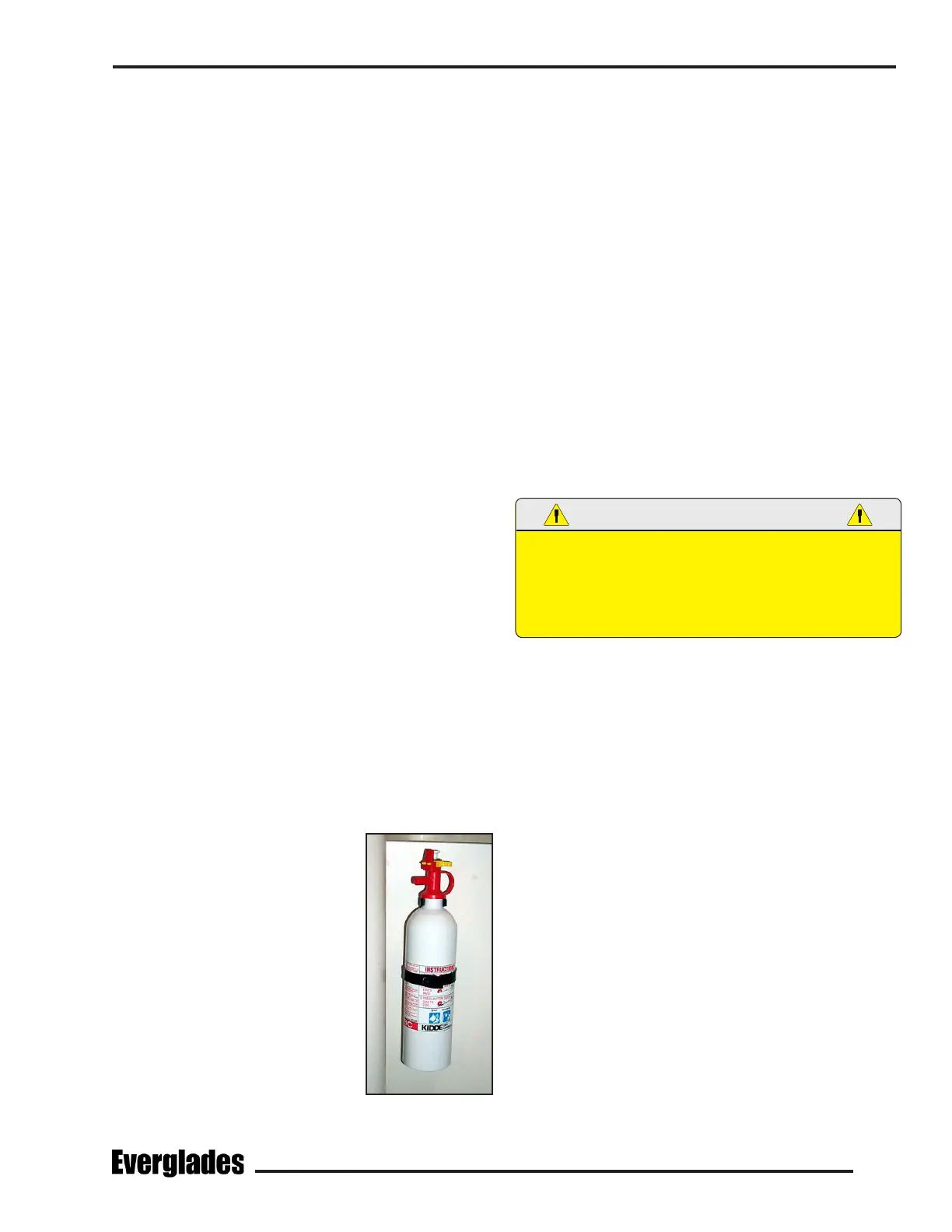
Fire Extinguishers
At least one re extinguisher
is required on all Everglades
boats. Coast Guard approved
fire extinguishers are hand-
portable, either B-I or B-II clas-
sication and have a specic
marine type mounting bracket.
It is recommended that the
extinguishers be mounted in a
readily accessible position.
Fire extinguishers require regular inspec-
tions to ensure that:
• Seals & tamper indicators are not broken or
missing.
• Pressure gauges or indicators read in the
operable range.
• There is no obvious physical damage,
corrosion, leakage or clogged nozzles.
Refer to the “Federal Requirements And Safety
Tips For Recreational Boats” pamphlet or visit the
U.S. Coast Guard Boating Safety web site, www.
uscgboating.org, for information on the type and
size re extinguisher required for your boat.
Please refer to the information provided by the
re extinguisher manufacturer for instructions
on the proper maintenance and use of your re
extinguisher.
INFORMATION FOR AGENT FE-241 AND FE-227 FIRE
EXTINGUISHERS IS PROVIDED BY THE MANUFACTURER. IT IS
ESSENTIAL THAT YOU READ THE INFORMATION CAREFULLY
AND COMPLETELY UNDERSTAND THE SYSTEM, IN THEORY
AND OPERATION, BEFORE USING YOUR BOAT.
1.6 Bilge & Fuel Fires
Fuel compartment and bilge res are very dan-
gerous because of the presence of gasoline in
the various components of the fuel system and
the possibility for explosion. You must make the
decision to ght the re or abandon the boat. If
the re cannot be extinguished quickly or it is
too intense to ght, abandoning the boat may be
your only option.
If you nd yourself in this situation, make sure all
passengers have a life preserver on, go over the
side and swim well upwind of the boat. This will
keep you and your passengers well clear of any
burning fuel that could be released and spread on
the water as the boat burns or in the event of an
explosion. When clear of the danger, check about
and account for all those who were aboard with
you. Give whatever assistance you can to anyone
in need or in the water without a buoyant device.
Keep everyone together in a group for morale and
to aid rescue operations.


 To Next Page