power tool to be forced in the direction opposite of the
wheel’s rotation at the point of the binding.
For example, if an abrasive wheel is snagged or pinched by
the workpiece, the edge of the wheel that is entering into the
pinch point can dig into the surface of the material causing
the wheel to climb out or kick out. The wheel may either jump
toward or away from the operator, depending on direction
of the wheel’s movement at the point of pinching. Abrasive
wheels may also break under these conditions. Kickback is
the result of power tool misuse and/or incorrect operating
procedures or conditions and can be avoided by taking
proper precautions as given below.
• Maintain a firm grip on the power tool and position your
body and arm to allow you to resist kickback forces.
Always use auxiliary handle, if provided, for maximum
control over kickback or torque reaction during start-up.
The operator can control torque reactions or kickback
forces, if proper precautions are taken.
• Never place your hand near the rotating accessory.
Accessory may kickback over your hand.
• Do not position your body in line with the rotating
wheel. Kickback will propel the tool in direction opposite
to the wheel’s movement at the point of snagging.
• Use special care when working corners, sharp edges etc.
Avoid bouncing and snagging the accessory. Corners,
sharp edges or bouncing have a tendency to snag the
rotating accessory and cause loss of control or kickback.
• Do not attach a saw chain, woodcarving blade,
segmented diamond wheel with a peripheral gap
greater than 10 mm or toothed saw blade. Such blades
create frequent kickback and loss of control.
• Do not “jam” the wheel or apply excessive pressure.
Do not attempt to make an excessive depth of cut.
Overstressing the wheel increases the loading and
susceptibility to twisting or binding of the wheel in the cut
and the possibility of kickback or wheel breakage.
• When wheel is binding or when interrupting a cut
for any reason, switch off the power tool and hold
the power tool motionless until the wheel comes to a
complete stop. Never attempt to remove the wheel from
the cut while the wheel is in motion otherwise kickback
may occur. Investigate and take corrective action to
eliminate the cause of wheel binding.
• Do not restart the cutting operation in the workpiece.
Let the wheel reach full speed and carefully re-enter the
cut. The wheel may bind, walk up or kickback if the power
tool is restarted in the workpiece.
• Support panels or any oversized workpiece to minimize
the risk of wheel pinching and kickback. Large
workpieces tend to sag under their own weight. Supports
must be placed under the workpiece near the line of cut
and near the edge of the workpiece on both sides of the
wheel.
• Use extra caution when making a “pocket cut” into
existing walls or
other blind areas. The protruding wheel may cut gas or
water pipes, electrical wiring or objects that can cause
kickback.
• Wear a dust mask. Exposure to dust particles can be
harmful to your health and make it dicult to breath. Use a
dust extraction system and wear a suitable protective mask.
• Wear noise protection. Exposure to high volumes of noise
may cause hearing damage.
• Do not use any abrasive wheels.
• Use only saw blades that comply with the characteristics
specied in this manual.
• Use only saw blade diameter(s) in accordance with the
markings.
• Use only saw blades with a speed marking that is higher
than or equal to the speed marked on the tool.
• Use only saw blades recommended by the manufacturer.
RESIDUAL RISKS
Even with application of safety standards and using the
tool as prescribed, certain residual risks can remain:
• Risk of personal injury due to prolonged use.
• Risk of injury caused by dust.
• Risk of injury caused by flying objects.
• Risk of burns due to accessories becoming hot.
• Risk of electric shock due to cutting through electric
cables. When cutting through floors, ceilings of walls
ensure there are no hidden cables or water pipes.
CLEANING AND MAINTENANCE
WARNING: Disconnect the tool from the power source
before any adjustments, cleaning, or maintenance is carried
out.
• Use compressed air to blow dirt out of the main housing
air vents and the blade guard. Wear approved eye
protection and a dust mask.
• Use a cloth dampened with water to clean the other
areas of the tool. Never use solvent based or harsh
chemicals of any type as this may weaken, damage or
destroy plastic components.
• Do not attempt to modify the tool or accessories in any
way.
• When servicing only use Evolution original parts and
carried out by a qualified person.
NOISE WARNING
WARNING: The noise emissions during actual use
of the power tool can dier from the declared values
depending on the ways in which the tool is used especially
what kind of workpiece is processed.
WARNING: The need to identify safety measures to
protect the operator that are based on an estimation of
exposure in the actual conditions of use (taking account of
all parts of the operating cycle such as the times when the
tool is switched o and when it is running idle in addition
to the trigger time).
The declared noise emission value(s) have been measured in
accordance with a standard test method and may be used for
comparing one tool with another. The declared noise emission
value(s) may also be used in a preliminary assessment of
exposure.
ENVIRONMENTAL PROTECTION
Waste electrical products should not be disposed
of with household waste. Please recycle where
facilities exist. Check with your Local Authority or
retailer for recycling advice.
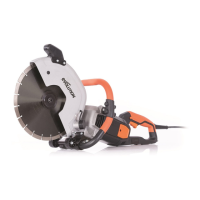
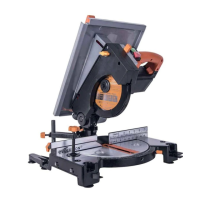
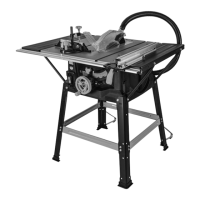
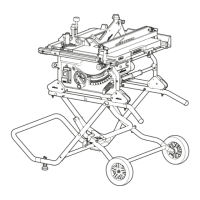
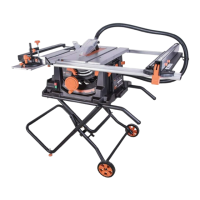
PRODUCT OVERVIEW KEY
A. Safety lock button
B. Trigger switch
C. Multi-tool
D. Cutting disc
E. Blade guard
F. Dust extraction port*
G. Wheeled cutting aid
H. Blade lock
I. Dust suppression**
J. Water control valve**
K. Water control electrical valve (R14DCT only)
EN





 To Next Page