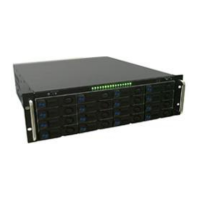
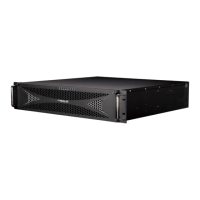
A RAID50 volume is a single volume which is striped across multiple
TerraBlock Servers or TX16 Expansion Chassis’. This multi-device striping
provides increased performance when accessing the RAID50 volume. RAID50
volumes are also referred to as ‘external tandem’ volumes due to their being
striped across multiple physical Facilis devices.
RAID50 uses the same storage-saving compression algorithm as RAID5 and
like RAID5, in the event of an individual physical drive failure, the RAID50
parity data is read in real-time from the parity information contained on the
remaining drives.
If a volume is created with RAID50 protection and one of the individual Facilis
devices becomes unavailable, the RAID50 volume will be unavailable to users
until the individual Facilis device (TerraBlock Server or TX16 Expansion
Chassis) is restored to operation.
A RAID51 volume is a single volume which is then mirrored across multiple
TerraBlock Servers or Facilis TX16 Expansion Chassis’. RAID51 volumes have
additional protection on top of the existing RAID5 Parity protection. If the
physical device (TerraBlock Server or TX16 Expansion Chassis) containing the
mirrored data becomes unavailable, the RAID51 volume will still be
mountable as ‘Read-only’ on the primary TerraBlock Server and the data
contained on the RAID51 volume will still be accessible.
RAID51 volumes are also referred to as ‘external tandem’ volumes, due to
their being mirrored across multiple Facilis devices.
RAID51 uses the same storage-saving compression algorithm as RAID5 and
like RAID5, in the event of an individual physical drive failure, the RAID51
parity data is read in real-time from the parity information contained on the
remaining drives.
RAID Descriptions
Mirrored Volumes:
In a 24D (24 drive) unit, a mirrored volume uses 2 groups even when a single group
is selected during creation.
A Mirrored volume created on group 1 will use group 2 for its mirror; a Mirrored
volume created on group 2 will use group 1 for its mirror. To create a Mirrored
volume on a given group, the alternate group must have enough free space available
as well. On the 24EX (12 drive) and 8D / 8XS (8 drive) units, the mirror occurs
within the same 8 or 12 drive group, so remaining space must be 2 x the intended
capacity of the volume.
RAID5 Volumes:
A RAID5 volume may be created on a single group, with parity (RAID5) data written
on the same group the volume is created on. To create a RAID5 volume on a single-
group system (8D, 8XS, 24EX), that group must have enough remaining space for
the capacity of the volume, plus 9% of the capacity of the volume for parity
information. On a 24D, 9% of the volume capacity must be available on the group
where the volume is being created.


 To Next Page