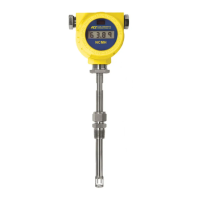
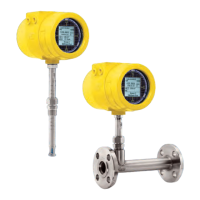
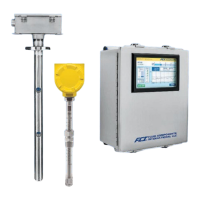
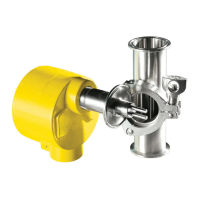
ST75/ST75V Mass Flow Meter Fluid Components International LLC
This page is subject to proprietary rights statement on last page
11
06EN003368 Rev. G
Application Verication
After verifying that the ow meter is functioning, review the application parameters as shown below to verify the calibration matches
the process media.
Equipment Needed
Flow Instrument Calibration Data
Process Parameters and Limits
Check Serial Numbers
Verify that the serial number of the ow element and the ow transmitter electronics are the same. The ow element and the ow
transmitter are a matched set and cannot be operated independently of each other.
Check the Instrument Installation
Verify correct mechanical and electrical installation. Verify the ow element is mounted at least 20 diameters downstream and 10
diameters upstream from any bends or interference in the process pipe or duct.
Check for Moisture
Check for moisture on the ow transmitter. Moisture may cause intermittent operation. Check for moisture on the ow element. If a
component of the process media is near its saturation temperature it may condense on the ow element. Place the ow element where
the process media is well above the saturation temperature of any of the process gases.
Check Application Design Requirements
Application design problems may occur with rst time application instruments, although the design should also be checked on
instruments that have been in operation for some time. If the application design does not match eld conditions, errors occur.
1. Review the application design with plant operation personnel and plant engineers.
2. Ensure that plant equipment such as pressure and temperature instruments conform to the actual conditions.
3. Verify operating temperature, operating pressure, line size, and gas medium.
Verify Standard Versus Actual Process Conditions
The ow meter measures the mass ow rate. The mass ow rate is the mass of the gas owing through a pipe per time. Other ow meters,
such as an orice plate or a pitot tube, measure the volumetric ow rate. The volumetric ow rate is the volume of gas per time. If the
readings displayed do not agree with another instrument, some calculations may be necessary before comparing them. To calculate the
mass ow rate, the volumetric ow rate, and the pressure and temperature, the point of measurement must be known. Use the following
equation to calculate the mass ow rate (Standard Volumetric Flow rate) for the other instrument:
Equation:
(Metric: Where bar(a) and °K are
Where: used for pressure and temperature.)
Q
A
= Volumetric Flow Q
S
= Standard Volumetric Flow
P
A
= Actual Pressure T
A
= Actual Temperature
P
S
= Standard Pressure T
S
=
Standard Temperature
PSIA and °R are used for pressure and temperature units.
Troubleshooting
Example: (Metric: P
S
= 1.01325 bar(a)
Q
A
= 1212.7 ACFM Q
S
= 1485 SCFM T
S
=
21.1°C (294.1K))
P
A
= 19.7 PSIA T
A
= 120 °F (580 °R)
P
S
= 14.7 PSIA T
S
= 70 °F (530 °R)
Q Q
S A
= × ×
P
T
T
P
A
A
S
S
(
1212.7 ACFM
1
)
(
19.7 PSIA
580 °R
)
(
530 °R
14.7 PSIA
)
= 1485 SCFM


 To Next Page