INSTRUCTION MANUAL
. . . . . . . . . . . . . . . . . . . . . . . . . . . . . . . . . . . . . . . . . . . . . . . . . . . . . . . . . . . . . . . . . . .
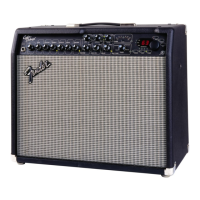
.............................................Cyber-Twininsights
51
We took the liberty of slightly modifying the Tweed tone stack. The original’s bass control “came up” very quickly.
Once turned higher than about 6 out of 12, there was no apparent difference in the bass response, but the
increase of inaudible low bass robbed the amp of audible power. The modification spreads out the useful range
of the bass control, but changes nothing else. This is similar to what we did in the Fender HR series (1996):
Blackface tone controls, unlike the British and Tweed controls, go silent when they are all turned all the way
down. This is because the mid control is wired differently. When translated into Virtual Tone Interpolation
™
(VTI), the Blackface tone controls in the Cyber-Twin do the same:
What are the “Modern” tone controls? There is no diagram, because they’re brand new along with VTI.
They’re like Baxandall tone controls with a mid control, but not really. They’re optimized for guitar, yet they can
go where traditional tone stacks can’t. They’re capable of everything from settings like an extreme mid-
scooped sound (or a mid mountain!) to hi-fi flat.
There’s more to tone, however, than tone stacks. The location of a tone stack in the circuit makes an
astounding difference in the sound of an amplifier, even when the amp is played “clean”. You can demonstrate
this by switching the Cyber-Twin’s tone stack location from pre-distortion to post-distortion without changing
anything else.
Also, there are many drive (distortion) types that have been used. The Cyber-Twin has 12 tube and 4 solid-
state drive types, ranging from the clean Blackface Tube 1 (which uses tubes!) to the super-sustain Dyna-
Touch 4 (solid-state). The vacuum tube drive types “Blackface” and “Hot Rod” use a common cathode gain
stage to set the dominant distortion characteristic. The “Tweed” and “HMB” vacuum tube drive types use a
common plate cathode follower to set the dominant distortion characteristic. Both types of tube distortion are
widely used to this day. By the way, in case you’re wondering, the drive type “HMB” stands for “Her Majesty’s
Bassman”.
Because of tone stack types, tone stack location, drive types, and a Dyna-Touch guitar power amplifier section,
the Cyber-Twin has the ability to “become” just about any amplifier, not just model it. This is one reason why
we say “Innovate
…
Don’t Emulate”
™
Matt Wilkens, Principal Engineer
Tweed Tone Stack used
in the Cyber-Twin
Later Production
1959 Fender Bassman
5F6-A Tone Stack
Blackface Tone Controls




 To Next Page

