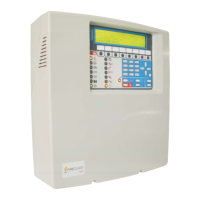
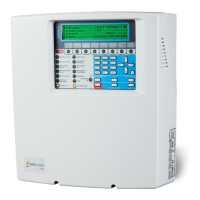
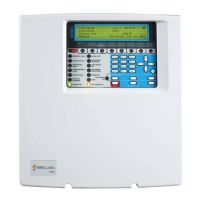
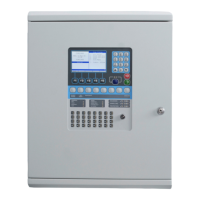
This document, the "Fault Finding Guide," provides a comprehensive overview of fault states and troubleshooting procedures for FIRECLASS Addressable Fire Alarm Control Panels running Firmware version 25. It details how the system reports faults, categorizing them into "pseudo points" for internal system conditions and "standard points" for issues with connected devices.
Overview of Fault Reporting
The FIRECLASS system utilizes two primary methods for fault reporting:
- Pseudo Points: These are specific points within the system dedicated solely to reporting internal fault conditions. They are activated when a monitored event occurs and may clear automatically after a predetermined time or when the monitored condition resolves. Pseudo points are organized by the system region they monitor, such as Field Interface Module (FIM) pseudo points, RBUS pseudo points, Network Card Fault pseudo points, Network Node pseudo points, and COM port pseudo points.
- Standard Points into Fault: The system can also report faults on regular points associated with devices. This involves placing the device's point into a special fault condition, distinct from a standard point activation. The software driver assigns different fault types, such as "NO RESPONSE" or "RELAY STUCK," depending on the specific issue with the monitored device. The underlying cause of these fault states is not directly visible to the FIRECLASS Express user.
FIM Pseudo Points
The Field Interface Module (FIM) pseudo points, reported as 'Pn' (where 'n' is the point number), indicate various internal FIM conditions. These include:
- Data Packet Error (P1): Indicates that required point command processing could not be completed, and at least one output point was not updated.
- FIFO Full (P2): Raised when the panel firmware reaches an internal limit and cannot perform a required action due to configuration complexity. This suggests checking general processing options for multiple causes linked to alarm processing.
- LNET Data Path Flt (P4): Signifies that a required Network Broadcast of events could not be completed, rendering the network unreliable until it re-synchronizes after a "Fire Reset."
- Configuration Store (P6): Activated if the panel's configuration checksum does not match the stored data, indicating a potentially corrupt configuration. This triggers a shutdown and locks the panel into a 'safe state.'
- FIM Comms Failed (P7): Raised if the SPI channel is held busy by the slave processor (FIM Local I/O) for over a second. It clears when communication resumes.
- Loop A Failed to Loop D Failed (P8-11): Similar to P7 but specifically monitors loop SPI channels. Also raised if a slave loop card is not fitted.
- FIM Bad Packet (P25): Raised if three consecutive corrupt data packets are received from the FIM local I/O processor via the SPI link. It self-clears after 10 seconds.
- FIM Fault (P26): Activated if the FIM Local I/O chip reports a health status indicating a fault (e.g., RAM or firmware checksum issues). Clears when the health report is OK.
- MP ROM Fail (P27): Raised if the firmware's checksum doesn't match stored values, leading to a 'safe state' restart in a 'locked' condition.
- MP System RAM (P28): Activated if RAM checks reveal read/write problems, also leading to a 'safe state.'
- Battery Low (P31): Activated if the battery voltage drops below a threshold. Clears when voltage recovers.
- RBus Circuit Fault (P32): Raised if faults are detected on all RBus nodes except zero, triggering a relay to isolate RBus 0 communications. Clears only on Fire Reset.
- Stack Overflow (P33): Activated if task stacks are near full, and does not clear.
- System Heap Error (P34): Activated if the system 'heap' area of RAM is corrupt, and does not clear.
- Local I/O F/W (P40): Raised if firmware on the FIM Local I/O chip and the main firmware are incompatible.
- Panel Incompatible (P41): Raised if the panel hardware is a restricted model but configured for a full product.
- Inhibit Sound LED (P44): Set if all sounder devices are isolated, preventing the sounder LED on the front panel from activating.
- Commissioning (P45): Raised if any commissioning states are active.
- Download Required (P46): In network configurations, raised if panel core functionality details differ across panels, potentially preventing a full upload.
- Test Equipment (P47): Activated when FIRECLASS Checker is connected.
- Walktest Outputs (P48): Activated when an output test is started from the panel user interface.
- Force Day Mode (P54): Activated to return the panel to day mode after a panel restart if it was in day mode.
- Isolation For Test (P56): Activated if the menu option to isolate non-LED outputs is selected.
- FCExpress Download (P58): Activated during a download from Express.
- FCExpress Upload (P59): Activated while Express is reading a configuration.
- Inhibit No Response faults (P60): During commissioning, prevents reporting of 'no response' faults for missing devices at restart.
- Config File Fail (P61): Activated during a download from Express.
- Stage 1 Image Fail (P62), Stage 2 Image Fail (P63), App. Image Fail (P64): Indicate failures in regular checks of boot loader stages or main panel firmware.
- X501 Service Mode (P65): Activated if the Service mode link on the CPU801 is fitted at panel restart.
RBUS Node Pseudo Points
RBUS node pseudo points, reported as 'RBnn.Pmm' (where 'nn' is the node number 0-15 and 'mm' is the point on that node 1-8), indicate faults within specific RBUS display or output modules. These include:
- MPIM Display Fail (P1): If configured as a display module, indicates a problem with the link to the LCD module.
- MPIM ROM Fail (P2): Raised if the MPM's firmware checksum in ROM is incorrect.
- MPIM RAM Fail (P3): Activated if RAM byte checks reveal read/write problems.
- Bad packet (P6): Indicates a corrupted data packet.
- MultiCast Seq Err (P7): Raised if a sequence identifier indicates a lost multicast packet, automatically clearing within 60 seconds.
- Char CHIP CSum Err (P8): If configured as an OCM, raised if the character set EEPROM data checksum is incorrect.
RBUS Node Faults (Presence/Absence)
These faults, reported as 'RBnn' (where 'nn' is the node number 0-15), indicate issues with the presence or absence of complete RBUS nodes.
- RBUS Fault (P0-15): Used by the RBUS or COMMS driver to indicate loss of configured nodes, presence of unconfigured nodes, or other fault states like 'F/W INCOMPATIBLE.' Logged event text provides more details, such as 'NO RESPONSE' or 'UNCONFIGURED DEVICE.'
Network Card Fault Pseudo Points
Network Card Fault pseudo points, reported as 'TLI Pnn' (where 'nn' is the point number 01-11), are assigned to the network card and configured via the 'Site Details' dialog in Express.
- Net Card Common (P1): An 'OR' of all other network card faults. It becomes true if any other fault condition is true. It's often disabled to avoid redundant messages.
- Net Card Left (P2): Raised if the TL1800EN Network Interface Module detects a short or open circuit on its left network port. Can be disabled if the network is wired as a spur.
- Net Card Right (P3): Raised if the TL1800EN Network Interface Module detects a short or open circuit on its right network port. Can be disabled if the network is wired as a spur.
- Net Card Ground (P4): Raised if the TL1800EN Network Interlace Module detects a ground fault.
- Net Card Data Trans (P5): Generated on Node to Node transfers that do not receive acknowledgements.
- Net Card Ring Cont (P6): Raised when a transmitting panel doesn't receive its transmitted message back on its opposite channel within the required time. Enabled only for ring topologies.
- Net Card Comms Fail (P7): Raised when a network card cannot communicate with other network cards.
- Net Card F/W (P8): Indicates network card firmware incompatibility with panel firmware.
Network Node Pseudo Points
These faults, reported as 'Net nnn' (where 'nnn' is the panel node number), relate to the presence or absence of panel nodes.
- Network Node (P1-99): Used by the supervisor panel to indicate panels not responding to supervision or reporting a lack of supervision.
COM1 Pseudo Points
COM1 pseudo points, reported as 'COM1', relate to the printer connection.
- Printer Comms (P1): Activated if a printer is configured but not connected to the panel.
COM2 Pseudo Points
COM2 pseudo points, reported as 'COM2', relate to the FIRECLASS Remote port configuration.
- Comms Fault (P1): Reports a fault if packet retries exceed the maximum number (100).
COM3 Pseudo Points
COM3 pseudo points, reported as 'COM3', relate to the network card connection.
- Comms Fault (P1): Reports a fault if packet retries exceed the maximum number (100).
Loop Pseudo Point
The Loop pseudo point, reported as the loop letter, indicates various loop-wide conditions.
- Loop Status (P1): Provides information on loop shutdown, open or short circuits, unconfigured devices (if at address 255), firmware incompatibility, and polling errors.
General Fault Overview (Standard Point Fault States)
This section lists common fault states for standard points on devices:
- ALARM CTRL FAULT: Raised on 410SNM devices configured as an Alarm Control if auxiliary voltage is absent.
- ALARM CTRL NO RESP: Raised on 410RIM and 410SNM if configured as alarm control units.
- ALARM CTRL OPEN CCT: Raised on 410SNM devices if configured as an Alarm Control and the supervised output is open.
- ALARM CTRL SHRT CCT: Raised on 410SNM devices if configured as an Alarm Control and a short circuit is present on the supervised output.
- ALARM CTRL STUCK: Raised on 410RIM and 410SNM devices if the relay cannot be switched to the required state.
- AUTO TEST FAILED: Raised if a device's self-test fails, indicating the device should be replaced.
- AUX. VOLTAGE FAULT: Raised by 410TSM, QIO, and QRM devices if auxiliary voltage drops below 21V (or 14.5V for 'Low Voltage detectors only').
- BEACON FAULT: Raised if beacon monitoring on an LPAV device indicates a fault.
- BEAM FAULT: Raised if the Beam Detector Module detects a FIRERAY fault.
- CALIBRATION FAULT: Raised on loop devices if the factory calibration value is outside the expected range, making the device unusable.
- CALLPOINT ACTIVE: Raised by a 410DDM in 'Fast CallPoints' mode if callpoints are activated but isolated, preventing detection of active conventional detectors.
- CO ELEMENT FAULT: Raised on PC detectors if the CO sensor part fails.
- CONTACT WIRING OPEN: Raised on 410MIM, 410SIO, 410TSM, and QIO devices if the supervised input is open.
- CONTACT WIRING SHRT: Raised on 410MIM, 410SIO, 410TSM, and QIO devices if a short circuit is present on the supervised input.
- DET LTA HI WARNING: Raised if the photo detector dirtiness is 80% or more (with Condition Monitoring enabled). The detector is still working but should be replaced.
- DET LTA LO WARNING: Raised on photo devices (with Condition Monitoring enabled) if LTA falls below the warning threshold. The detector is still working but should be replaced.
- DETECTOR REMOVED: Used by 410DDM when monitoring conventional devices with a diode base.
- DEVICE FAULT: A general fault when a device is present and replying but indicates an error that cannot be more specifically categorized.
- DEVICE POWER UP: Cleared after device initialization if a loop device was removed and re-inserted.
- DISABLED FOR TEST: Logged if non-LED outputs are isolated by the user, placing the panel in Commissioning Mode.
- DOOR CTRL FAULT: Raised on 410SNM configured as a door control if auxiliary voltage is absent.
- DOOR CTRL NO RESPNS: Raised by 410RIM and 410SNM units configured as door control units and not responding to polls.
- DOOR CTRL OPEN CCT: Raised on 410SNM or 410QMO configured as a door control if the supervised output is open.
- DOOR CTRL SHORT CCT: Raised on 410SNM or 410QMO configured as a door control if a short circuit is present on the supervised output.
- DOOR CTRL STUCK: If the monitored contact is stuck on a 410RIM or 410SNM, the relay cannot be switched.
- EXT PSU LOST: Reported by 410DIM and 410DDM if external power supply problems exist.
- EXT. CTRL FAULT: Raised on 410SNM devices configured as an Extinguishing Control unit.
- EXT. CTRL NO RESPNS: Raised on 410SNM if configured as Extinguishing control (LAV800 raises general fault 'No Response').
- EXT. CTRL OPEN CCT: Raised on 410SNM devices if configured as an Extinguishing control unit and supervised output is open.
- EXT. CTRL SHORT CCT: Raised on 410SNM devices if configured as an Extinguishing control unit and a short circuit is present on the supervised output.
- EXT. CTRL STUCK: Raised on 410SNM devices if configured as an Extinguishing control unit and the relay cannot be switched.
- F/W INCOMPATIBLE: Indicates incompatibility between main panel firmware and support chip firmware.
- H/W ISOLATOR AUTO: Raised by devices with monitored internal line isolators (410DDM, 410TSM, 'Q' devices) if the internal isolator is activated.
- HIGH CURRENT: Raised by 410DDM in 4-20mA mode if measured current is higher than expected.
- HI T.TERM AVG FAULT: Raised if photo detector dirtiness is 100% (with Condition Monitoring enabled). Detector is working but should be replaced.
- GENERAL FAULT: Raised by 410DDM if measured current is below expected range.
- LATE POLL: Raised if a device's last poll time is outside a tight timescale. Clears when polling is within parameters.
- LOOP FAULT SHUTDOWN: Raised on the loop pseudo point if the loop is shut down.
- LOOP O/C FAULT: Raised on the loop pseudo point if an 'Open Circuit' is found due to open loop polling.
- LOOP S/C FAULT: Raised on the loop pseudo point if the loop processor detects higher than expected loop current.
- LOW TEMPERATURE FLT: Raised on PC detectors if the temperature sensor fails or environmental conditions are below -20°C.
- MULTIPLE DEVICES: Indicates more than one device replying to the polled address. Detected only during the 120-second loop initialization after a panel restart. Cleared by panel restart.
- NET NO SUPERVISION: Raised if a networked panel fails to receive the regular supervision poll.
- NO RESPONSE: A general fault state if a configured device does not respond to a poll (loop device, RBus unit, or panel not responding to network supervision).
- OPTICAL ELEMENT FLT: Raised on PC detectors if the optical sensor fails.
- OVERLAPPING DEVICES: Raised if a second physical device is on the loop at an address covered by a multi-IO device.
- PERFORMANCE FAULT: Used by 410DDM when monitoring a 4-20mA device, related to processing bands configured in Express.
- POLLING ERROR: Similar to 'Late Poll,' raised if a point has not been polled within a time window.
- POWER WIRING OPEN: Used for 410BDM, raised if the device detects a supply open circuit.
- POWER WIRING SHORT: Used for 410BDM, raised if the device detects a supply short circuit.
- RELAY COIL FAULT: Used for fault reporting on sounder circuits and the alarm relay on the FIM.
- RELAY OR SDR STUCK: Used on 410SNM, 410SIO, 410MIO, 410QMO, 410QRM, and 410TSM devices if the relay cannot be switched.
- SIGNALLING FAULT: Raised for supervised digital inputs if set for signalling operation.
- SINGLE POINT POLL: Logged with the point address if the user polls a single device, placing the panel in Commissioning Mode.
- SOUNDER FAULT: Used to report faults on sounders, AV devices, AV Bases, 410SNM, and FIM sounder circuits. Could be due to absent auxiliary voltage.
- SOUNDER LINE OPEN: Used to report faults on sounders, 410QMO, and 410SNM if the supervised output is open.
- SOUNDER LINE SHORT: Used to report faults on sounders, 410QMO, and 410SNM if a short circuit is present on the supervised input.
- SOUNDER NO RESPONSE: For sounder and AV devices, and 410SNM configured as DC sounders or AC speakers. Not raised if the device not responding has a sounder base.
- TEMP TOO LOW CO FLT: Raised on PC detectors during short periods (< 10h) of low temperature operation (-10°C to -20°C).
- UNCONFIGURED DEVICE: A general fault state if a device responds to polls but was not configured by EXPRESS or the panel menu.
- WIRING FAULT: Raised if one of the FIM sounder circuits configured as a 'general' output detects an open or short circuit.
- WIRING O/C FAULT: Indicates the supervised input is open.
- WIRING S/C FAULT: Applies to 410CIM, 410DIM, 410BDM, 410MIO, 410DDM, and 410SIO devices, indicating a short circuit on the supervised input.
- WRONG CHAR SET CHIP: Raised if the OCM does not contain a character set chip supporting the panel's codepage.
Network Card Fault Handling
The TL1800EN LEDs provide visual indications of network card status:
- Yellow LED (ON): Emergency CPU Fault or Main CPU Fault.
- Green LED (Flashing): Emergency CPU or Main CPU running normally.
- Red LED (Pulsing): Network Tx Right, Network Rx Right, Network Tx Left, Network Rx Left. At high baud rates, they appear ON.
CPU Fault LEDs are hardware watchdog circuit outputs. If a CPU Fault is indicated, the watchdog holds the CPU in reset until the reset button is pressed.
Comms Fault
"Comms Fault" indicates a problem between the panel and the TL1800EN card.
Actions:
- Check the cable connection between the TL1800EN card and FIM COM3.
- Verify the TL1800EN has a power supply and that CPUs are running (Status LEDs).
- Check that TL1800EN Dip Switch settings for 'Host interface baud rate' match Fireclass Express, Panel Details dialog.
Open or Short Circuit - Left/Right
These faults indicate an open or short circuit from a panel to an adjacent panel on the left or right network port. Applies to FOM800 connections.
Action:
- If the network is wired as a Bus, ensure end nodes are set in Express and SW1-6 is ON.
Network Ground Fault
'Net Card Ground' indicates an earth fault on the TL1800EN connected to the panel.
Network Card Data Transfer Fault
Data transfer faults arise from failures to obtain correct network acknowledgements for transmitted data (e.g., network supervision reply).
Ring Continuity
"Net Card Ring Cont." indicates that a transmitting panel is not receiving its transmitted message back on its opposite channel within the required time. This fault is enabled only for ring topologies.
Action:
- In Network Bus topologies (SW1-6 = ON), this fault is automatically disabled.
Net Card Comms Fail
Comms fault reported from the TL1800EN to the panel.
Causes:
- Link issues between Emergency CPU and Main CPU (if Emergency CPU Fault LED = ON).
- Link issues between Emergency CPU and Emergency Display (if used, SW2-2 = ON).
- Link issues between Main CPU and local panel (used when other traffic is absent to retry serial communications).
Action:
- Check the connection to the TL1800EN card.
Network Traffic Diagnostics
Version 22.0 and later firmware provides a panel menu option (7-Service > 3-Diagnostics > 8-Net Card Info) to print network statistics. These statistics help assess network performance and pinpoint noisy interference or intermittent faults. Key figures include:
- Monitored Network Fault Events: State of all monitored network fault events.
- Next Active Logical Address.
- Source of 'Flow Control = On'.
- Left/Right Port: Good Messages, Serial Errors, Incomplete Messages, Checksum Errors.
- Packet Counts: Sent, Received.
- Seconds Count: 'Count Up Time' (time since figures reset) and Full Up Time (time since network card restarted).
- Analogue Measurements: Left ADC, Right ADC, and Network Ground. These 10-bit average values help detect partial open/short circuits and earth leakage faults.
- Fault Thresholds: OPEN CIRCUIT FAULT (12F or less), SHORT CIRCUIT FAULT (281 or greater), GROUND LEAKAGE FAULT (26C or less).
- Clearing Thresholds: Left/Right readings within 134 to 27D, Ground readings above 28B.
High Level Checks (Network)
- Ensure all network cards are connected L to R in a ring network.
- Verify the TL1800EN host interface baud rate matches the Fireclass Express -> Panel Details dialog.
- Confirm the network card has been reset after downloading an updated network configuration.
- Update network parameters if a Graphics system is on the network.
- If the network card was previously connected to a different host panel, perform a SW1-7=ON reset (or address 127 reset) to erase old data.
- Check network cables for required resistance and capacitance values as specified in the TL1800EN Fixing Instructions.
- Ensure network cables are screened and correctly connected to a clean earth.
- Route network cables away from power and data cables to avoid interference.
Wiring Reminders
This section provides a summary of End-Of-Line (EOL) and Alarm Resistors for various modules. Refer to individual device documentation for full information.
- 410MIM: EOL 200Ω / Alarm 100Ω
- 410MIO: EOL 330Ω / Alarm 150Ω
- 410DDM: EOL 4k7 / Alarm 560Ω
- 410QIO: EOL 3k3 / Alarm 680Ω
- 410QMO: EOL 27k
- 410TSM: EOL 3k3 / Alarm 680Ω
- 410SNM: EOL 27k Note: 0.5w
- 410SIO: EOL 3k3 / Alarm 680Ω
- SB520: EOL 270Ω Note: 6w
- FIM 801/2: Sounder EOL 2.7k, Supervised I/P EOL 10k / Alarm 2k
- RBus: Terminate 150Ω at FIM and 120Ω at last device on Bus
- 410CIM: EOL 200Ω / Alarm 100Ω
- 410DIM: EOL 4k7
System Fault
The FIRECLASS panel provides visible and audible indications for 'System Fault' to comply with EN54.
- Visual Indication: The "System fault" LED on the front door is driven by a latching circuit that turns on the LED and pulses the buzzer when triggered. To clear the LED and silence the buzzer, use the push button on the back of the board.
- Hardware Trigger: The latching circuit is a wired OR'ed connection of all system processors' watchdog drives. If any processor resets, a "System Fault" is indicated. The LED cannot pinpoint which specific peripheral processor reset, but the main CPU reset can be logged.
- Software Triggers: The panel firmware can generate a "System Fault" under extreme circumstances, categorized into two levels:
- Partial Operation: The panel is partially functioning (e.g., if the front cover display test fails, leading to a corrupt or non-existent display).
- Safe State: The system stops running and is held in a "Safe State" under conditions like Firmware Boot ROM Checksum failure, Firmware RAM test failure, Firmware FLASH test failure, Configuration FLASH test failure, or Configuration RAM test failure. If these conditions occur, the system writes a signature to Non-Volatile memory, resets via watchdog timeout (causing a "System Fault" indication), and halts upon restart after reading the signature ID.
Recovery From Safe State
To clear the system state and recover from "Safe State":
- Fit header link H2 on the CPU card.
- Reboot the system and wait at least 30 seconds.
- Remove header link H2 and reboot the system.

 Need help?
 General

 To Next Page