22 Fault Finding Guide Doc. version 2
6 System Fault FIRECLASS Fire Alarm Control Panels
6 System Fault
6.1 Overview
Within the FIRECLASS panel there are both visible and
audible indications for ‘System Fault’, which are
required for compliance with the EN54 standard. This
section outlines the functionality of the visual
indications.
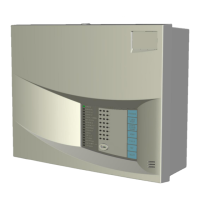
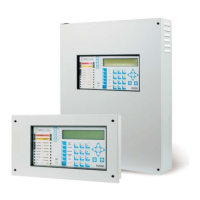
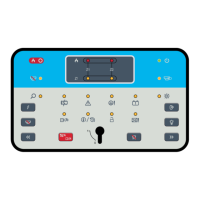
The “System fault” LED is visible on the front door of
the panel. The drive to the LED is a latching circuit which
turns on the LED when triggered and pulses the buzzer.
To clear the LED and silence the buzzer, reset the
latching circuit by using the push button on the back of
the board.
6.2 Hardware
The drive to the latching circuit is effectively a wired
OR’ed connection of all the system processors watch-
dog drives. It is arranged so that if any processor resets,
a “System Fault” will be indicated.
A limitation is that the “System fault” LED cannot
indicate exactly which processor has reset, just that one
of the processors has reset. The panels log can report if
the main CPU has reset, but there is no mechanism to
indicate which peripheral processor has reset.
6.3 Software Triggers
The panel firmware is designed so that under extreme
circumstances it can generate a “System Fault”. There-
are two levels of system fault:
The “Partial Operation” indication of “System Fault.
The panel is partially functioning.
The “Safe State” indication of “System Fault”. The
panel has stopped running.
These are described in the following sections.
6.3.1 Partial Operation
If the front cover display test fails, a fault is raised. Addi-
tionally, as required by EN54, the panel firmware
detects this and triggers a “System Fault”. The system
is still functioning albeit with a corrupt or non-existent
display (that is, the primary fire display has been lost).
6.3.2 Safe State
The following fault conditions place the system into
“Safe State”:
Firmware Boot ROM Checksum failure
Firmware RAM test failure.
Firmware FLASH test Failure
Configuration FLASH test failure.
Configuration RAM test failure.
If the firmware encounters any of these conditions, the
system is held in a “Safe State” (panel not running) by
performing the following actions:
Write to Non-Volatile memory a signature indicating
that a “System Fault” has occurred.
Reset the system via watchdog timeout. This will
cause a “System Fault” indication.
Upon restart, the Non-Volatile memory is read. The
signature ID is found indicating a fault and the
system halts.
6.3.3 Recovery From Safe State
To recover the system from “Safe State” (as described
above) the system state must be cleared. Perform
these actions:
Fit header link H2 on the CPU card.
Reboot the system and wait at least 30 seconds.
Remove header link H2 and reboot the system.


 To Next Page