EasyManua.ls Logo

Fluke 540B - Precautions

Fluke 540B
76 pages
Print Icon
To Next Page IconTo Next Page
To Previous Page IconTo Previous Page
Loading...
540B
REF
NAME
REF
FUNCTION
NR.
DESIG
13
SHUNT
J 805
Binding
posts
provided
to
accept
the
Fluke Model A40
J 806
Current
Shunts. A locking
screw
for
the
larger
shunts
is
provided
and
is
locat
ed
on
the
rear
panel
of
the
Model
A54
plug-in
unit.
Without a Model A40
plug-in
the
i
nstru-
ment
has
a
basic
current
range
of
2.
5 to 5
ma.
14
DC
INPUT J
801
Binding
posts,
with
centers
3/ 4 inch
apart,
are
provided
J 803
for
connecting de voltage
to
the
A54. Connect
the
positive
lead
to
the
upper
post.
The
lower
post
is
chassis
ground.
15
AC INPUT
J 802 A dual
purpose
AC
INPUT
connector
arrangem
ent
is
pro-
J 804 vided
in
the
.Model A54.
AC
voltages
may
be
applied
to
the
unit
through
the
UHF type
connector
or,
since
a
separate
ground
post
is
located
3/4
inch
from
the UHF
connector's
center,
a
standard
dual banana plug.
16 PROTECTION DISABLE
s
803
Disconnects
the
diode
protection
circuit
in
parallel
with
the
(Model A54-2 only)
thermocouple,
when
depressed
.
Depression
of
the
switch,
while
at
null
(zero) on
the
GALVANOMETER
meter
in
the
AC
TRANSFER mode,
will
cause
a deflection.
If
the
de-
flection
at
each
frequency
and on
each
range
of
interest
is
noted
periodically,
the
change
in
deflection
will
then be
an
indication of
the
long
term
stability
performance
of
the
transfer
portion
of
the
unit
including
the
protective
cir-
cuitry.
17
PANEL
BUSHING
NONE
An
internally
threaded
bushing
used
in
conjunction with
the
current
shunt
retaining
screw.
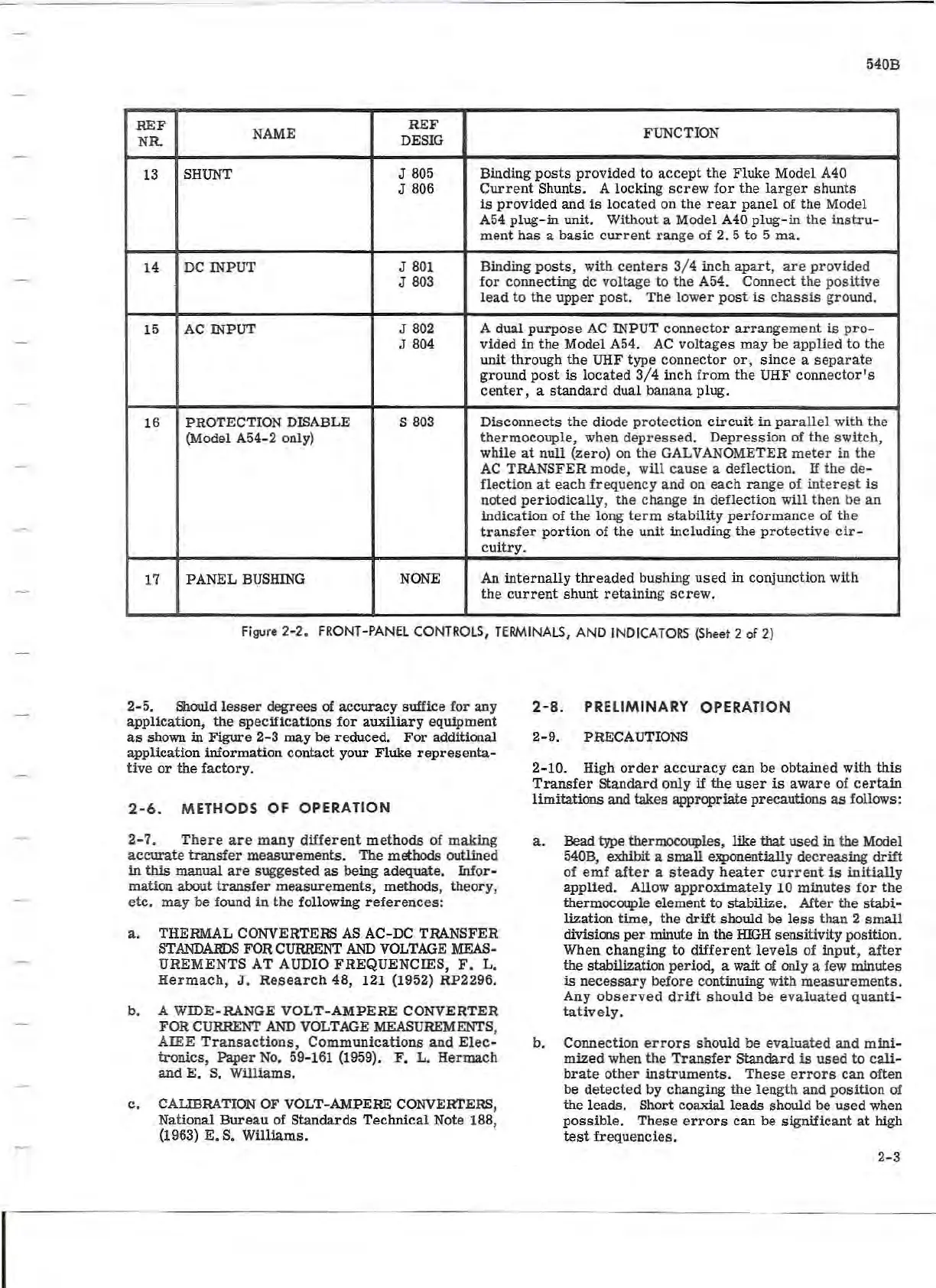
Figure 2
-2
. FRONT-PANEL CONTROLS,
TERMINALS,
AND
INDICATORS
(Sheet 2 of 2)
2-5.
Should
lesser
degrees
of
accuracy
suffice
for
any
application,
the
specifications
for
auxiliary
equipment
as
shown
in
Figure
2-3
may be reduced.
For
additional
application information contact your Fluke
repres
enta
-
tive
or
the
factory.
2-6
.
METHODS
OF
OPERATION
2-7.
There
are
many
different
methods
of
making
accurate
transfer
measurements.
The methods outlined
in
this
manual
are
suggested
as
being adequate. Infor-
mation about
transfer
measurements,
methods, theory,
etc.
may
be
found
in
the
following
references:
a.
THERMAL CONVERTERS
AS
AC-DC TRANSFER
STANDARDS
FOR
CURRENT
AND
VOLTAGE
MEAS-
UREMENTS
AT
AUDIO
FREQUENCIES,
F.
L.
Hermach,
J.
Research
48, 121 (1952} RP2296.
b. A WIDE-RANGE
VOLT
-
AMPERE
CONVERTER
FOR CURRENT
AND
VOLTAGE MEASUREMENTS,
AlEE
Transactions,
Communications
and
Elec-
tronics,
Paper
No. 59-161
(1959}.
F.
L.
Hermach
and
E.
S.
Williams.
c.
CALIBRATION OF VOLT-AMPERE CONVERTERS,
National
Bureau
of
Standards
Technical
Note 188,
(1963}
E.
S.
Williams.
2-8.
PRELIMINARY OPERATION
2- 9. PRECAUTIONS
2-10. High
order
accuracy
can
be
obtain
ed
with
this
Transfer
Standard
only if
the
user
is
aware
of
certain
limitations and
takes
appropriate precautions
as
follows:
a.
Bead
type thermocouples, like
that
used in the Model
540B, exhibit a
small
exponentially
decreasing
drift
of
emf
after
a
steady
heater
current
is
initially
applied. Allow
approximately
10
minutes
for
the
thermocouple element
to
stabilize. After
the
stabi-
lization
time,
the
drift
should
be
less
than 2
small
divisions
per
minute
in
the
HIGH
sensitivity position.
When
changing
to
different
levels
of input,
after
the
stabilizati
on
period, a wait of only a few minutes
is
necessary
before continuing with
measurements.
Any
observed
drift
should
be
evaluated
quanti
-
tatively.
b. Connection
errors
should
be
evaluated
and
min
i-
mized
when
the
Transfer
Standard
is
used
to
cali
-
brate
other
instruments.
These
errors
can
often
be
detected
by changing
the
length
and
position
of
the
leads.
Short coaxial
leads
should be
used
when
possible.
These
errors
can
be
significant
at
high
test
frequ
encies
.
2-3