EasyManua.ls Logo

Fluke 540B - Battery Check Circuits

Fluke 540B
76 pages
Print Icon
To Next Page IconTo Next Page
To Previous Page IconTo Previous Page
Loading...
540B
DC
FROM BALANCE
NETWORK
AND
THERM
OCOUP
LE
PUSH-PULL OSC.
&
FRE
O.
DO
UBLER
Q1,
Q2
,
Q3,
i l
2.5
kHz
5.0
kHz
5.0
kHz
S
YN
CH
RONO
US
DEMODULATOR
Q4, Q5,
T4, CR4,
CR5,
CR6,
CR7
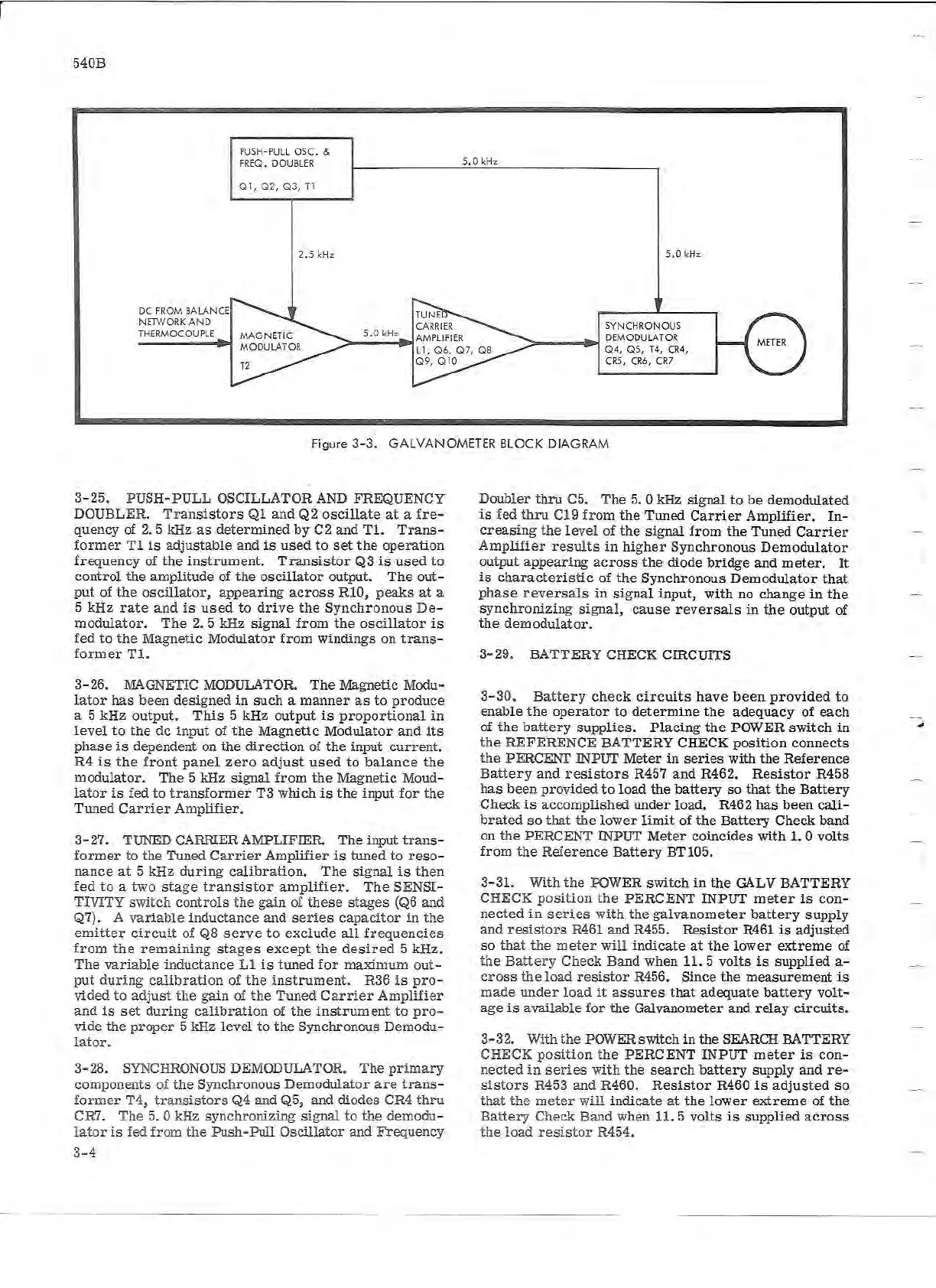
Figure
3-3.
GALVANOMETER BLOCK DIAGRAM
3-25.
PUSH-PULL OSCILLATOR AND
FREQ
UENCY
DOUBLER.
Transistors
Ql
and
Q2
oscillate
at
a
fre-
quency of 2. 5 kHz
as
determined
by
C2
and
Tl.
Trans-
former
Tl
is
adjustable and
is
used
to
set
the
operation
frequency
of
the
instrument.
Transistor
Q3
is
used
to
control the amplitude of
the
oscillator
output.
The
out-
put
of
the
oscillator
,
appearing
across
RlO,
peaks
at
a
5 kHz
rate
and
is
used
to
drive
the
Synchronous
De-
modulator.
The
2.
5kHz
signal
from
the
oscillator
is
fed to
the
Magnetic Modulator
from
windings on
trans-
former
T
l.
3-26.
MAGNETIC MODULATOR.
The
Magnetic Modu-
lator
has
been
designed
in
such
a
manner
as
to
produce
a 5
kHz
output.
This
5 kHz
output
is
proportional
in
level
to
the
de
input
of
the
Magnetic
Modulator
and
its
phase
is
dependent on the
direction
of
the
input
current.
R4
is
the
front
panel
zero
adjust
used
to
balance
the
modulator.
The
5kHz
signal
from
the
Magnetic Moud-
lator
is
fed to
transformer
T3
which
is
the
input
for
the
Tuned
Carrier
Amplifier.
3-27.
TUNED CARRIER AMPLIFIER.
The
input
trans-
former
to
the
Tuned
Carrier
Amplifier
is
tuned
to
reso-
nance
at
5 kHz
during
calibration.
The
signal
is
then
fed
to
a
two
stage
transistor
amplifier.
The
SENSI-
TIVITY
switch
c
ontrol
s
the
gain
of
these
s
tage
s
(Q6
and
Q7). A
variable
inductance and
series
capacitor
in
the
emitter
circuit
of
Q8
serve
to
exclude
all
frequencies
from
the
remaining
stages
except
the
desired
5kHz.
The
variable
inductance
Ll
is
tuned
for
maximum
out-
put
during
calibration
of
the
instrument.
R36
is
pro-
vided
to
ad
ju
st
the
gain
of
the
Tuned
Carrier
Amplifier
and
is
set
during
calibration
of
the
instrument
to
pro-
vide
the
proper
5kHz
level
to
the
Synchronous Demodu-
l
ator.
3-28.
SYN
CHRO
NOUS
DE
MODULATOR.
The
primary
components of
th
e Synchronous
Demodulator
are
trans-
f
orm
er
T4
1
transi
stors
Q4 and Q5, and diodes CR4
thru
CR7.
The
5. 0 kHz synchronizing
signal
to
the
demodu-
lator
is
fed from
the
Push-Pull
Oscillator
and
Frequ
ency
3-4
Doubler
thru
C5.
The
5. 0 kHz signal
to
be
demodulated
is
fed
thru
C19
from
the
Tuned
Carrier
Amplifier.
In-
creasing
the
level
of
the
signal
from
the
Tuned
Carrier
Amplifier
results
in
higher
Synchronous
Demodulator
output
appearing
across
the
diode
bridge
and
meter.
It
is
characteristic
of
the
Synchronous
Demodulator
that
phase
reversals
in
signal
input,
with
no
change
in
the
synchronizing
signal,
cause
reversals
in
the
output of
the
demodulator.
3-29.
BATTERY CHECK CICUITS
3-30.
Battery
check
circuits
have
been
provided
to
enable
the
operator
to
determine
the
adequacy
of
each
of
the
battery
supplies
.
Placing
the
POWER
switch
in
the
REFERENCE
BATTERY CHECK
position
connects
the
PERCENT INPUT
Meter
in
series
with the
Reference
Battery
and
resistors
R457
and
R462.
Resistor
R458
has
been
provided
to
load the
battery
so
that
the
Battery
Check
is
accomplished
under
load. R462
has
been
cali
-
brated
so
that
the
lower
limit
of
the
Battery
Check band
on
the
PERCENT INPUT
Meter
coincides
with
1. 0
volts
from
the
Reference
Battery
BT105.
3-31.
With
the
POWER
switch
in
the
GALV BATTERY
CHECK
position
the
PERCENT
INPUT
meter
is
con
-
nected
i n
series
with
the
galvanometer
battery
supply
and
resistors
R461 and R455.
Resistor
R461
is
adjusted
so
that
the
meter
will
indicate
at
the
lower
extreme
of
th
e
Battery
Check
Band
when
11.5
volts
is
supplied
a-
cross
the
l
oa
d
resistor
R456. Since
the
measurement
is
made
under
load
it
assures
that
adequate
battery
volt-
age
is
available
for
the
Galvanometer
and
relay
circuits.
3-32.
With
the
POWER switch
in
the SEARCH BATTERY
CHECK
position
the
PERCENT
INPUT
meter
is
con
-
n
ecte
d
in
series
with
the
search
battery
supply
and
re
-
s
istors
R453
and
R460.
Resistor
R460
is
adjusted
so
that
the
meter
will
indicate
at
the
lower
extreme
of
the
Battery
Check Band when 11. 5
volts
is
supplied
across
the
load
resistor
R454.