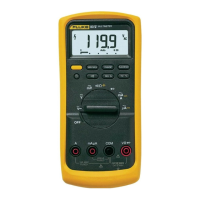
8021
B
Section 2
Operating
Instructions
2-1. INTRODUCTION
2-2.
To
fully
utilize the measurement
capabilities of your 8021 B a basic understanding
of
its measurement
techniques and limitations is
required. This section
of
the manual
provides that information.
For
additional
application or
operation literature, write
or
call
the
John Fluke Mfg. Co.,
Inc.; telephone
(206)
342-6300.
2-3.
PREPARING FOR
OPERATION
2-4. Unpacking
2-5.
Your 8021 B
was packed and shipped in an especially designed protective container.
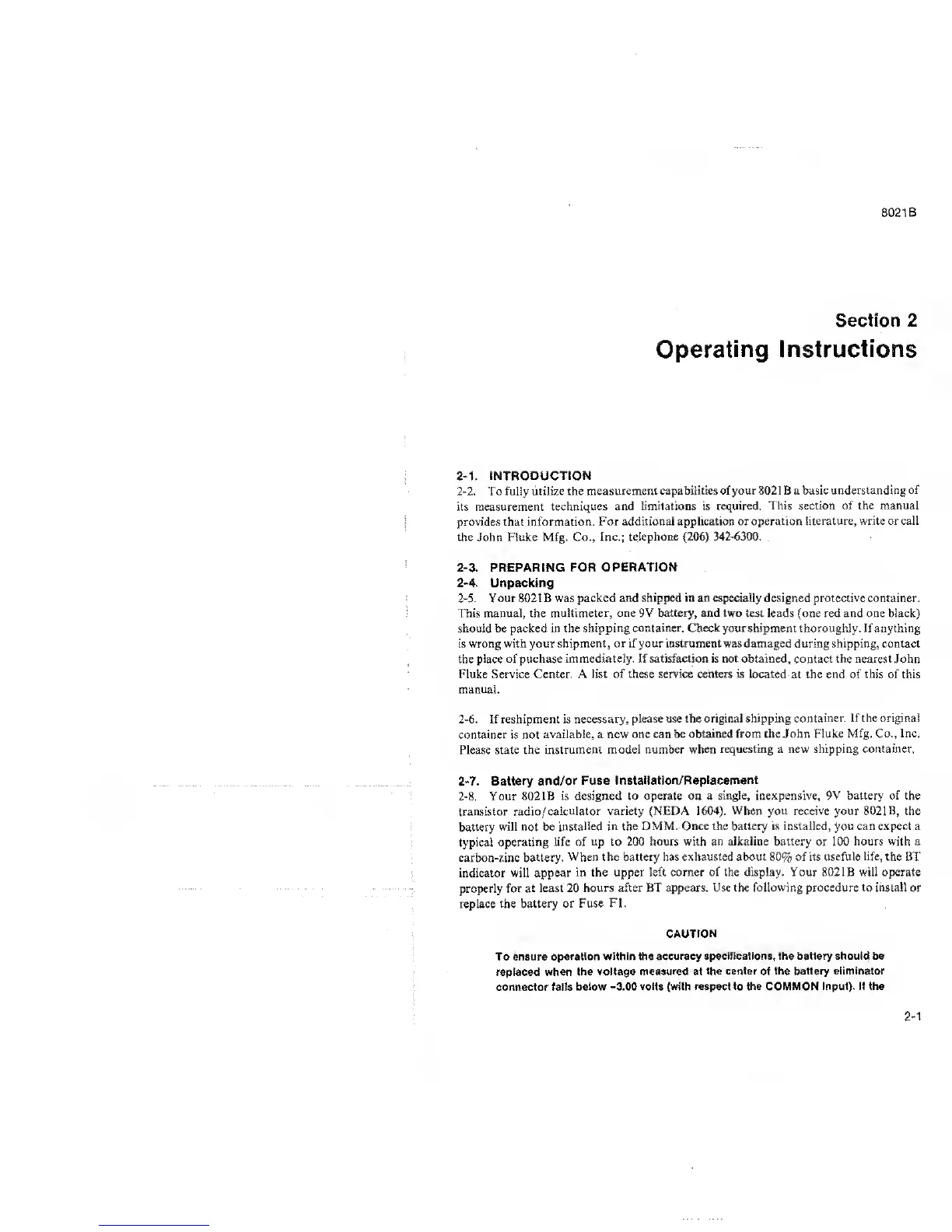
This manual, the
multimeter, one
9V
battery, and two test leads (one red
and
one black)
should be packed in the
shipping container. Check your shipment
thoroughly. If
anything
is wrong with your
shipment, or if your instrument was
damaged during shipping, contact
the place of puchase
immediately. If satisfaction
is not obtained, contact the nearestJohn
Fluke Service
Center. A list of these
service
centers is located
at
the
end
of this
of this
manual.
2-6.
If reshipment is
necessary, please use the
original shipping container. If the original
container is not
available, a
new one can be obtained from the John
Fluke Mfg. Co., Inc.
Please state the
instrument model
number when requesting a new shipping container.
2-7. Battery and/or Fuse
Instailation/Replacement
2-8.
Your
802 IB is
designed to operate on a single, inexpensive, 9V battery of the
transistor
radio/calculator variety
(NEDA 1604). When you receive your 8021
B,
the
battery will not be
installed in the DMM. Once the battery is installed, you
can expect
a
typical
operating life of
up to 200 hours with an alkaline battery or 100 hours
with
a
carbon-zinc
battery. When the
battery has exhausted about
80%
of its usefule life, the BT
indicator will appear
in the upper left
corner of the display. Your 802 IB will operate
properly
for at least 20 hours
after BT appears. Use the following procedure to install or
replace the
battery or Fuse FI.
CAUTION
To ensure
operation within the accuracy specifications,
the battery should be
replaced when
the voltage measured at the center of
the battery eliminator
connector falls
below
-3.00
volts (with respect to
the COMMON input). If the
2-1



 To Next Page