14
You can monitor the recording via Headphone Output 1 if you wish, using Focusrite Control to set
up your monitoring mix. A second, different mix can be created for a musician and can be routed to
Headphone Output 2.
A note about latency
You will probably have heard the term “latency” used in connection with digital audio systems. In the
DAW recording application described above, latency is the time it takes for your input signals to pass
through your computer and audio software, and back to you.
While not an issue for most recording situations, latency can be a problem for a performer who
wishes to record while monitoring their input signals. This might be the case if you need to increase
your buffer size, which could be needed when you record overdubs on a large project using many
DAW tracks, software instruments and FX plug-ins.
Common symptoms of a buffer setting that is too low could be glitching audio (clicks and pops), or a
particularly high CPU load within your DAW (most DAWs have CPU readouts). If you experience this
on a Mac, you can raise the buffer size from the DAW application itself but on a Windows PC you will
need to change this from the ASIO ControlPanel which can usually be accessed from your DAW
Setup Preferences*.
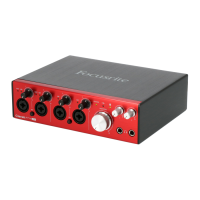
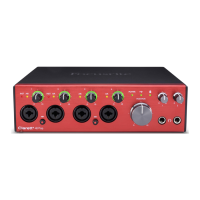
The Clarett+ 4Pre, in conjunction with Focusrite Control, allows “low latency monitoring”, which
overcomes this problem. You can route your input signals directly to the Clarett+ 4Pre’s headphone
and line outputs. This enables the musicians to hear themselves with near zero latency – i.e.,
effectively in “real time” – along with the computer playback, even with very high DAW buffer sizes.
The input signals to the computer are not affected in any way by this setting. However, note that any
effects being added to the live instruments by software plug-ins will not be heard in the headphones
in this case, although the FX will still be present on the recording.
* Typical name – page names may vary with DAW


 To Next Page