EN-18
• β-OHB levels may increase if a person fasts, exercises
vigorously or has diabetes and becomes ill. If your β-Ketone
result is 0.0 mmol/L, repeat the β-Ketone test with new
test strips. If the same message appears again or the result
does not reect how you feel, contact your healthcare
professional.
Follow your healthcare professional’s advice before you
make any changes to your diabetes medication programme.
If your β-Ketone result is between 0.6 and 1.5 mmol/L, this
may indicate development of a problem that could require
medical assistance. Follow your healthcare professional’s
instructions. If your β-Ketone result is higher than 1.5
mmol/L, contact your healthcare professional promptly
for advice and assistance. You may be at risk of developing
diabetic ketoacidosis (DKA).
Please consult your doctor to determine a target range
that works best for you.
*1. American Diabetes Association (2014). Clinical Practice
Recommendations. Diabetes Care, 37 (Supplement 1): S16.
*2. Third Report of the National Cholesterol Education
Program (NCEP) Expert Panel on Detection, Evaluation,
and Treatment of High Blood Cholesterol in Adults (Adult
Treatment Panel III) nal report(2002).Circulation106:
3143–3421
*3. National Kidney Foundation (2014)
*4. NIH - National Heart, Lung, and Blood Institute (NHLBI)
https://www.nhlbi.nih.gov/health-topics/blood-tests
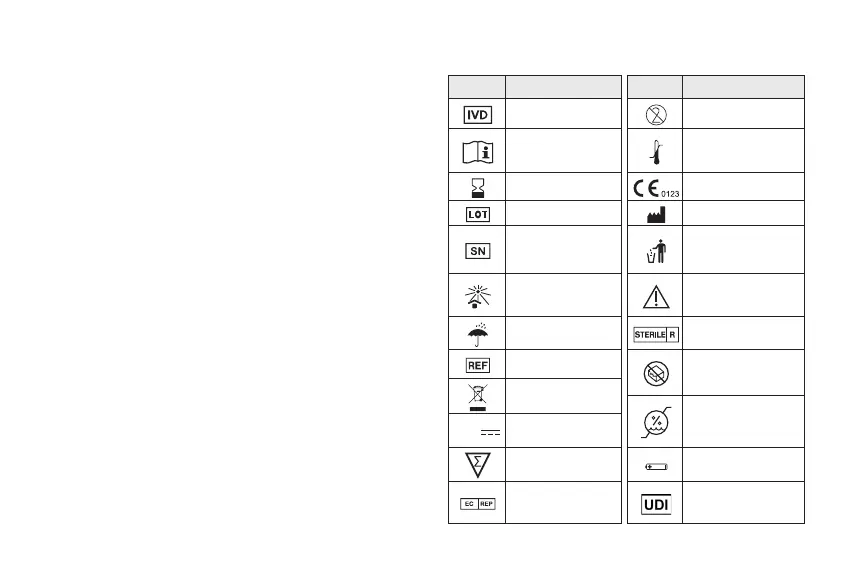
Symbol Information
Symbol Referent Symbol Referent
For in vitro diagnostic
use
Do not reuse
Consult instructions
for use
Storage/Transportation
temperature limitation
Use by CE Mark
Batch code Manufacturer
Serial number
Dispose of the
packaging properly
after use
Keep away from
sunlight
Caution, consult
accompanying
documents
Keep Dry
Sterilized using
irradiation
Model number
Do not use if package is
damaged
Disposal of waste
equipment
Storage/Transportation
humidity limitation
1.5V
1.5 Volts DC
Quantity Battery
Authorised
representative in the
European Union
Unique device
identier


 To Next Page