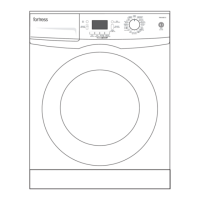
This document is the user manual for a Fortress brand washer, model FW1215C718. It provides comprehensive instructions for safe operation, installation, usage, and maintenance of the appliance.
Function Description
The Fortress FW1215C718 is a household washing machine designed to clean various types of laundry. It features multiple wash programs tailored for different fabric types, soiling levels, and temperatures, along with auxiliary functions to customize the wash cycle. The machine automatically adjusts water usage based on the weight of the loaded laundry. It is equipped with a control panel that includes a program selection knob, display, delayed start button, program follow-up indicator, start/pause button, and buttons for adjusting spin speed and temperature. A child lock function is also available to prevent unintended changes during operation.
Important Technical Specifications
- Model: FW1215C718
- Maximum capacity (dry laundry): 7 kg
- Height: 84 cm
- Width: 60 cm
- Depth: 56.5 cm
- Net weight (± 4 kg): 70 kg
- Rated Voltage / Frequency: 220-240V/50Hz
- Total current: 10 A
- Total power: 2000-2350 W
- Spin speed (maximum): 1200 rpm
- Stand-by mode power: 1.00 W
- Off-mode power: 0.25 W
- Water inlet: Single water inlet
- Water supply pressure: 1 to 10 bars (0.1 – 1 MPa). Requires 10 – 80 liters of water per minute from a fully open tap.
- Draining hose height: At least 40 cm, and 100 cm at most.
- Power connection: Specific 220-240V socket, no less than 13A.
Usage Features
Sorting and Preparing Laundry:
- Laundry should be sorted by fabric type, color, soiling degree, and allowable water temperature, following garment tag instructions.
- Metal attachments (underwired bras, buckles, buttons) should be removed or items placed in a laundry bag/pillow case to prevent appliance damage.
- Pockets must be emptied of coins, pens, paper clips, etc., and turned inside out.
- Small items like infant's socks or nylon stockings should be placed in a laundry bag.
- Curtains should be placed without compressing, and attachments removed.
- Zippers should be fastened, loose buttons sewn, and rips mended.
- Only "machine washable" or "hand washable" items should be washed with appropriate programs.
- Colors and whites should not be washed together, especially new dark cottons.
- Tough stains should be pre-treated.
- Only machine-wash suitable dyes/color changers and limescale removers should be used.
- Trousers and delicate laundry should be turned inside out.
- Angora wool items can be placed in the freezer for a few hours before washing to reduce pilling.
- Laundry with flour, lime dust, milk powder, etc., should be shaken off before loading to prevent buildup and damage to internal parts.
Energy Saving Tips:
- Operate the appliance at its highest allowed capacity without overloading.
- Follow detergent packaging instructions for dosage.
- Wash lightly soiled laundry at low temperatures.
- Use faster programs for small quantities of lightly soiled laundry.
- Avoid prewash and high temperatures for lightly soiled or unstained laundry.
- Select the highest recommended spin speed if planning to use a dryer.
- Do not use excessive detergent.
Loading Laundry:
- Open the loading door, place items loosely, and push the door until it locks. The door remains locked during operation and opens a few minutes after the cycle ends. Misplacing laundry can cause noise and vibration.
Detergent and Softener Usage:
- The detergent drawer has three compartments: prewash, main wash, and softener.
- Detergent and softener should be added before starting the program.
- Never leave the drawer open during operation.
- For programs without prewash, do not use the prewash compartment.
- Liquid detergent should not be used in the prewash compartment for programs with prewash, or with the time delay function as it may stain clothes.
- Use detergents specific to washing machines; avoid soap powder.
- Adjust detergent amount based on laundry quantity, soiling, and water hardness; avoid excessive foam.
- For softeners, do not exceed the maximum level mark and dilute if fluidity is lost.
- Bleaches (oxygen-based) can be used with detergents, adding detergent first, then bleach while water is filling. Do not mix bleach and detergent directly. Use small amounts of bleach and rinse well, avoiding direct contact with clothes or use on colored items.
Program Selection:
- Programs are selected via a knob and are limited by appropriate spin speeds for fabric types.
- Temperature can be adjusted using the Temperature Adjustment button.
- Spin speed can be adjusted using the Spin button.
- Main Programs: Cotton (for sheets, towels, underwear), Synthetics (shirts, blouses, curtains), Wool.
- Additional Programs: Cotton Eco (energy/water saving), Intensive+ (hygienic wash), Delicate, Hand Wash 20°C, Daily/Quick, Sport, Mix 40, Jeans, Wash (for shirts), Curtain.
- Special Programs: Rinse, Spin+Drain.
- Auxiliary Functions: Prewash (for heavily soiled laundry; not for lace/curtains), Quick Wash (for lightly soiled cottons/synthetics), Rinse Plus (additional rinse for sensitive skin), Rinse Hold (prevents wrinkles by keeping laundry in final rinse water), Delayed Start (up to 19 hours).
Starting and Cancelling Programs:
- Press Start/Pause to begin.
- To cancel a program, turn the Program Selection knob to another program. The machine will cancel the previous program, but may not drain water immediately.
Standby Mode:
- The appliance enters an energy-saving standby mode if no program is started or no action is taken within approximately 2 minutes after a program ends. Lights dim or turn off. Rotating the knob or pressing a button restores normal display.
Maintenance Features
Cleaning the Detergent Drawer:
- Clean every 4-5 washing cycles to prevent powder accumulation.
- Remove the siphon piece from the softener compartment by pulling it out.
- Wash the drawer and siphon with lukewarm water.
- Reinsert the drawer and ensure it is seated correctly.
Cleaning the Loading Door and Drum:
- To prevent odors and residues, run the Cotton 90°C program with Rinse Plus auxiliary function every 2 months, without laundry.
- Add 100g of powder anti-limescale (or one tablet) to the main wash compartment before starting the drum cleaning program.
- Dry the inside of the bellow with a clean cloth after the program.
- Ensure no foreign substances remain in the drum after each wash.
- If bellow holes are blocked, clear them with a toothpick.
- Clean rust stains on the drum with stainless steel cleaning agents; avoid steel wool or wire wool.
- Never use sponge or scrub materials on painted or plastic surfaces.
Cleaning the Body and Control Panel:
- Wipe the body with soapy water or non-corrosive mild gel detergents and a soft cloth.
- Use only a soft, damp cloth for the control panel.
Cleaning the Water Intake Filters:
- Filters are located at the end of each water intake valve at the rear of the washer and at the end of each water supply hose.
- Close taps, remove hose nuts, and clean filters with a brush or pliers.
- Clean filters on the flat ends of the hoses and gaskets under running water.
- Replace gaskets and filters, then tighten hose nuts.
Draining Remaining Water and Cleaning the Pump Filter:
- The pump filter prevents solid items from clogging the pump impeller.
- Clean the filter every 3 months or when clogged.
- Unplug the appliance.
- Open the filter cover by pressing the tab downwards and pulling it out (use a thin plastic-tipped tool if needed).
- Place a container to catch water.
- Loosen the pump filter anticlockwise until water flows, draining all water.
- Remove the filter completely, clean residues and fibers around the impeller.
- Install the filter and close the cover.
- Drain water completely before transporting the appliance or in case of freezing temperatures.
Safety Instructions:
- Read the user manual carefully.
- Use suitable power source (220-240V~/50Hz).
- Never immerse in water.
- Avoid direct sunshine.
- Turn off when not in use.
- Stop using immediately if malfunction occurs and contact authorized service center.
- Unplug before cleaning or maintenance.
- Clean with dry cloth; avoid corrosive detergents or swashing with water.
- Store in dry, cool place if not used for prolonged periods.
- Keep flammable/explosive objects away.
- Not for use by persons with reduced physical/sensory/mental capabilities or lack of experience, unless supervised. Children should be supervised.
- Ensure openings are not obstructed by carpet.
- Appliance resumes operation after power interruption.
- Securely fasten water supply and draining hoses.
- Never open loading door or remove filter while water is in the drum (risk of scalding).
- Do not force open locked loading door.
- Use detergents, softeners, and supplements suitable for automatic washing machines only.
- Follow textile tags and detergent package instructions.
- Only wash and rinse laundry marked accordingly.
- Keep children away during operation; use child lock.
- Close loading door when leaving the room.
- Loading door glass becomes hot during high-temperature washes; keep children away.
- Installation and electrical connections must be done by an authorized service agent.
- Remove all packaging reinforcement and transportation locks before operation to prevent damage.
- Do not use old or used water supply hoses.
- Ensure the appliance is level and balanced on its feet to prevent vibration and movement.
- Do not use tools to loosen lock nuts on feet.
- Power cord plug must be easily accessible.
- Do not use extension cords or adapters.
- Damaged power cords must be replaced by authorized service agents.
- Foreign substances in the pump filter can cause damage and noise.
- Clean filter after water cools down (risk of burning).
- Do not use metal-tipped tools to remove the filter cover.
The manual emphasizes that specifications, designs, and dimensions are subject to change without prior notice to improve appliance quality. Figures are schematic and may not exactly match the appliance. Values are obtained under laboratory conditions and may vary depending on operational and environmental conditions.


 To Next Page
 General