Part No. 90-0113-00
Fdmman2.p65 2/98
Alternating Current (AC) An electric current
that reverses direction at regular intervals.
Sources of alternating current are shore
power, generator power, inverter power or
household current.
Ampere (Amp, A) The unit of measure of
electron flow rate of current through a circuit.
Ampere-hour (Amp-Hr., AH) A unit of
measure for a battery’s electrical storage
capacity, obtained by multiplying the current in
amperes by the time in hours of discharge
(Example: a battery which delivers 5 amperes
for 20 hours delivers 5 amperes times 20
hours, or 100 Amp-Hr. of capacity.)
AH Capacity The ability of a fully charged
battery to deliver a specified quantity of
electricity (Amp-Hr., AH) at a given rate (Amp,
A) over a definite period of time (Hr.). The
capacity of a battery depends upon a number
of factors such as: active material, weight,
density, adhesion to grid, number, design and
dimensions of plates, plate spacing design of
separators, specific gravity and quantity of
available electrolyte, grid alloys, final limiting
voltage, discharge rate, temperature, internal
and external resistance, age and life of the
battery (bank).
AGM (Absorbed Glass Mat) Battery A lead
acid, maintenance-free battery.
AWG (American Wire Gauge) A standard
used to measure the size of wire.
Circuit An electric circuit is the path of an
electric current. A closed circuit has a
complete path. An open circuit has a broken
or disconnected path.
Circuit (Series) A circuit which has only one
path for the current to flow. Batteries arranged
in series are connected with the negative of
GLOSSARY
the first to the positive of the second, negative
of the second to the positive of the third, etc.
If two 6 Volt batteries of 50 ampere-hours
capacity are connected in series, the circuit
voltage is equal to the sum of the two battery
voltages, or 12 Volts, and the ampere-hour
capacity of the combination is 50
ampere-hours.
Circuit (Parallel) A circuit which provides
more than one path for current flow. A parallel
arrangement of batteries (of like voltage and
capacity) would have all positive terminals
connected to a conductor and all negative
terminals connected to another conductor. If
two 12 Volt batteries of 50 ampere-hour
capacity each are connected in parallel, the
circuit voltage is 12 Volts, and the
ampere-hour capacity of the combination is
100 ampere-hours.
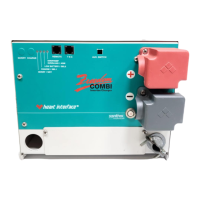
Combi Freedom Combi
TM
is a trademark of
Heart Interface to indicate a combination
inverter/charger.
Current The rate of flow of electricity or the
movement rate of electrons along a
conductor. It is comparable to the flow of a
stream of water. The unit of measure for
current is ampere.
Cycle In a battery, one discharge plus one
recharge equals one cycle.
Dip Switch A series of small switches used
for special programming of the Freedom
Combi. These switches are located on the
back of the Freedom Remote Control Panel.
Direct Current (DC) Current that flows
continuously in one direction such as that
from batteries, photovoltaics, alternators,
chargers and DC generators.
36


 To Next Page