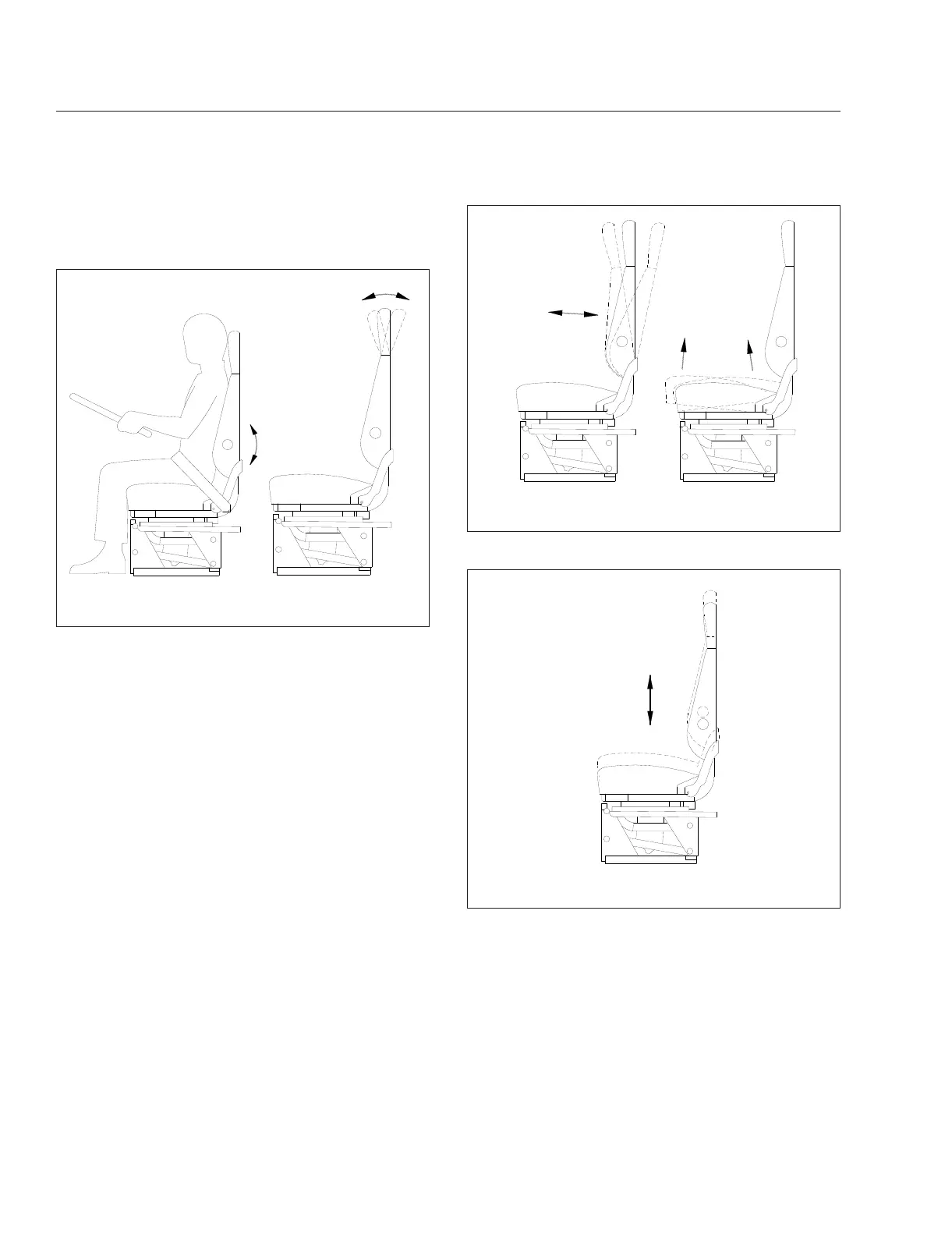
This adjustment is either mechanical or air con-
trolled, depending on the make and model of the
seat. See
Fig. 5.7.
4.
Headrest: When this adjustment is made, the
upper part of the backrest (back cushion)
changes angle to provide head and upper back
support as shown in
Fig. 5.7.
5.
Backrest Tilt: This adjustment pivots the backrest
forward or backward as shown in
Fig. 5.8.
6.
Seat Cushion Tilt: This adjustment raises or low-
ers the front and/or back of the seat (bottom)
cushion. This adjustment is easier to perform
when all weight is removed from the seat. See
Fig. 5.8.
7.
Seat Tilt: When this adjustment is made, the seat
assembly, both backrest and seat cushion, tilts
forward or backward as shown in
Fig. 5.8.
8.
Ride Height Adjustment: The entire seat moves
up or down when adjusting the ride height. The
adjustment is either manual or air controlled, de-
pending on the make and model of the seat. See
Fig. 5.9.
9.
Damper: When you sit on the seat, a leveling
valve places you in the center of the ride zone.
When the damper is adjusted properly under nor-
mal driving conditions, the seat should not top or
bottom against the limits of the vertical travel.
10.
Ride Firmness: A firmer ride gives a better feel
for the road but less protection against uneven-
ness in the road surface. A softer ride smooths
out the bumps.
10/05/2001
A
B
f910483
A. Lumbar Support B. Headrest Adjustment
Fig. 5.7, Lumbar Support and Headrest Adjustment
A
B
10/05/2001
f910484
A. Backrest Tilt B. Seat Cushion Tilt
Fig. 5.8, Cushion Tilt Adjustments
10/05/2001
A
f910485
A. Ride Height
Fig. 5.9, Ride Height Adjustment
Cab Features
5.3







 To Next Page