34
WWW.FUHR.DE
multitronic
881/881GL/ServoAccess
1. After all of the FUHR multitronic compo-
nents have been installed, check that
the door leaves and frames are aligned
parallel.
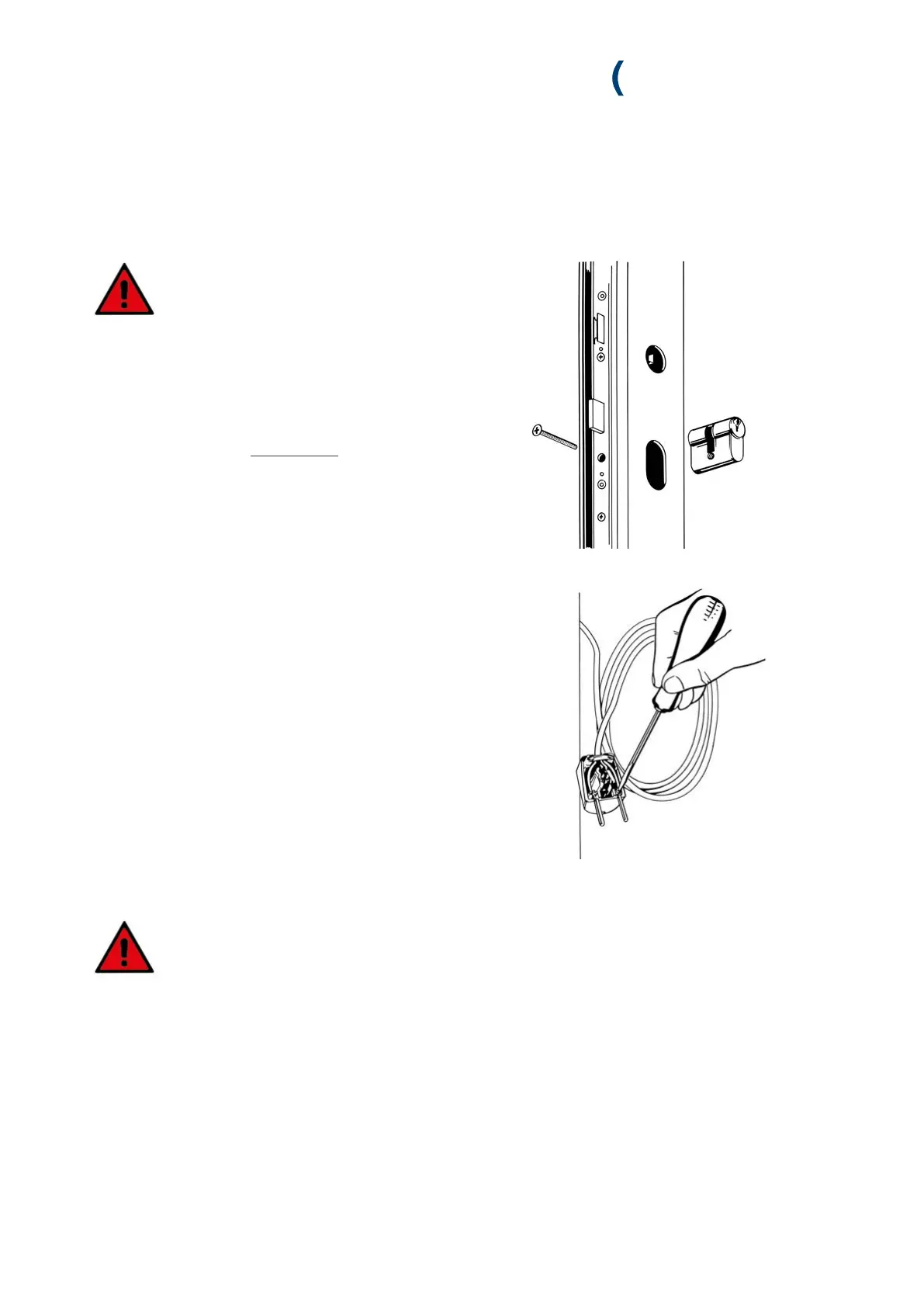
2. Install a profile cylinder with free-running mechanism
and forced decoupling in the centre lock in accordance
with the certificates of EN 179/EN 1125 resp. with the
marking ‘FZG’. A current list of the non-restricted cylin-
ders which are approved with our multipoint locks can be
found on our website at www.fuhr.de.
3. Subsequently connect the 230 V cable to the mains vol-
tage by means of a two-pin earthed plug for testing pur-
poses (only to be carried out by qualified personnel).
4. The green LED will light up as soon as the operating vol-
tage is applied. Upon closing over the door, the latching
deadbolts extend 20 mm. The lock is now automatically
locked and the red LED lights up.
5. In order to test all functions, the door should be opened
and locked several times in the door factory via the drive
unit, the profile cylinder, and via the lever-handle. In the
event of any problems arising, please proceed in accor-
dance with chapter 11.
6. If the FUHR multitronic lock is fully operational, the two-
pin earthed plug can be removed and the door can be
despatched.
5 Commissioning
5.2 COMMISSIONING ON SITE
1. Install the door in the wall opening in the usual manner, guiding the 230 V cable to the internal side
of the wall. Make sure that fixing materials (e.g. wall anchors) are not located where the electronic
components are.
2. An electrician must connect up the 230 V cable to the power supply. The door frame’s earthing/
grounding is to be professionally checked. Conduit must be used for 230 V concealed cabling.
3. In order to be able to warrant the power supply of all electronic components, also in the case of a
network operator’s power failure, emergency exit doors in accordance with DIN EN 179 and DIN EN
1125 as well as fire doors in accordance with DIN 4102 and DIN EN 1634 should be equipped with an
emergency power supply!
5.1 OPERATION VERIFICATION CHECK ON THE FABRICATOR’S PREMISES


 To Next Page