48
So what is “just right”?
It all depends on the type of audio material and your application.
Live sound mixing
If you’re going to be mixing audio from a variety of live musical instruments or you’re going to be creating
some broadband effects over a wide dynamic range, you’ll need to allow plenty of operating headroom to
avoid analogue clipping or, worse still, running out of digits.
DJ mixing with pre-recorded material
If you were only ever going to work with pre-recorded, auto-levelled material, you’ll probably get away
with just enough headroom to mix tracks and add the odd effect – but read the whole section anyway,
you may find it instructive.
Live sound operating levels
It is important to retain enough headroom to maintain good transient response, details and impact for
live sound mixing – not only to allow for backline systems being turned up to “11” mid-set and for high
peak-to-rms percussion transients, but also to allow for the natural signal level build-up through the
console, once you start tweaking eqs, adding effects and sub-grouping multiple channels.
Assuming a professional quality analogue or 24-bit digital console, run each channel’s pre-fader or level
and each group’s mix level at around 0dBU/+4dBu ( analogue) or -18dBFS (digital) if at all possible.
Modern 24-bit systems with good studio quality converters usually work well at -18dBFS but some MI
products may use lower grade converters which will need to be run at higher operating levels to avoid
sounding mushy. If you suspect this is the case with your system, you’ll need to run the PFL or group levels
around the -12 to -9dBFS level and keep an eagle-eye open for signal clipping during the live
performance.
Understanding level meters
This section spends a lot of time discussing meters because, without an understanding of their typical
calibration levels, it’s difficult to get your gain structure and operating levels properly optimised.
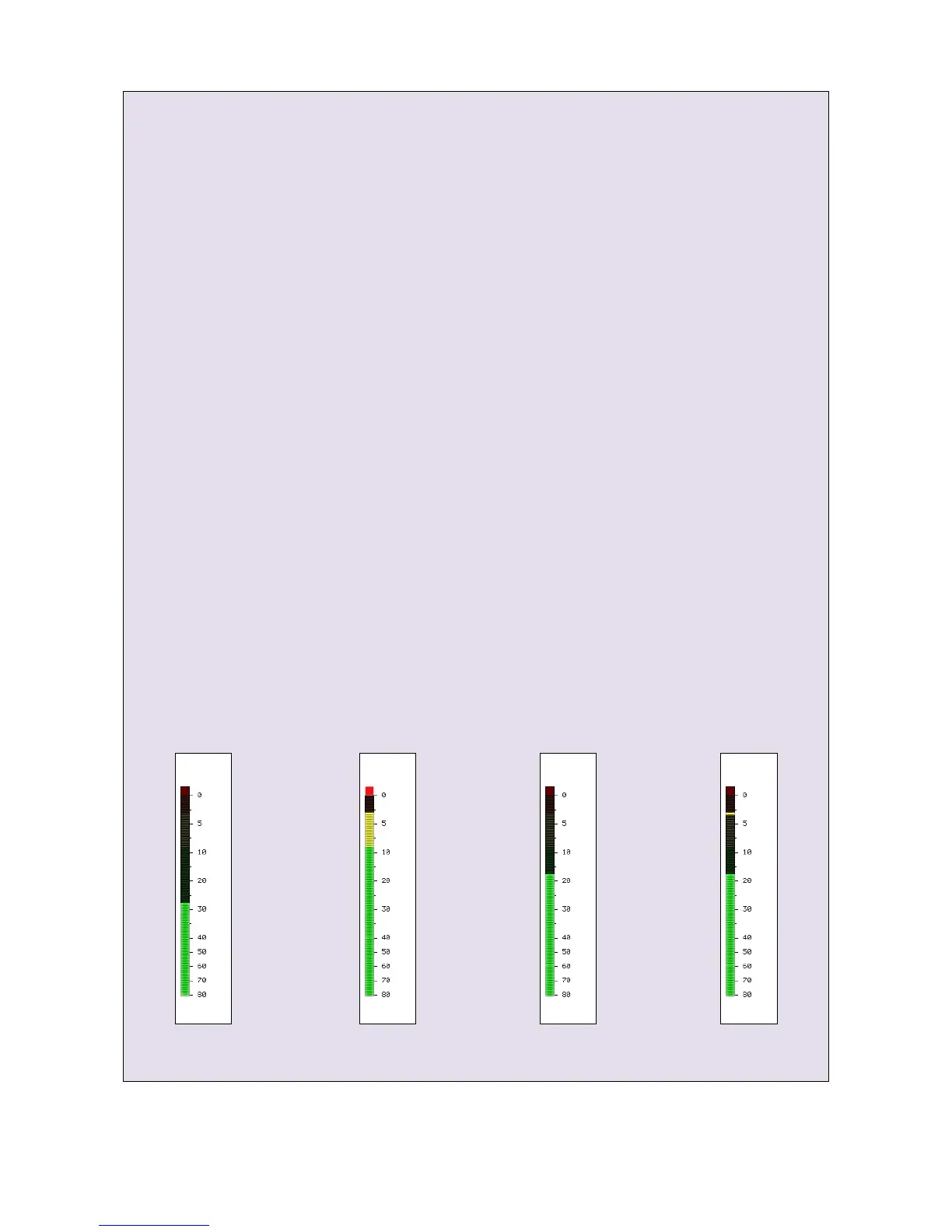
Professional live sound meters calibrated with respect to “Full Scale” (dBFS)
Too low (-28dBFS) Too high (-3dBFS) Just right (-18dBFS) Peak-hold option
Wasting dynamic range Peaks could be clipped Noise-free without clipping May not be true peak
www.funktion-one.com © Funktion One Research Limited 2011


 To Next Page