49
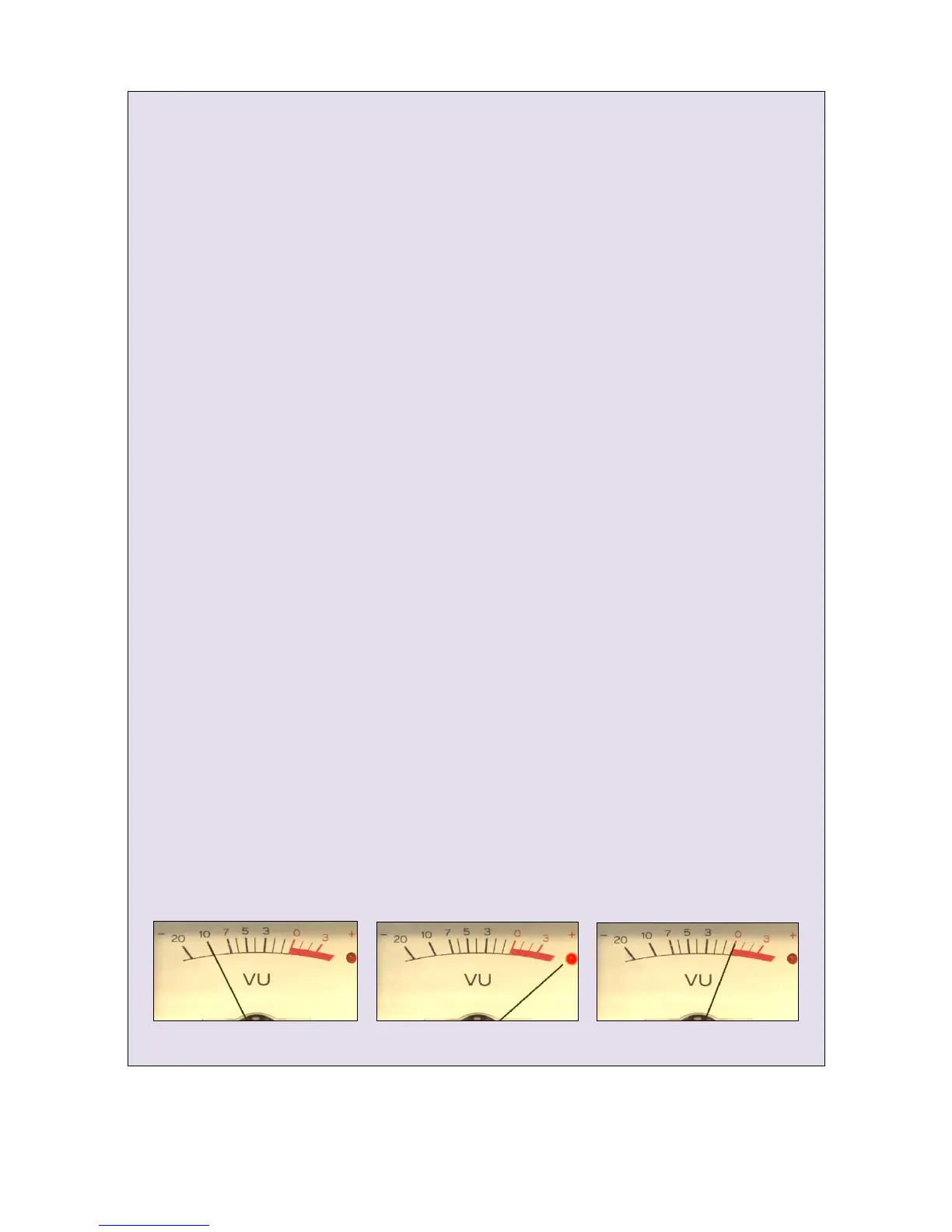
The illustrations above show levels on a typical bar meter with a dedicated peak LED at the top. Some
analogue peak LEDs don’t respond to very fast transients and some digital ones don’t respond until the
processor has seen several maximum bits in a row. Peak-hold indicators often hold maximum rms – not
true waveform peaks – so they are not always a good indicator of potential clipping.
If, for live sound, your bar meter is way above the -18dB mark, you’re probably clipping peaks and
transients irrespective of what the peak LED or peak-hold indicator is telling you.
Q & A
Q) Surely 18dB below clipping (-18dBFS) won’t drive my loudspeaker system hard enough?
A) Remember that 18dB below clipping represents about +4dBu/0VU output level on most pro-
audio consoles. Effects, eq., mixing and natural performance dynamics will require the 18dB of
headroom through your channel, effects and subgroup sections.
Lower-cost digital console calibration and limited converter quality may push you towards an
operating level only 12 to 9dB (-12 to -9dBFS) below clipping as mentioned earlier. -9dBFS is an
old DIN standard but it’s the exception rather than the rule – particularly with modern 24-bit
systems.
Once you’ve done all this without crashing the mix, you can then use the master faders to push
the required level to your main system amplifier racks where your controller limiters will take care
of the odd rogue peak.
Standard EBU alignment level for digital audio is also 18dB below full scale (maximum digital level) -
usually written as -18dBFS - so sticking to the 18dB rule will also make you compatible with broadcasters
when working at festivals and VIP DJ events.
Professional live sound analogue meters calibrated with respect to +4dBu
Most pro-audio analogue equipment can handle internal and output signal levels of approximately
10vrms before clipping. 10vrms is approximately +22dBu so 18dB below that clip levels is approximately
+4dBu.
Traditionally, most pro-audio VU-meters (and VU-scaled bar meters) were calibrated so that 0VU
corresponded to the industry standard +4dBu to give you 18dB of headroom.
More Qs & As
Q) What’s a dBu?
A) dBu (sometimes written as dBv) refers to so many dB with respect to approximately 0.775vrms.
You’ve probably seen the 0.775vrms standard used for power amplifier sensitivity.
Q) Why the strange voltage reference?
A) The original standard was devised for telephone circuitry and early audio. It was originally called
dBm and was defined as 1mW into 600 ohms. Work out 0.775
2
/600 and you’ll get a milliwatt.
Too low (-10VU = 28dB below clip) Too high Just right (0VU = 18dB below clip)
Wasting dynamic range Peaks could be heavily clipped Noise-free without clipping
www.funktion-one.com © Funktion One Research Limited 2011


 To Next Page