50
Professional analogue and digital peak programme meters (PPMs)
Peak programme meters don’t actually measure short signal bursts or transients. They are designed for
estimating programme levels.
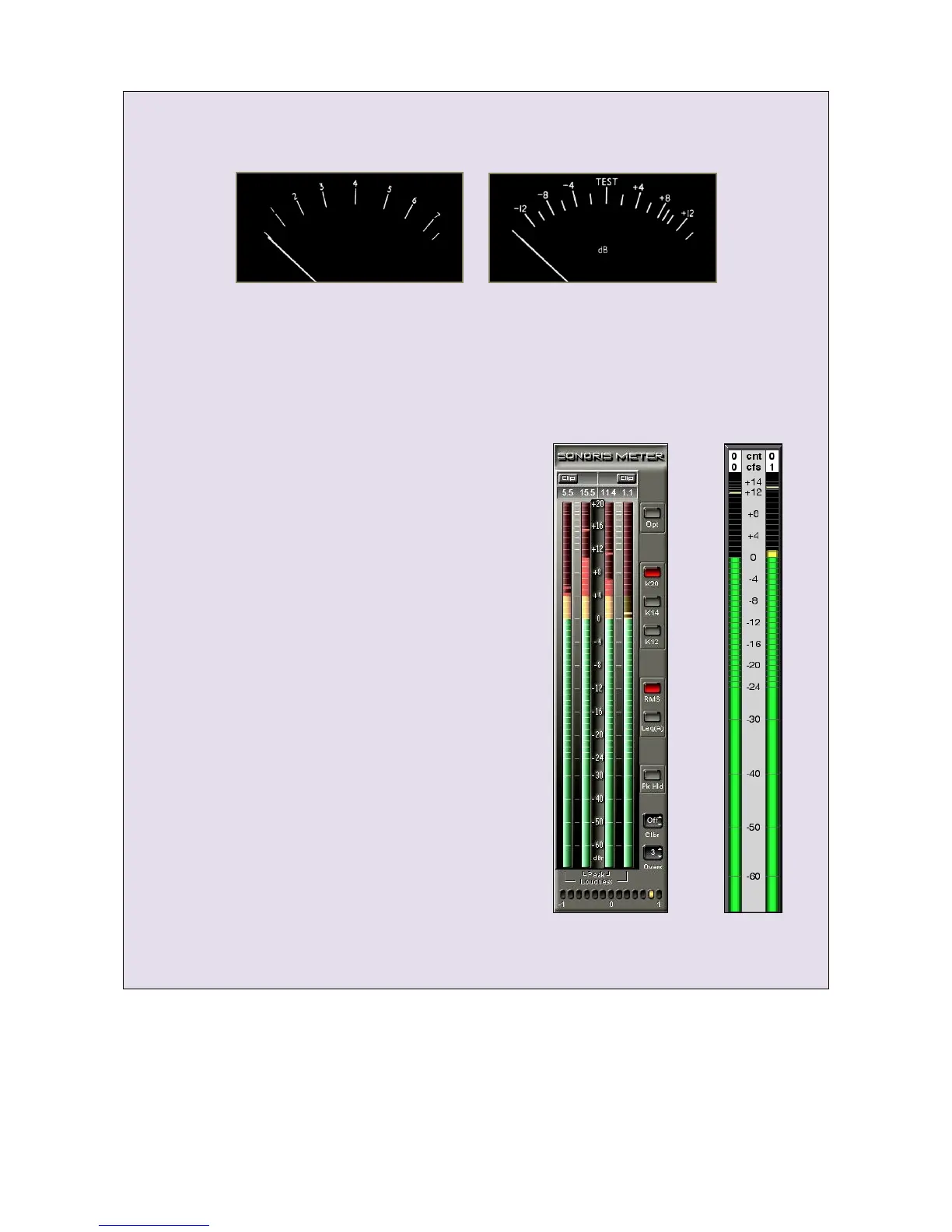
UK “BBC” PPM scale – in 4dB steps EBU PPM scale – also in 4dB steps
“4” is usually set for -18dBFS “Test” is usually set for -18dBFS
There are almost as many PPM scales as there are broadcasting authorities – including a “DIN” standard
- where “0” is only -9dBFS!
PPMs move faster than most rms meters in response to tone-bursts and fall back more slowly – making
them easier to read. But they still underestimate very short bursts and often ignore transients altogether
so the 18dB below clip rule must still apply.
K-meters
K-meters – named after Bob Katz, the well-known
mastering engineer – usually measure rms levels
with a fixed 600ms integration and fall-back time
over a very wide levels range.
Some versions include peak facilities. K-meters
usually have switchable scaling: K-20 indicates 0dB
at -20dBFS, K-14 has 0dB at -14dBFS and K-12 has
0dB at -12dBFS.
As most K-meters are software-based, it is possible
to select K-20, K-14 etc as required. Live sound users
should use the K-20 standard wherever possible.
K-meters were designed for recording applications –
and as an attempt to get some consistency in control
room monitoring levels. For recording purposes, 0dB is
set for 83dBspl but this isn’t relevant for live sound use.
A K-meter’s main advantage in live sound applications
is its accurate indication of levels with reference to
full scale.
Sondris Meter Spectrafoo meter
(Set to K-20) (Set to K-14)
www.funktion-one.com © Funktion One Research Limited 2011


 To Next Page