Measurement of Small Signals – Hints for System and Cell Design
64
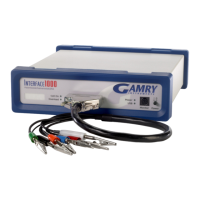
• Have the leads approach the cell from different directions.
• Remove the alligator clips from the leads. In extreme cases you can replace the banana plugs and pin
jack with smaller connectors. If you do so, be careful not to compromise the isolation between the
center conductor and the shield.
The cell leads must not be moved during an experiment measuring small currents. Both microphonic and
triboelectric effects can create spurious results when the cell cables are moved.
Cell Construction
If you need to measure small currents or high impedances, make sure that your cell construction does not limit
your response.
A cell where the resistance between the electrodes is only 10
10
Ω cannot be used to measure an impedance of
10
13
Ω. In general, glass and PTFE are the preferred materials for constructing cells. Even glass may be a
problem when it is wet.
You also must consider C
shunt
. Make the “inactive” portion of your electrodes as small as possible. Avoid placing
electrodes close together or parallel with each other if you are measuring high impedances.
Reference Electrode
Keep the impedance of your reference electrode as low as possible. High-impedance reference electrodes can
cause instability of the potentiostat and excessive pick-up of voltage noise.
Avoid:
• Narrow-bore or Luggin capillaries tipped with glass frit.
• Poorly conductive solutions, especially in Luggin capillaries.
• Asbestos-thread and double-junction reference electrodes.
Reference electrodes often develop high impedances as they get used. Anything that can clog the isolation frit
can raise the electrode impedance. Avoid using saturated KCl-based reference electrodes in solutions of
perchlorate ions.
Instrument Settings
When setting up a very sensitive experiment,
• In EIS, use the largest practical excitation. Don’t use a 10 mV excitation on a coated specimen that can
handle 100 mV without damage.
• Avoid potentials where large DC currents flow. You cannot measure 1pA of AC current on top of 1 mA
of DC current.
EIS Speed
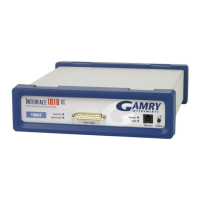
In EIS, do not expect the Interface 1010 to measure 10
10
Ω impedances at 1 kHz. Many of the factors listed
above limit the performance.
As a rule of thumb, the product of impedance, Z, times frequency, f, should be less than 10
9
Ω∙Hz for good EIS
measurements with an Interface 1010, i.e.,
Z · f < 10
9
Ω∙Hz
Ancillary Apparatus
Do not use the Interface 1010 with ancillary apparatus connected directly to any of the cell leads. Ammeters
and voltmeters, regardless of their specifications, almost always create problems when connected to the
Interface 1010 cell leads.


 To Next Page