2
Rotate the crank arm to check for clearance.
The pedal pod should not interfere with any part of the bike.
Use the pedal wrench to tighten the spindle.
: Do not overtighten. Garmin recommends torque of 25 to 30 lbf-ft. (34
to 40 N-m).
Firmly plug the cable into the spindle.
Rotate the crank arm to check for clearance.
Repeat steps 2–9 to install the right pedal.
: If the pedal pod cable rubs the chain, you can add washers between
the pedal pod and the crank arm to increase clearance.
: The left and right cleats are the same.
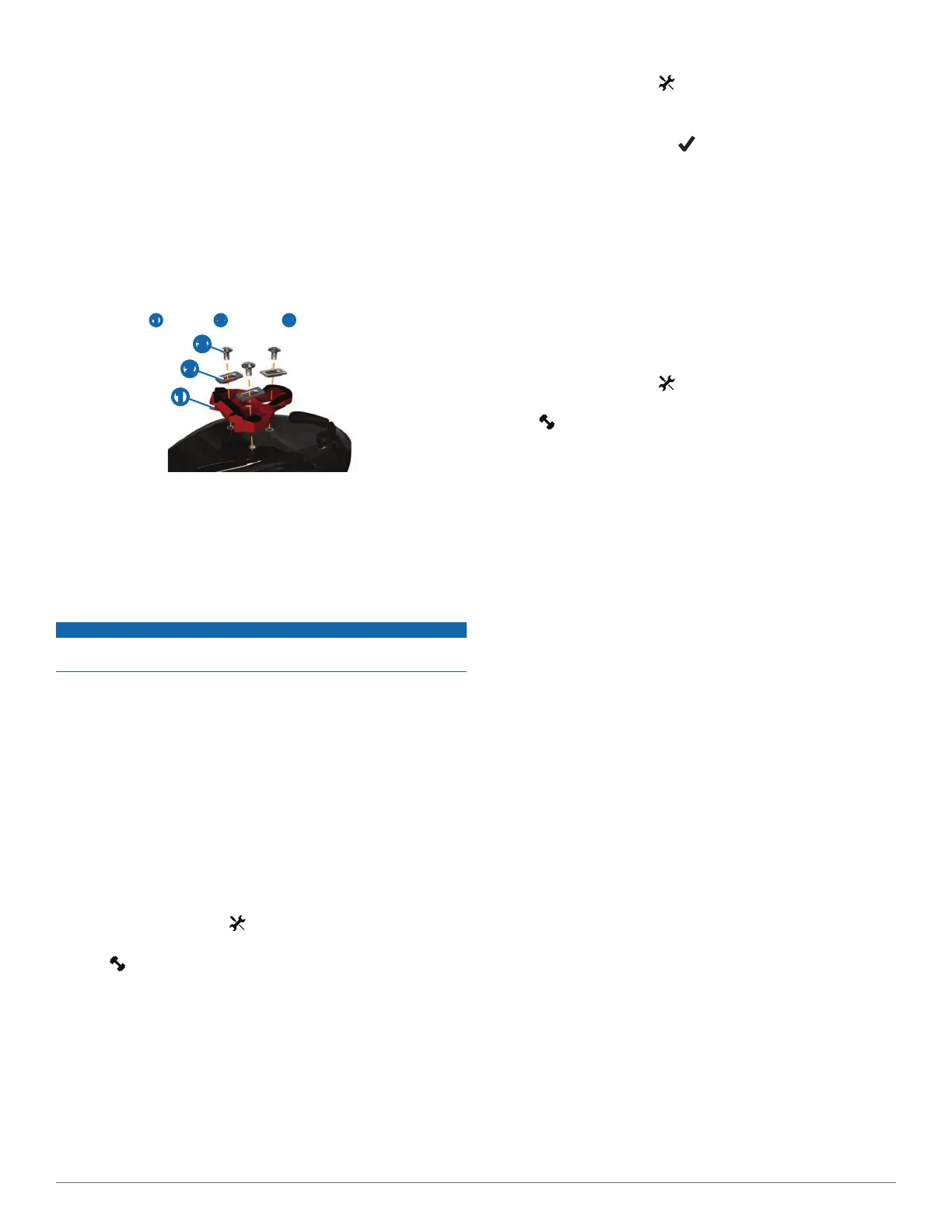
Apply a thin layer of grease on the cleat bolt threads.
Align the cleat ➊, washers ➋, and bolts ➌.
➊
➋
➌
Use a 4 mm hex key to loosely attach each bolt to the sole of the shoe.
Adjust the cleat to the shoe in your preferred position.
This can be adjusted after a trial ride.
Tighten the cleat rmly to the shoe.
: Garmin recommends torque of 4 to 6 lbf-ft. (5 to 8 N-m).
notice
Do not overtighten the release tension screw on the bottom of the pedal. The
release tension should be adjusted equally for both pedals.
Use a 3 mm hex key to adjust the release tension of each pedal.
There is a window on the back of the pedal binding that shows the allowable
range.
Before you can view Vector data on the Edge
®
, you must pair the devices.
Pairing is the connecting of ANT+
™
wireless sensors.
This procedure contains instructions for the Edge 810. If you have another
compatible device, see your owner’s manual or go to www.garmin.com/
vectorowner.
Bring the Edge within range (3 m) of the sensor.
: Stay 10 m away from other ANT+ sensors while pairing.
Turn on the Edge.
From the home screen, select > .
Select a prole.
Select .
Enable the sensor, and select .
Rotate the crank arm a few times.
When the sensor is paired with your Edge, the sensor status is .
You can customize a data eld to display Vector data.
Before you ride with Vector for the rst time, you must enter the crank length, set
the install angle of the sensors inside the pedals, and calibrate the static zero
reference.
The crank length is often printed on the crank arm.
Rotate the pedals a few times in order to activate Vector.
From the home screen, select > .
Select a prole.
Select > .
Enter the crank length, and select .
Before you set the installation angles, you must set the Edge data elds to
display power and cadence.
You can go for a short ride on a trainer or on the road.
Ride until the cadence is nearly 70 rpm.
Accelerate smoothly to approximately 90 rpm.
When the installation angles are successfully set, a message appears and
data elds display power data on the Edge.
: During this task, the bike must be in an upright position and nothing can
be touching the pedals.
From the home screen, select > .
Select a prole.
Select > .
When the zero reference is determined, a message appears on the Edge.
For best results, Garmin recommends calibrating Vector at the start of every ride.
Perform a static zero calibration (page 2).
Go for a ride.
While coasting, smoothly pedal backwards 5 consecutive times or more.
When Vector is calibrated, a message appears on the Edge.
You can get the latest owner’s manual from the web.
Go to www.garmin.com/vectorowner.
Click .
If you are transporting your bicycle or not using Vector for an extended period of
time, Garmin recommends removing Vector and storing it in the product box.





 To Next Page