GASMAX/TX Operation & Maintenance Manual, Revision 1.0
Page 16
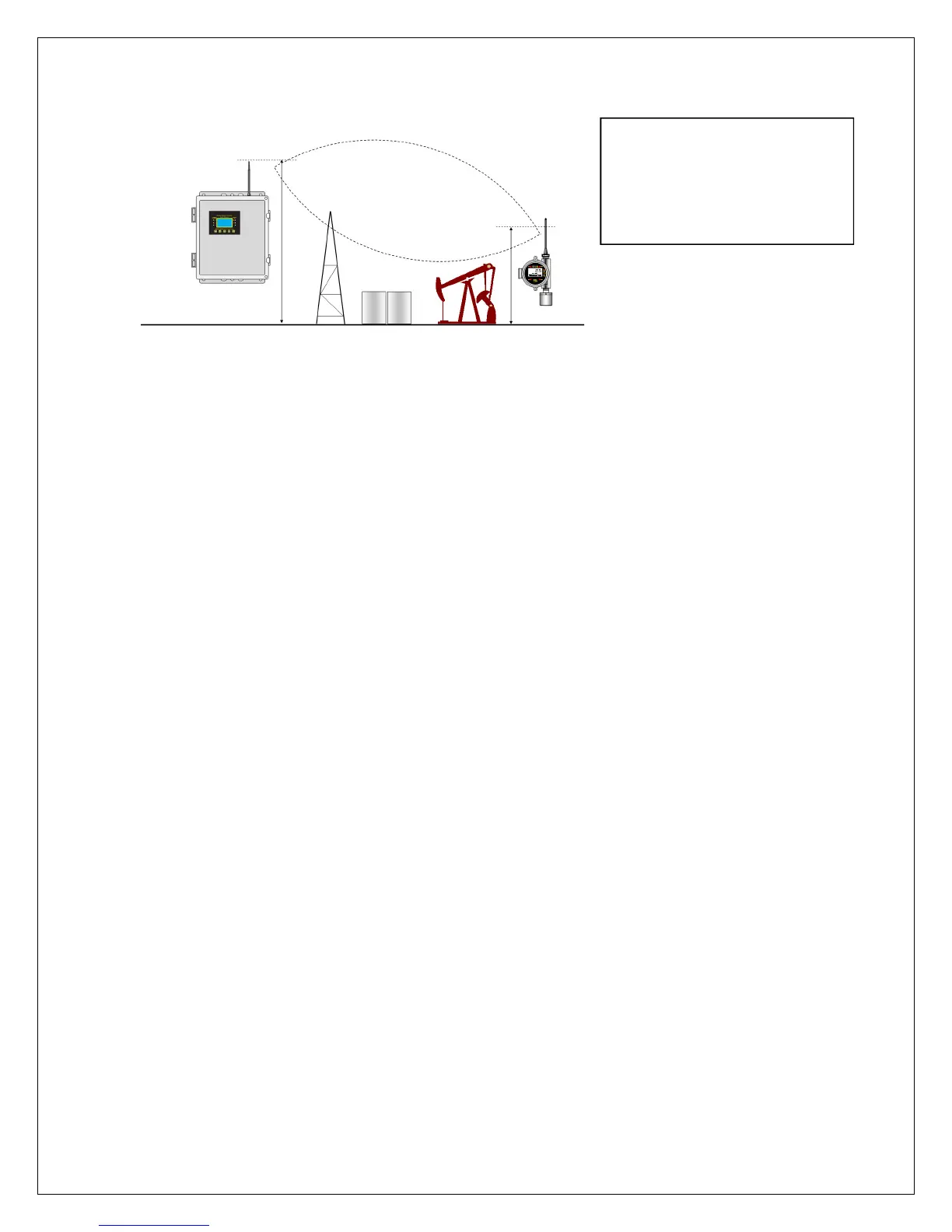
Figure 5-3: RF Transmission Zone
GDS Corp always recommends that a wireless survey be completed at the site to ensure the integrity of
the wireless communications link. Special care should be taken to account for moveable obstacles such as
cranes, railroad cars, trucks, containers, and any other large ‘structures’ that could end up being placed –
temporarily – in a location that blocks the wireless signal.
MONOPOLE AND COLLINEAR OMNI-DIRECTIONAL ANTENNAS
Monopole “rubber duck” antennas are the most commonly used antennas for portable and semi-portable
equipment where extreme range or directional reception is required. When mounted vertically, they
provide good ‘omnidirectional’ reception and transmission from all horizontal directions, and are
generally rugged and when sealed properly against moisture can provide years of quality service.
Collinear antennas are more sophisticated and combine several vertical antennas that operate in parallel
to increase signal gain by focusing the reception pattern in a more horizontal plane.
Rubber duck and collinear antennas provide best performance when installed with at least 1 to 2
“wavelengths” away from walls or steelwork. Since wavelength proportional to frequency, 900 MHz
signals have a wavelength to approximately 12 inches and 2.4 GHz signals have a wavelength of about 3
inches. Therefore, 900 MHZ antennas should be installed with at least 2 feet of clearance and 2.4GHz
antennas at least 6 inches of clearance from walls or structures. Antennas may be mounted with less
clearance but output will be reduced; this may not matter if the distances involved are short. It is
important the antenna mounting bracket to well connected to “earth” or “ground” for good lightning
surge protection.
Rubber duck or collinear antennas emit RF energy in ‘vertical polarization’, where the electric fields
oscillate in the vertical plane and the magnetic fields oscillate in the horizontal plane. Transmitting and
receiving antennas should always be oriented such that the polarization is the same.
Distance 900 MHz 2.4 GHz
100 Ft 10’ / 3m 6’ / 2m
500 Ft 22’ / 7m 15’ / 5m
1000 Ft 30’/ 10m 20’ / 6m
3000 Ft 54’ / 17m N/A
RF Transmission Zone



 To Next Page