Need help?
Do you have a question about the Getinge 88-SERIES and is the answer not in the manual?
Key safety instructions and precautions for operating the machine.
Steps for loading, selecting, and running programs without a barcode scanner.
Instructions for loading and selecting programs using the barcode scanner.
Details on alarm signals, acknowledging fault codes, and a list of machine fault codes.
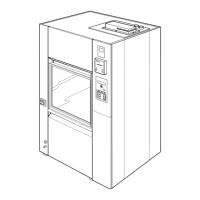
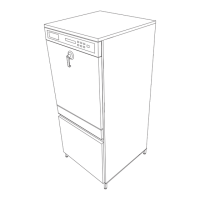
The Getinge 88-Series is a fully-automatic washer disinfector designed for cleaning, disinfection, and drying various items in hospitals, laboratories, and the pharmaceutical industry. Its intended applications include surgical instruments (both solid and tubular), dishes, hand bowls, glass goods, suction flasks, baby bottles, anesthesia equipment, and OP shoes, with specific program designs for each. Validation of goods according to intended use is performed using Getinge Disinfection AB's standard loads.
The machine operates with a sophisticated electronic controller capable of storing up to 64 programs, 16 of which can be activated for use. Six of these programs are directly accessible via program selection buttons, while others can be chosen through menu buttons. The machine comes with standard programs, and customized programs can be obtained from the reseller. An Installation Qualification, Operating Qualification, and Performance Qualification, in accordance with ISO 15883, are required before the machine is put into service to ensure safe and optimal operation.
The Getinge 88-Series features double vertical sliding doors, which can be motorized for automatic opening and closing. These doors are equipped with crush protection, causing them to reverse if activated. An interlock system ensures that only one door can be opened at a time. To open the soiled-side door, the clean-side door must first be closed and locked by pressing the designated button. When the door is locked, a yellow lamp flashes for approximately 5 seconds. Pressing the button again during this "cancel time" unlocks the soiled-side door, allowing it to be opened manually or automatically. In standby mode, the door can be opened and closed by pressing the button for 10 seconds. Starting a wash program involves closing and locking the soiled-side door, which causes a yellow lamp to flash and the program to initiate. Upon program completion, a green lamp illuminates on both sides, and the clean-side door opens automatically. Once fully open, the green lamp extinguishes. The clean-side door must be closed and locked before the soiled-side door can be opened.
The machine incorporates a dosing system, typically with two standard systems: one for alkaline detergent and one for rinse-aid or acid detergent. Dosing amounts are individually programmable for each cycle. The machine will not start if a detergent holder is empty, displaying a "DOS 1 LOW LEVEL" alarm, for example. Optional third and fourth dosing systems can be installed for specialized agents like heat-sensitive goods disinfectants or instrument milk.
The machine is designed with multiple built-in safety devices, which must not be bypassed or disabled. Operating the equipment in a manner not specified by the manufacturer can compromise safety. The machine must be used by trained personnel familiar with its operation and safety instructions. The maximum load capacity for the wash trolley is 75 kg. The process tank takes more than 2 minutes to fill with water, and the booster tank also takes more than 2 minutes to fill. The washing chamber should empty within 20 seconds. For cleaning and disinfecting tubular instruments with passages smaller than 2 mm, a fine filter must be used to prevent blockages and ensure effective cleaning and disinfection. The machine can be heated by electricity or steam and can be connected to a treated water supply. Water quality is crucial for optimal results. The water used in all stages must be compatible with the machine's materials, the chemicals used, and the process requirements. Getinge Disinfection AB recommends that water for pre-rinsing, washing, and final rinsing phases be of drinkable quality, adhering to WHO guidelines. For the final washing/disinfection phase, RO (reverse-osmosis) water or similarly treated water is recommended, with typical specifications including:
Loading: Items should be loaded onto the trolley, ensuring that water jets can reach all surfaces and that washer arms can rotate freely. Sharp and pointed utensils should be positioned to prevent injury. All vessels must be emptied before loading and placed with openings downwards to allow free water flow. Domed bases should be inclined to prevent water collection. Anodized aluminum and nickel-plated instruments are not suitable for washing. Rigid endoscopes must be dismantled according to manufacturer instructions. Optics and light cables must be approved for thermal disinfection. Program Selection: For machines without a barcode scanner, programs can be selected using dedicated buttons or from a list via menu navigation. For machines with a barcode scanner, scanning the trolley's barcode automatically selects the appropriate wash program. Manual program selection is also possible. Program Monitoring: During operation, a yellow lamp indicates the program is running, and the display shows the current program phase and temperature. The remaining time can be viewed by pressing a button. Program Completion: A green lamp indicates program completion, and the clean-side door opens automatically. Items may be hot and should be handled with care to avoid burns. Detergent Handling: Only detergents prescribed by the manufacturer should be used. Users must follow manufacturer instructions for handling liquid agents, wearing protective glasses and gloves. Household dishwasher detergents are not to be used. The cleaning effect can vary, so trying different quality detergents may be necessary if results are unsatisfactory.
Daily Inspection:
If Necessary Maintenance:
Printer (Option) Maintenance:
Fault Indications: The machine displays fault codes (e.g., A01) if a process is aborted due to a fault, and a red lamp illuminates. To acknowledge a fault, note the code, cancel the acoustic signal, correct the fault or call service personnel, enter the password (558387), and press the confirmation button. This drains liquid from the machine and unlocks the soiled-side door (unless the drain pump is faulty). Items in the machine after a fault are not clean and must be re-washed. Handling alarms (e.g., "DOSE 1 LOW LEVEL") appear in plain text and prevent the machine from starting until resolved. These alarms indicate low detergent levels but allow one more run to complete.
 General
| Brand | Getinge |
|---|---|
| Model | 88-SERIES |
| Category | Laboratory Equipment |
| Language | English |


 To Next Page