19 - Additional info
Duty Cycle - what is it?
Duty cycle refers to how the solenoid valve is actually controlled. The G-Force III boost controller outputs a signal to the
solenoid valve that rapidly pulses it on and off about 30 times a second (0.033 seconds per cycle) to bleed air from the
wastegate, and duty cycle alters how long it is on for each cycle, and how long it is off.
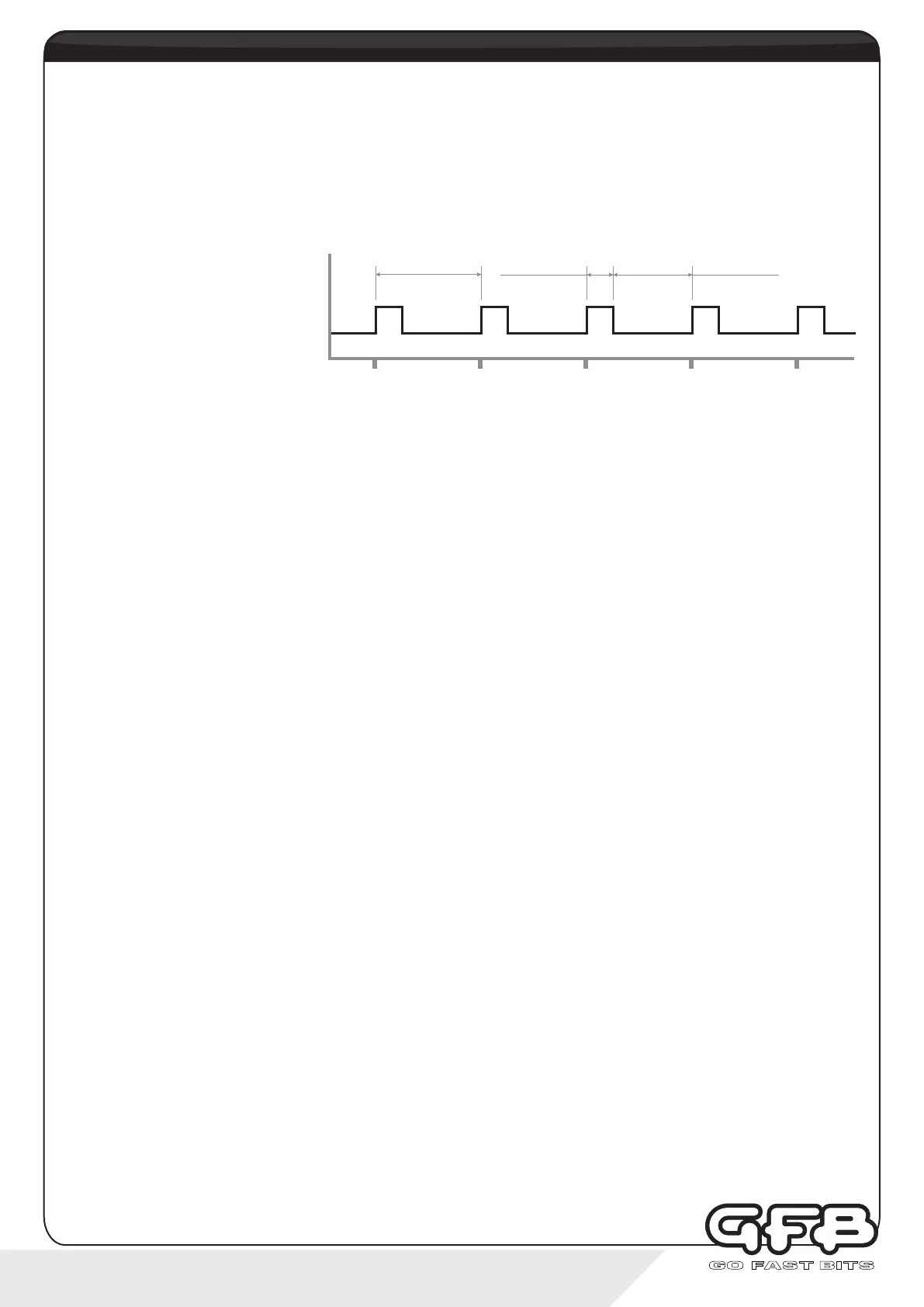
For example, a duty cycle of 25% means that the solenoid valve is pulsed ON for 25% of each cycle, and OFF for 75% of
the cycle. A 25% duty cycle output from the G-Force to the solenoid valve is illustrated opposite:
The higher the duty cycle, the
longer the solenoid is pulsed
on each cycle, which bleeds
more air from the wastegate
actuator, resulting in a higher
boost pressure.
Duty Cycle limits
Running 10% duty cycle means that the solenoid is effectively off and all of the pressure gets to the wastegate, which is
the same as having no boost controller, and the turbo will run the minimum pressure (aka “gate” pressure) possible.
Running the solenoid at 100% duty cycle prevents ALL of the pressure from getting to the wastegate, which is effectively
the same as removing the hose from the wastegate altogether, which results in the highest boost pressure the turbo is
capable of supplying.
Why can’t I just dial-in how much boost I want instead of fiddling with duty cycle?
Fair question. Unfortunately, the G-Force III (or any boost controller for that matter) doesn’t know what boost pressure
your specific turbo/wastegate/engine/weather conditions/etc will return for a given duty cycle - there simply is no
formula that says “for this turbo on that car, “X”% duty cycle will give “Y”psi of boost”.
The controller NEEDS to know this relationship between duty cycle and resulting boost pressure, because when boost
is rising quickly, it must pulse the solenoid at the correct duty cycle BEFORE the boost reaches the target boost
pressure. If it doesn’t know the correct duty cycle, it cannot do this.
The reason it must pulse the solenoid before boost reaches the target is because there is always a small delay between
the controller making a change to the duty cycle, and the wastegate (and therefore boost pressure) responding to the
change. This delay means that if the controller simply waited until the boost pressure reached the target and then
responded accordingly, boost pressure would overshoot the target.
Therefore, the only way to determine the duty cycle/boost relationship is through trial-and-error, by starting at a low duty
cycle, reading the resulting boost pressure, and increasing it until you reach the desired boost.
Once the G-Force III knows the duty cycle that results in the target boost pressure, it can then make changes to the duty
cycle to compensate for small variations in boost (when a value for “Sensitivity” has been entered).
Tech
“OFF” period
(0.025 seconds)
“ON” period
(0.008 seconds)
1 cycle
(0.033 seconds)


 To Next Page