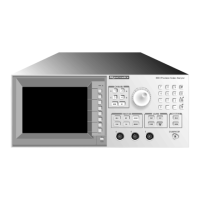
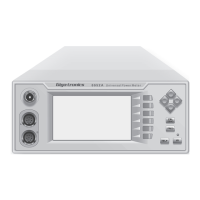
2.5 Operation
Single-channel operation is essentially the same dual-channel for standard peak power and CW
measurements. The single channel 8501A does not have a ratio measurement capability. The following
instructions define the operation of both instruments. If a Model 8501A is being used, ignore references
to A and B keys, distinctions between the A and B channels, and reference to two detectors. The single
channel of the 8501A is channel A for definition purposes. If the instructions require that a distinction be
made between the two instruments, the specific model number will be given rather than PPM.
2.5.1 Power On Self-Test (POST)
1. Before turning on the power to the PPM, be sure that it is set for the correct input voltage.
Procedures for setting the operating voltage are given in Section 2.2.
2. Connect a detector (detector) to the
DETECTOR INPUT
at channel A, using the Giga-tronics
detector cable (P/N 16956-XXX, where XXX defines the specified length of the cable) supplied
with the system. If a Model 8502A is to be used, detectors should be connected to channel A and
B inputs for dual channel operation.
To connect the cable to the detector housing, pull back on the metal sleeve at the detector end of
the cable, align the red dots, and make the connection. To connect the other end of the cable to
the front panel
DETECTOR INPUT
receptacle, again pull back the metal sleeve, align the red dots
on the cable and input receptacle, and make the connection.
☛ NOTE:
The detector must be connected to the Calibrator connection on the front panel, to
a 50-ohm termination, or to a signal source before initiating the POST function.
3. Turn on the power by pressing the power switch on the front panel. The PPM will perform a
self-test to verify that it is operating properly.
The self-test is not identical to the one performed by selecting [MENU] (11) [F2], or by sending the
SELT command over the GPIB. The POST will not report errors 5 or 6 because you may not have
removed the RF power from the detectors, or error 10 because it sometimes fails erroneously soon after
power on (see Self-Test Failure Indications in Section 2.15).
The PPM will automatically return to the last setup before the instrument was powered off.
2.5.2 Warm Up Time and Temperature
When initially operating the PPM, it is common to see a prompt on the display stating
RECAL: dT XXX DEGS-C.
The number of degrees shown is the difference between the present temperature of the detector and the
temperature at which it was last calibrated.
The prompt occurs only if the change in detector temperature is more than 5 °C. When this prompt is
displayed, sufficient time should be allowed for the instrument to warm up so that accurate readings can
be taken. Variations of less than 5 °C from the calibration temperature do not result in a temperature
prompt display because minor temperature changes in the detector are monitored and compensated by the
68000 microprocessor.
If the PPM continues to display the temperature prompt after 30 minutes warm up, or if the room
ambient temperature changes by more than 5 °C, a Self-Calibration will be required (see the Self
Calibration Procedures in Section 2.7).
Series 8500A Peak Power Meters
2-10
Manual No. 20790, Rev C, November 1998


 To Next Page