asymmetric or full stall. This speed range should therefore be avoided and used only on landing.
The theoretical best glide speed in calm air is realized at the hands-off position. Minimum sink
is reached by pulling approx. 10 cm of brake. If the brakes are pulled more, the sink does not
reduce any further, the control pressures increase noticeably and the pilot reaches minimum
speed.
Braking on both sides with the main brake with the trimmers open creates an extremely
unstable profile and there is a risk of front stall or other extreme flight manoeuvres. Braking in
accelerated flight is therefore forbidden!
Trim and accelerated flight (using the Trimmers and Speed Bar)
Trim Speed
The Falcon has a high basic trim speed even with neutral trimmer position, and this can be
increased considerably by using the additional speed system and the trimmers. This gives the
pilot a wide speed range, with which to make the ideal adjustment to cruise speed.
Accelerated speed
Once you have become accustomed to flying the Falcon, you can practice using the trimmer
and speed system. To understand correct trimmer usage, study the diagrams showing trim and
speed bar movement as well as speed bar hook-ups. The diagrams also illustrate how different
trimmer settings affect the airfoil shape, and how changes in the Centre of Pressure (CP) influence
pitch stability.
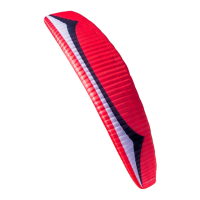
The Falcon’s Reflex wing section is unique - it has a remarkably wide and relatively safe speed
range. On the slower settings, sink rate improves dramatically and brake pressures are light. This
enables you to make the best use of thermal cores. You will also have improved climb rate and
shorter, slower take-offs and landings. See diagram RTR below describing differences in turning.
On faster trim or speed bar settings, brake pressures generally increase and weight-shift or
wing tip steering becomes safer and more effective. With the trimmers fully off, the wing’s speed
and stability increases and its ability to cut through turbulence and cover distance improves.
When flying accelerated the glider reacts
much faster to a collapse. Also the glider
reacts more radically when a collapse occurs
during accelerated flight compared to flying
at trim speed.
Flying at maximum and minimum speed
should only be done with sufficient altitude
and experience. Avoid flying accelerated near
the ground, and be careful using the
accelerator in turbulence.
If you do encounter a collapse while using the
accelerator, immediately step off the bar
completely before taking any other
corrective actions.
Trimmer and speed bar settings are
additional points to include in your pre-flight
checklist!
If the setting is not symmetrical, the
paraglider will turn in flight. And if you
inadvertently release the trimmers, the
Reflex profile of the Falcon will keep your
wing level, so after hitting the throttle you
will descend with increased speed instead of
climbing as intended.



 To Next Page