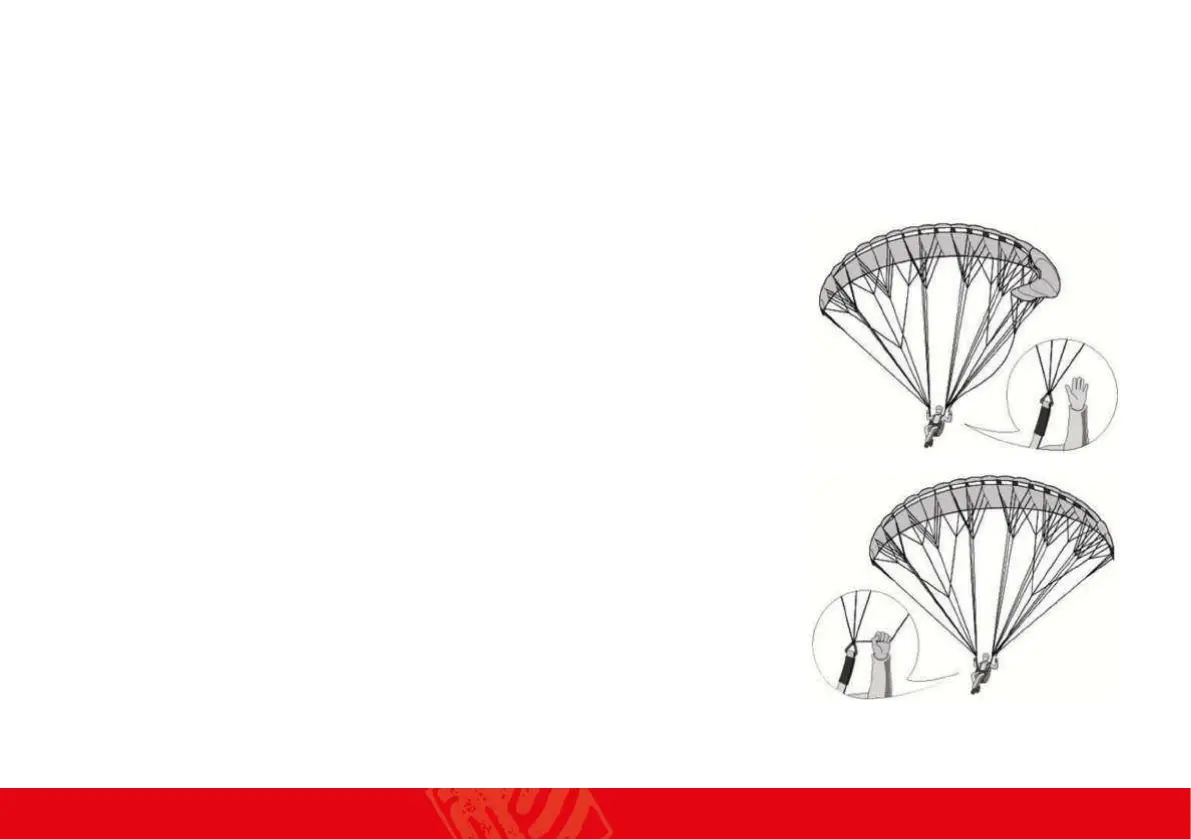
and carefully counter-braking the open side of the canopy. If you react too early, you risk stalling
the collapsed canopy completely and this can lead to a cascade of further collapses.
When you have a big collapse in accelerated flight you must first release the speed bar
immediately. Check your position relative to the ground, and if you have enough space stay
neutral with your weight and brake to open side slightly to control the turn, but let the glider
turn, to maintain airspeed. Watch the open side of the wing, and apply brake to control and limit
the turn, but avoid applying so much brake that the open side of the wing starts to arc backwards
as this indicates the flying side of the wing is on the edge of stall. Once the turn is stabilized
weightshift heavily towards the open side of the wing so that you can limit the turn or maintain
direction without having to apply excessive brake. In most cases the collapse will open on its own,
but you may need to pump it out. This is the optimum action to avoid a spin or stall and help your
glider to recover as fast as possible.
Cravat / glider wrapped around lines
A cravat occurs after a severe deflation when the wing tip becomes trapped in the glider lines.
It can occur on the Falcon, usually after big deflations or in cascading situations. The pilot should
be familiar with the procedure for correcting it. On the Falcon, there is a separate stabilizer
/winglet main line that goes down to the A2 riser. This line usually becomes slack in the event of a
cravat. Pull it down completely until it becomes tight and the cravat normally comes out.
Alternatively, on the side of the wing with the cravat, pull the brake fast and strong. Be
careful not to let the wing enter a developed spin. If the tangle has not come free after several
attempts, you still have the option to open it like a deep stall or a full stall. These flight
manoeuvres always require adequate altitude and a high level of pilot skill.
Deploy your reserve if the corrective manoeuvres described in the following sections do not
return the glider to a controllable flying position or if there is not enough altitude for correction.
Symmetric front collapse
A symmetric front collapse will normally reopen promptly by itself without any pilot input.



 To Next Page