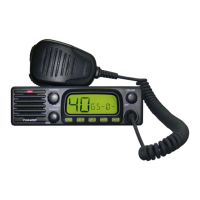
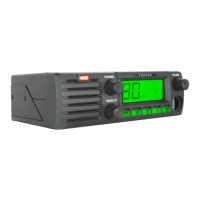
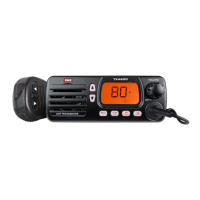
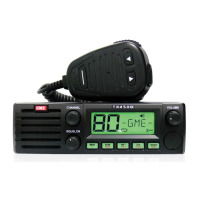
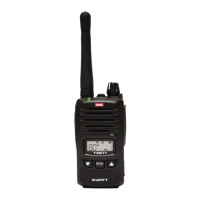
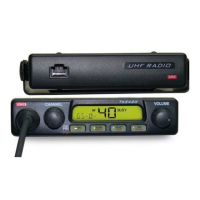
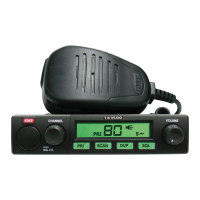
The TX4800 can be programmed to suit specific customer
requirements by enabling only those features that are
useful to the customer's operation.
The following section describes the additional features
available in the TX4800. In most cases only a few of
these features will be enabled in a TX4800 at any
one time. Many of the front panel keys are able to
perform multiple functions depending on how they are
programmed. In addition many of the functions can
be programmed into more than one key which means
that no specific key can be addressed as performing a
particular function. It is therefore a matter for the Dealer
to inform you of the keys that are enabled and what their
functions are. Then refer to this manual to learn how
to use the specific functions with which you have been
provided. (The table on page 5 is provided to enable you
to tick the appropriate boxes to match the 8 function
keys with the specific functions programmed by
the Dealer).
THE SQUELCH KEY
The Squelch (or mute) is used to eliminate any annoying
background noise when there are no signals present.
The TX4800 features a pre-set squelch system which can
be switched ON or OFF using the Squelch key. When
the squelch is OFF, the receiver's background noise
will be heard (unless Quiet is enabled) and the 'BUSY'
indicator will appear on the display. When the squelch
is ON, the receiver will remain quiet when there are no
signals present, but an incoming signal will overcome the
squelch action and be heard in the speaker.
To disable the squelch, briefly press the Squelch key. A
low beep will be heard. If there are no signals present,
you will hear the receiver's background noise.
To re-enable the squelch, briefly press the Squelch key
again. A high beep will be heard.
NOTE: Disabling the squelch will allow you to listen to
all other callers on the channel, unless Selcall is in use
and the Quiet key has been pressed as indicated by the
icon on the display.
Setting the Squelch Sensitivity
If an incoming signal is very weak and is close to the
minimum squelch level, it may become broken or
'chopped' by the squelch action. To prevent this, simply
open the squelch to allow the signal to be heard clearly.
Alternatively, you can reduce the squelch sensitivity as
described above right.
The sensitivity of the squelch to incoming signals can be
set to suit your operating environment. The TX4800 has
three preset squelch sensitivity settings which can be
selected using a front panel key sequence.
•
SQL1: Maximum Sensitivity
The squelch will open even on very weak signals. This
is the best setting for quiet country or rural locations
where there are very few weak interfering stations or
little locally generated interference.
•
SQL2: Medium Sensitivity
The squelch will open on most signals, but will not be
as sensitive to very weak signals or local interference.
Suitable for general or suburban use.
•
SQL3: Minimum Sensitivity
The squelch will open on reasonably strong signals
and weak signals will not be heard. Suitable for inner
city applications or areas of severe interference.
To pre-select the Squelch sensitivity
1. Turn the TX4800 OFF at the Volume control.
2. Hold the F6 key while turning the unit back ON again.
3. Using the
or buttons select SQL1, SQL2
or SQL3.
4. Turn the unit OFF again to store the setting.
THE HI/LO POWER KEY
The Hi/Lo Power key is used to change the output
power of the transmitter from its maximum level of 25
Watts down to 5 Watts. There are a number of reasons
why you might want low power, including operating in
close proximity to other radios or a nearby repeater, or
conserving power when operating from a battery supply.
If the other radios or the nearby repeater are some
distance away, you should select Hi Power, to ensure
maximum range.
NOTE: Some channels on the radio may be permanently
programmed for Low Power. The Hi/Lo power key will be
ignored on these channels.
To Select Low Power
Briefly press the LO Power key. A low beep will be
heard and LO will appear on the left of the display.
NOTE: If the radio gets too hot, it may automatically
switch to low power to avoid damage.
USING THE PROGRAMMABLE FUNCTIONS


 To Next Page