10 308-550
Installation
Air Exhaust Ventilation
FIRE
AND EXPLOSION HAZARD
Be sure to read and follow the warnings
and precautions regarding
TOXIC
FLUID HAZARD,
and
FIRE OR EXPLO
-
SION HAZARD
on page 3, before op
-
erating this pump.
Be sure the system is properly ventilated for your
type of installation. Y
ou must vent the exhaust to a
safe place, away from people, animals, food handl
-
ing areas, and all sources of ignition when pumping
flammable or hazardous fluids.
Diaphragm failure will cause the fluid being
pumped to exhaust with the air
. Place an appropri
-
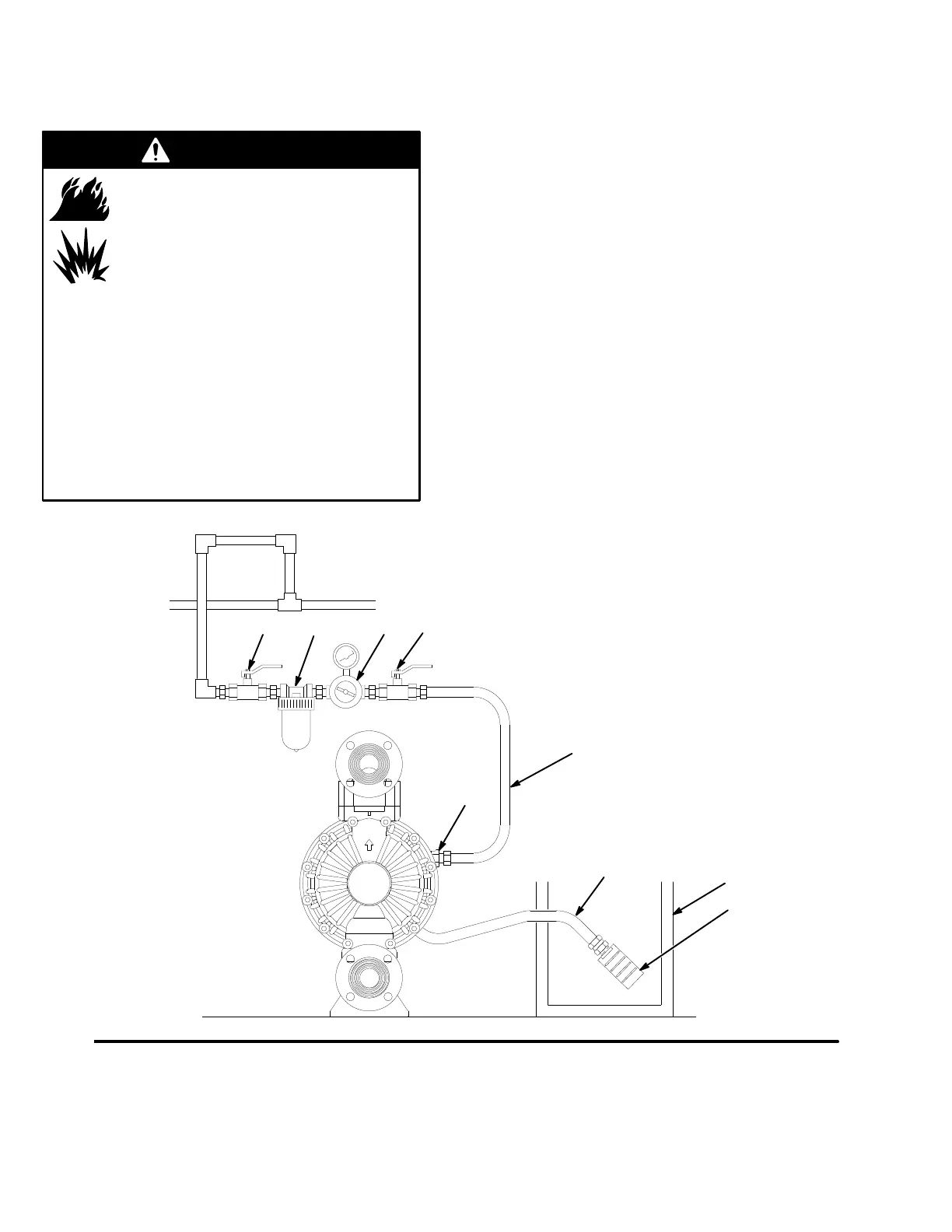
ate container at the end of the air exhaust line to
catch the fluid. See Fig. 6.
WARNING
The air exhaust port is 3/4 npt(f). Do not restrict the air
exhaust port. Excessive exhaust restriction can cause
erratic pump operation.
T
o provide a remote exhaust:
1.
Remove the muf
fler (P) from the pump air exhaust
port.
2.
Install an electrically conductive air exhaust hose
(T) and connect the muf
fler (P) to the other end of
the hose. The minimum size for the air exhaust
hose is 3/4 in. (19 mm) ID. If a hose longer than 15
ft (4.57 m) is required, use a larger diameter hose.
A
void sharp bends or kinks in the hose. See Fig. 6.
3.
Place a container (U) at the end of the air exhaust
line to catch fluid in case a diaphragm ruptures.
04617
Fig. 6
KEY
A Air
supply line
B
Bleed-type master air valve
(required for pump)
C
Air regulator
D
Air line quick disconnect
E
Master air valve (for accessories)
F
Air line filter
P Muffler
T
Electrically conductive air exhaust hose
U
Container for remote air exhaust
FBEC
A
D
VENTING
EXHAUST AIR
P
T
U


 To Next Page