Service
Repairing the Air Valve
Tools
Required
T
orque wrench
T
orx screwdriver or 8 mm (or 5/16”) socket wrench
Needle-nose pliers
O-ring pick
Lithium base grease
NOTE:
Air V
alve Repair Kit 236–273 is available.
Refer to page 27. Parts included in the kit are marked
with a symbol, for example (4
). Use all the parts in
the kit for the best results.
Disassembly
WARNING
T
o reduce the risk of serious injury whenever you
are instructed to relieve pressure, always follow the
Pressure Relief Procedure
on page 12.
1.
Relieve the pressure.
2.
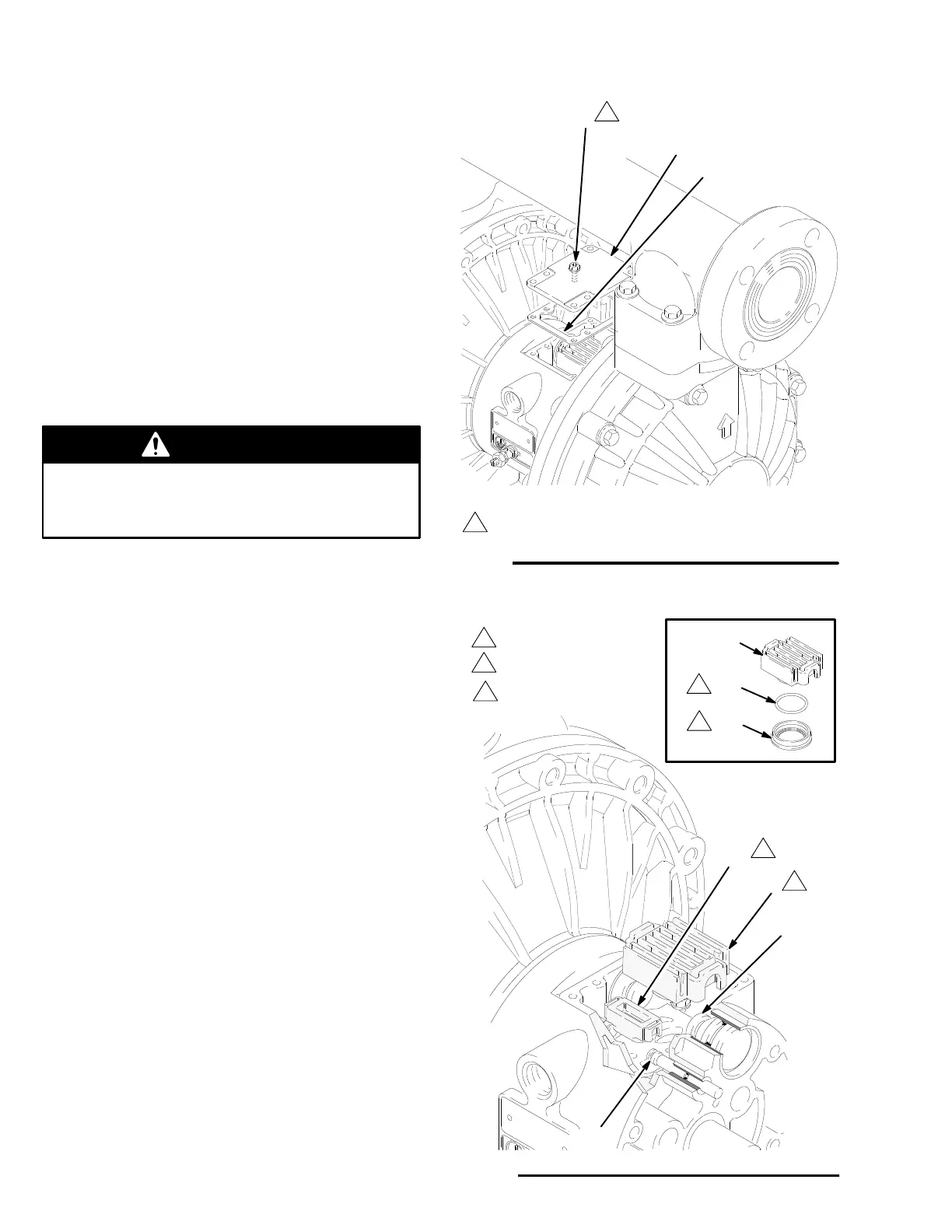
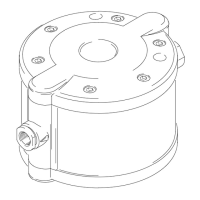
With a torx screwdriver or 8 mm (or 5/16”) socket
wrench, remove the six screws (3), air valve cover
(2), and gasket (4). See Fig. 7.
3.
Move the valve carriage (5) to the center position
and pull it out of the cavity
. Remove the valve
block (7) and o-ring (6) from the carriage. Using a
needle-nose pliers, pull the pilot block (18) straight
up and out of the cavity
. See Fig. 8.
4.
Pull the two actuator pistons (1
1) out of the bear
-
ings (12). Remove the u-cup packings (10) from
the pistons. Pull the pilot pins (16) out of the
bearings (15). Remove the o-rings (17) from the
pilot pins. See Fig. 9.
5.
Inspect the valve plate (8) in place. If damaged,
use a torx screwdriver or 8 mm (or 5/16”) socket
wrench to remove the three screws (3). Remove
the valve plate (8) and seal (9). See Fig. 10.
6.
Inspect the bearings (12, 15) in place. See Fig. 9.
The bearings are tapered and, if damaged, must
be removed from the outside. This requires disas
-
sembly of the fluid section. See page 22.
7.
Clean all parts and inspect for wear or damage.
Replace as needed. Reassemble as explained on
page 17.
04618
Torque
to 28–33 in–lb
(3.2–3.7 N.m).
Fig.
7
3
2
4
2
2
04900
18
5
Fig. 8
1
2
See
Detail at right.
Grease.
3
Grease lower face.
1
7
6
5
2
3
3
11
16


 To Next Page