96
Programming example: servos running in parallel
In some cases a second servo is required to run in par-
allel with an existing servo; for example, if a second ele-
vator or rudder is to be actuated by a separate servo, or
where a second servo is needed to cope with very high
control forces, or where two servos are required for a
large control surface due to the high torsional forces in-
volved.
This task could be solved simply by connecting both ser-
vos together in the model using a conventional Y-lead.
However, this has the drawback that the linked servos
cannot be adjusted individually from the transmitter, i.e.
you forfeit the basic advantage of the computer radio
control system: freely variable servo settings.
For this reason the simplest method of operating two
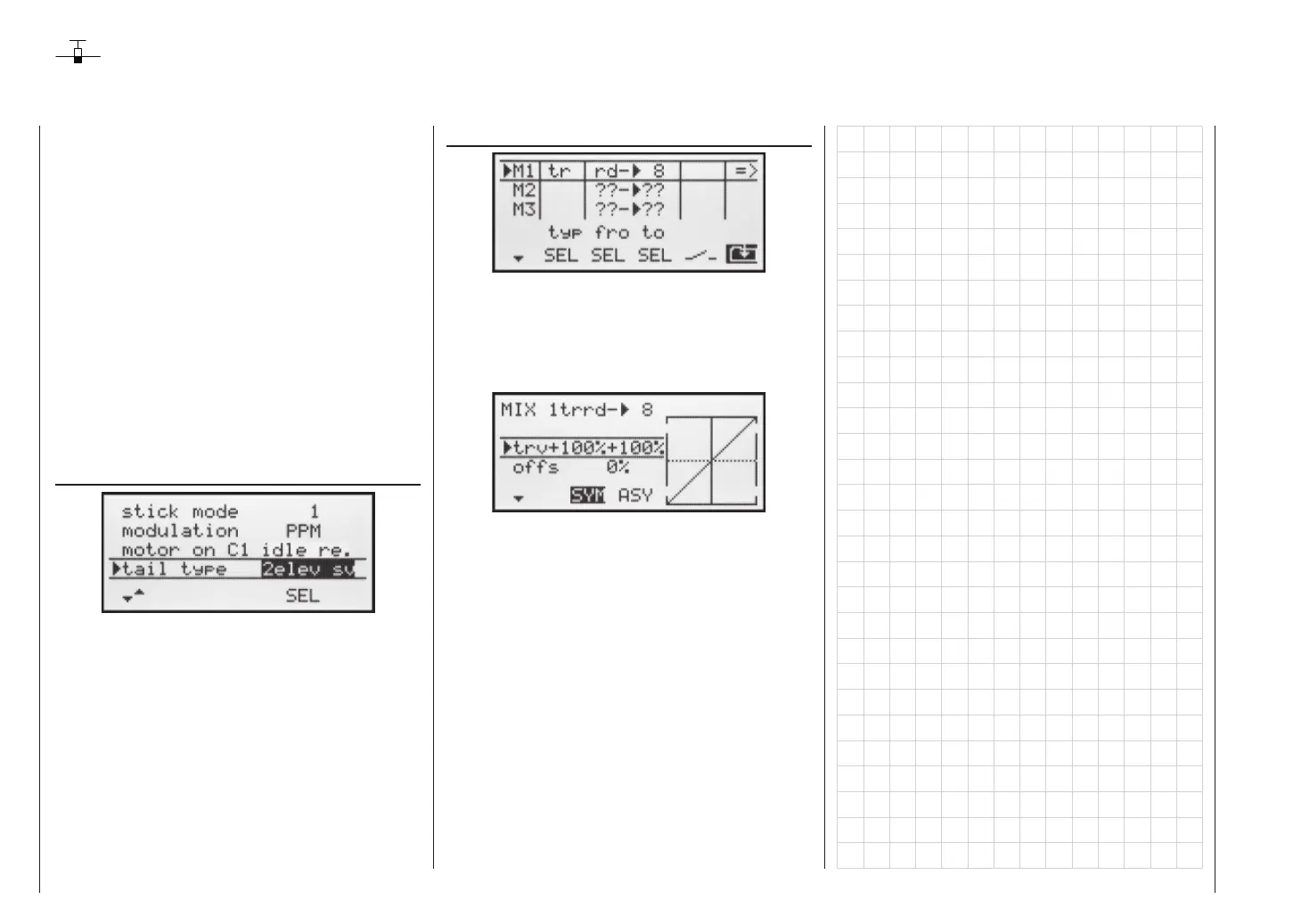
elevators in parallel (servos 3 + 8) is to use the “Tail”
menu. First move to the menu …
»Base settings« (page 38 ... 41)
… and set “2 elev sv” in the “Tail type” line.
The following example makes use of the »Free mixers«
menu, which offers the advantage of asymmetrical and /
or non-linear curves.
In this example we will connect two rudders “in parallel”.
The second rudder could be connected to receiver out-
put 8, which is not already in use.
The fi rst step is to move to the menu …
Programming examples: Fixed-wing model
»Free mixers« (page 77 ... 80)
… and set up a mixer “Tr rd 8”. In the “Type” column
select the “Tr” setting, so that the rudder trim affects both
rudder servos.
Finally switch to the graphics page and set a SYMmetri-
cal mixer input of +100%:
Here again, for safety reasons it is really essential that
you set input 8 to “free” in the »Control settings« menu.
As an added refi nement, you may want both rudders to
defl ect outwards as part of a braking system controlled
by the C1 stick. This can be accomplished by setting up
two additional mixers “c1 4” and “c1 second rud-
der channel”, with suitable servo travel settings. An off-
set of +100% is then selected for both mixers, as the
C1 stick is (usually) at its top end-point when the airbra-
kes are retracted, and the winglet rudders are only re-
quired to defl ect outward proportionally when the brakes
are extended.











 To Next Page