Correctly balancing an aerobatic model is critical to
its performance and flight characteristics. Checking
the balance on giant-scale models is best done with
two people.
Step 1
Measure back 5" from the leading edge at the root rib
and mark the location with a felt-tipped pen on the
bottom of the wing. This is the recommended center
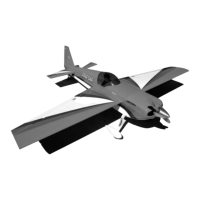
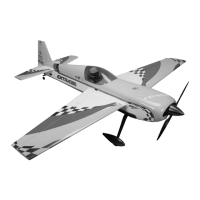
of gravity (CG). The CG range for your Extra 260 is
between 4
3
/
4
and 5
1
/
4
".
Step 2
Fully assemble the model. With the airplane upright,
lift the airplane with your index fingers to find the
balance point. The balance point (CG) should be
at the mark made at the root rib. If not, add the
necessary weight to the nose or tail to obtain the
correct balance.
A 6-channel or greater computer radio is highly
recommended. This allows the following features:
• Mixing the right aileron to the left aileron (flaperon
mix)
• Electronically adjustable aileron differential
• Mixing the right elevator to the left elevator (dual
elevator mixing)
• Independent travel and trim adjustments of each
elevator half
• Rudder-to-elevator mixing to correct rudder-to-
elevator coupling
• Rudder-to-aileron mixing to correct rudder-to-
aileron coupling
When using a 6-channel or greater computer radio,
each servo is plugged into its own separate channel.
Consult your radio manual for specific details on
hookup and programming.
If using a 6-channel radio with flaperon mix, the
aileron servos are each plugged into their own
channels. The right aileron plugs into the aileron
socket in the receiver, while the left aileron plugs
into channel 6. With flaperon activated in the
programming, this allows for independent travel
adjustment of each aileron in each direction and
electronic aileron differential. Consult your manual for
more programming details.
With a 6-channel computer radio, it will be necessary
to Y-harness the two elevator servos; a reversed
elevator servo is needed to achieve the correct control
direction. A servo reverser can be used here.
Aileron (measured at root of aileron)
High Rate Low Rate
2
7
/
8
" (38˚) Up 15/16" (13˚) Up
3
1
/
4
" (41˚) Down 1
1
/
4
" (15˚) Down
Elevator (measured at widest point of elevator)
High Rate Low Rate
3
3
/
4
" (41˚) Up 15/16" (10˚) Up
3
3
/
4
" (41˚) Down 1
1
/
16
" (12˚) Down
Rudder (measured at front of counter balance)
High Rate Low Rate
3
1
/
2
" (45˚) Right 1
7
/
8
" (25˚) Right
3
1
/
2
" (45˚) Left 1
7
/
8
" (25˚) Left
40
Balancing the Model
Radio Setup
Control Throws



 To Next Page