Storage & Shooting
Image storage modes / shooting
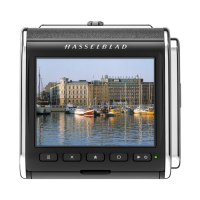
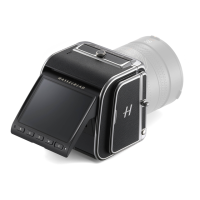
e H3D can store captured images in three ways:
1. Untethered / Compact ash card mode
In this mode the H3D acts independently of other connections. Images are stored on the
internal, removable compact-ash card.
• The main advantage with this mode is the freedom of cables and extra equip-
ment.
• The main disadvantages with this mode in the eld are the battery power capacity
and the size of the card’s holding capacity.
Please note that the recommended types of CF cards are Sandisk Extreme-III or Lexar
Professional 133x. Other cards will work but oer a reduced capture rate.
2. Semi-tethered / Imagebank-II mode
is mode enables you to attach the camera to a portable Hasselblad ImageBank-II via
a FireWire cable. e Imagebank features massive storage capacity and high-speed data
transfer. It is small, lightweight, battery powered and easily clips to your belt, so the
solution is just as portable as the untethered option.
• The main advantage with this mode is the great number of images that can be
stored without a pause.
• The main disadvantage with this mode is the extra equipment and cablage needed
that might restrict mobility in some cases.
3. Tethered / Studio mode
is mode enables you to connect your H3D directly to a computer and to operate the sys-
tem using Hasselblad FlexColor soware and store images on a computer hard-disk.
• The main advantages with this mode are the almost limitless storage capacity and
being able to work on the images (with Hasselblad FlexColor) on a large screen.
• The main disadvantage with this mode is the lack of mobility to any great
extent.
Selecting the current medium
A choice has to be made concerning where the captured images will initially be stored.
e current storage medium is the location to which new shots are saved and from which
you can browse using the navigation button. In many cases, the destination medium is
selected automatically, for example:
• When you are connected to a computer, then images are always saved directly to
the computer hard disk.
• When only one medium is connected (e.g., a compact-ash card), then this medium
is automatically selected.
However, if you are working away from your computer and have several media attached
(e.g., both a card and an ImageBank-II, then you may need to select a medium explicitly
if you want to browse its contents and store images new to it.
35


 To Next Page
 Loading...