12
Transducer connection
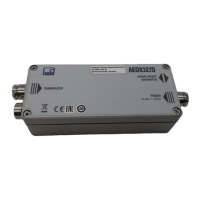
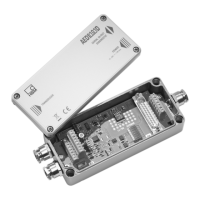
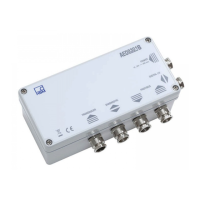
HBM AED9301B
For
R
B
= 80 , R
L1
= R
L2
= 1.6 (l = 10 m) and U
BR
= 5 V
there is an excitation current of
I
BR
= U
BR
/ (R
L1
+ R
L2
+ R
B
) = 60 mA
and thus a voltage drop over the two line resistances totaling approx. 0.2 V
(U
Bridge
= 4.8 V).
For
R
B
= 80 , R
L1
= R
L2
= 16 (l = 100 m) and U
BR
= 5 V
there is an excitation current of
I
BR
= U
BR
/ (R
L1
+ R
L2
+ R
B
) = 45 mA
and thus a voltage drop over the two line resistances totaling approx. 1.4 V
(U
Bridge
= 3.6 V).
This is irrelevant for the 6-wire circuit, as the voltage drop over the sensor lines is taken into
account in the measurement signal.
But with a 4-wire circuit, the dependency of the copper resistance of the cables on tempera-
ture goes directly into the measurement result, as the bridge excitation voltage U
Bridge
changes:
R
L
(t) = R
L20
(1 + (t – 20 °C)),
where R
L20
is the line resistance at 20 °C and is the temperature coefficient of the cop-
per.
R
L20
– calculation see page 10,
CU
= 0.00392 [1/K]
With a cable length of l = 109.36 yd and a temperature differential of 10°C, there is a line re-
sistance of
R
L1
(t) = R
L2
(t) = 16 (1 + 0.00392 10) = 16.6
This changes the bridge excitation voltage of
U
Bridge
= 3.6 V (at 20 °C) to U
Bridge
= 3.53 V.
This change in bridge excitation voltage directly at the transducer changes the measurement
signal of the bridge by 2 % (= 100 % (1 – 3.53 V / 3.6 V)).
This typical calculation shows that if long cables are involved, only 6-wire circuitry should be
used.


 To Next Page