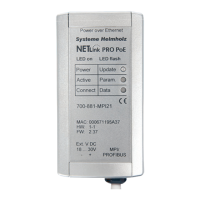
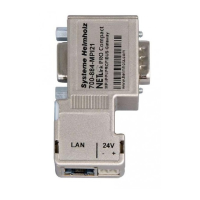
NETLink
®
Ethernet Products
nications are only allowed with a single preconfigured station.
This station will then forward all data packets that are not meant
for it to the desired rack/slot and relay the corresponding answer
back to the NETLink
®
unit.
To use this feature, you will have to enter the rack and slot num-
bers for the target address into the relevant RFC 1006 driver on
the SCADA/HMI application you are using.
For example, if you wanted to communicate with target address 2,
you would enter the following on Visu 1: Rack 0, Slot 2.
If, on the other hand, you wanted Visu 2 to communicate with
target address 49, you would enter the following on Visu 2:
Rack 1, Slot 17.
Section 11.3.3 includes a table that shows addresses converted in-
to rack and slot values.
There are many parameter configuration tools that do not have
fields with the names “Rack” and “Slot.” Instead, these tools usu-
ally have an input field called “Remote TSAP” that is two bytes
long and needs a hex format value. This field, of which only the
lower byte is important for our purposes, is configured as shown
in the following examples:
If you wanted to communicate with target address 2, you would
enter the following: Remote TSAP 0202
hex
.
If, on the other hand, you wanted to communicate with target
address 49, you would enter the following: Remote TSAP 0231
hex
.
Section 11.3.3 includes a table that shows addresses converted in-
to remote TSAP values.
If you want to do the calculation yourself, you can use the fol-
lowing simple formula: Rack * 32 + Slot = Address.
For more information, please refer to Section 10 (Troubleshoot-
ing).
Helmholz GmbH has additional documents with example appli-
cations for SCADA, HMI, and OPC available (see Section 11.3ff).
-Nr.: 2
-Nr.: 49

 To Next Page
 Loading...